New EU laws relating to green claims and deforestation do not mean food businesses can relax. David Burrows reports from this month’s Footprint Legal Briefing in association with DWF.
Deforestation: deal with IT
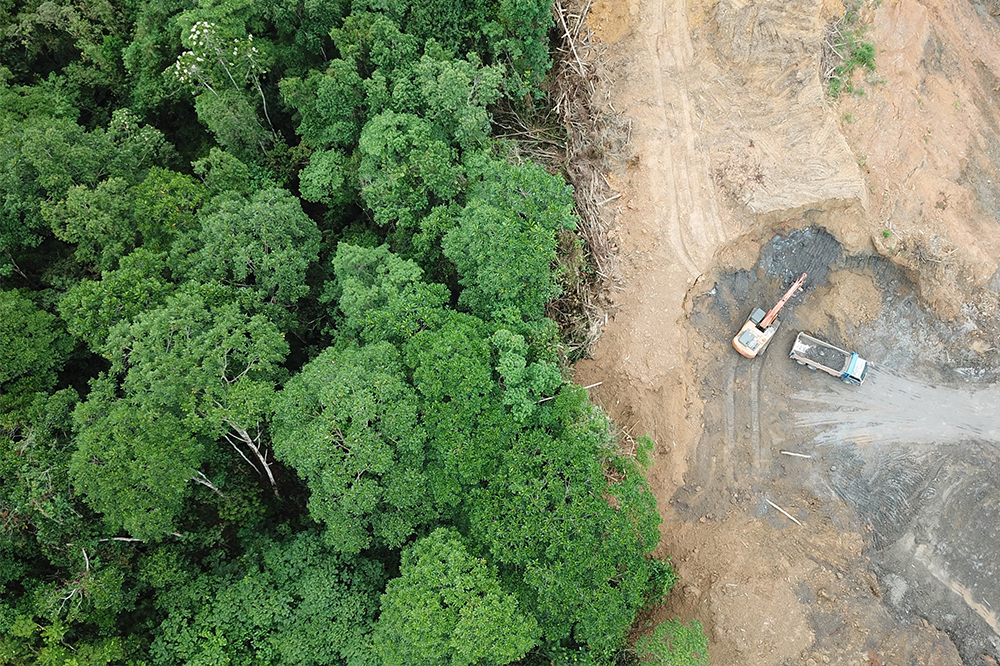
The European Commission has proposed delaying its anti-deforestation law for the second year running. The flagship environmental policy, EUDR, is designed to force companies to stop using commodities, including palm oil, coffee, cocoa, soya and beef, that are produced on deforested land. Many businesses have complained the reporting requirements are far too arduous, and some member states tend to agree.
“I think the European Parliament will agree to this delay,” explained Kirsty Poots, an associate in the consumer regulatory team at law firm DWF, during a foodservice industry roundtable last week in London, organised in association with Footprint.
That the EU has just signed a trade deal with Indonesia – the world’s leading exporter of palm oil, which is one of the commodities in the EUDR – is merely coincidence, of course. IT systems are to blame, said EU environment commissioner Jessika Roswall, as she sent letters to both the Council of the EU and the European Parliament.
“We have serious capacity concerns regarding the IT system given the projected load,” a Commission spokesperson explained at a briefing in Brussels, reported by Ends Europe. “The Commission will therefore seek a postponement of EUDR by one year [and] this will allow us to remedy… the design of the IT system,” they added.
This certainly doesn’t mean food businesses can switch off. DWF has a number of clients impacted by the new rules, which have already been postponed once (a year-long delay was agreed in December, pushing back implementation to this coming December for large businesses and July 2026 for smaller ones). Some firms are “completely on top of this”, Poots explained, while others “have just come across it”.
The reporting involves considerable amounts of detail (partly explaining why there are concerns about the ability of IT systems to cope with it all). Simply sourcing ‘certified sustainable products’ is not enough. The due diligence statement that companies must submit to the EU system to prove their products are deforestation-free have to for example include ‘country of production and the geolocation of all plots of land where the relevant commodities were produced’. This is not the time for companies to slow down, suggested Poots, and those who have just realised they need to comply must quickly catch up in the extra 12 months they might now have.
UK plans chopped?
EUDR will affect many UK food businesses, and not just in terms of reporting requirements. Compliant commodities are reportedly in short supply and attracting premiums already, for example.
There were also plans to introduce a due diligence systems in the UK to prevent companies from using commodities linked to deforestation. However, the secondary legislation required to specify which commodities fall under the new system has not yet materialised.
The Environmental Audit Committee (EAC) asked the UK Government for an update in July but what appeared to be a priority for the Conservative Government has dropped off the agenda under Labour.
Regulatory reticence
Also on the wane, it seems, is the Competition and Markets Authority’s (CMA) interest in greenwashing.
Regulation of green claims was expected to ramp up this year with the introduction of the consumer-focused parts of the Digital Markets, Competition and Consumers Act 2024 (“DMCCA”) in April. The CMA had been excited by the prospect of its new investigatory powers, including the ability to dish out fines of up to 10% of a company’s global turnover for breaches of consumer laws. For a business the size of McDonald’s, for example, that’s up to $2.5bn (10% of $25bn). Compass or Nestlé could face fines of $0.5bn or $10bn respectively.
Fines in the billions may be unlikely but those in the millions are certainly a possibility (there have never previously been any fines arising out of claims, pricing, misleading actions or omissions that have exceeded £1m). “This is everything, everywhere, all at once,” warned Dominic Watkins, head of consumer sector at DWF, at a Footprint roundtable in April last year.
“These are numbers that are massively different to anything we’ve seen before,” noted DWF in a June update this year, adding: “In reality, a lot has to happen for a case ever to reach that stage, if indeed the CMA decides to prioritise environmental claims within its enforcement action.”
And it has all gone a little quiet. “Not much has happened since,” Watkins told those at last week’s food industry legal briefing. Whether this is down to a change in CMA chair and a consequent shift in direction is not clear. In January, former Amazon UK and Amazon China country manager Doug Gurr was appointed interim CMA chair. Growth is the priority for this government and that applies across departments and regulators. Amazon has been pretty good at that. The Government has said that free and fair competition and effective consumer protection also support growth. Amazon’s record on those is more debatable.
Far from plain sailing
The CMA may be stepping back from policing green claims, but that is not the case at the Advertising and Standards Authority (ASA). The regulator is increasingly leaning on AI to monitor green claims and spot those that fall foul of the relvant advertising codes.
DWF solicitor Abigail Reay highlighted this month’s rulings on cruise companies, for example, that had made exaggerated and misleading green claims, which were not fully substantiated. A website, www.cruise1st.co.uk, for cruise 1st seen on 15 April 2025, included a page dedicated to MSC Cruise’s offerings which made the claims “Powered by LNG, the world’s cleanest marine fuel”, “Uses new green technologies”, and “If you’re keen on cruising but worried about the environmental impact, the MSC World Europa offers a green alternative.”
The ASA challenged whether the ad gave a misleading impression of the environmental impact of the advertised cruise ship. It did. The ASA noted that these “were absolute claims, pertaining to the performance of the fuel, the technologies used by the ship and the environmental impact of the ship as a whole in comparison with other cruise providers. However, evidence to support the claims had not been provided.”
Context here – and with the other cruise ship case involving Cruise Circle and claims around LNG, a fossil fuel with lower carbon emissions but nonetheless still a fossil fuel – was also key. This is an industry, like food, that is widely understood to have a significant impact on the environment, and not just in terms of emissions from fuel. “While the cruise ship used a type of propeller that reduced the impact of noise on marine life, the ASA understood that cruising’s impact went beyond underwater noise and that the ship engaged in the discharge of greywater, blackwater, ballast water and water from exhaust gas cleaning systems, all of which could harm marine life and ecosystems,” the ASA noted in a summary of the cases.
DWF’s lawyers noted, as they have previously, that knowing what level of substantiation is enough to support any green claims is tricky. There are some more straightforward rules to follow when making claims though, and these include avoiding vague or general claims and using ‘industry terms’. Instead, ask yourself what the average consumer will understand, the legal experts said.
Neutralised
Finding the balance between a substantiated and clear claim that is simple enough for consumers to understand and sexy enough to meet the needs of the marketing team is harder than ever. On this point, Watkins highlighted the case of the ‘Klimaneutral’ (climate neutral) claim made by a German sweets company.
The claim made on pack was deemed to be too vague by the country’s Federal Supreme Court; the company should have clearly specified whether it was based on a reduction of carbon emissions or simply buying offsets. A QR code on the pack with access to such details was not, reportedly, enough. “Goodness knows how much information regulators expect on packaging or in an advert,” Watkins said.
There was an expectation that the EU’s Green Claims Directive could have cleared some of this up. Under the regulations, claims would have to be pre-approved by certification bodies, for example. However, these laws are on hold too: the European Commission caught everyone by surprise this summer by announcing that it is considering scrapping its proposed directive to introduce substantiation and certification requirements for environmental claims and labels under the Directive.
Again, this doesn’t mean businesses can relax, according to DWF’s lawyers. The existing EU framework to protect consumers against greenwashing, including the Empowering Consumers for the Green Transition (“ECGT”) Directive, entered into force in March 2024. This means claims like carbon neutral will still require verification, as will forward-looking claims like ‘net-zero by 2050’.
Delays, postponements and political wrangling are creating confusion when it comes to environmental regulations both here and in Europe. Businesses who want to avoid a kick from regulators must therefore stay on their toes.