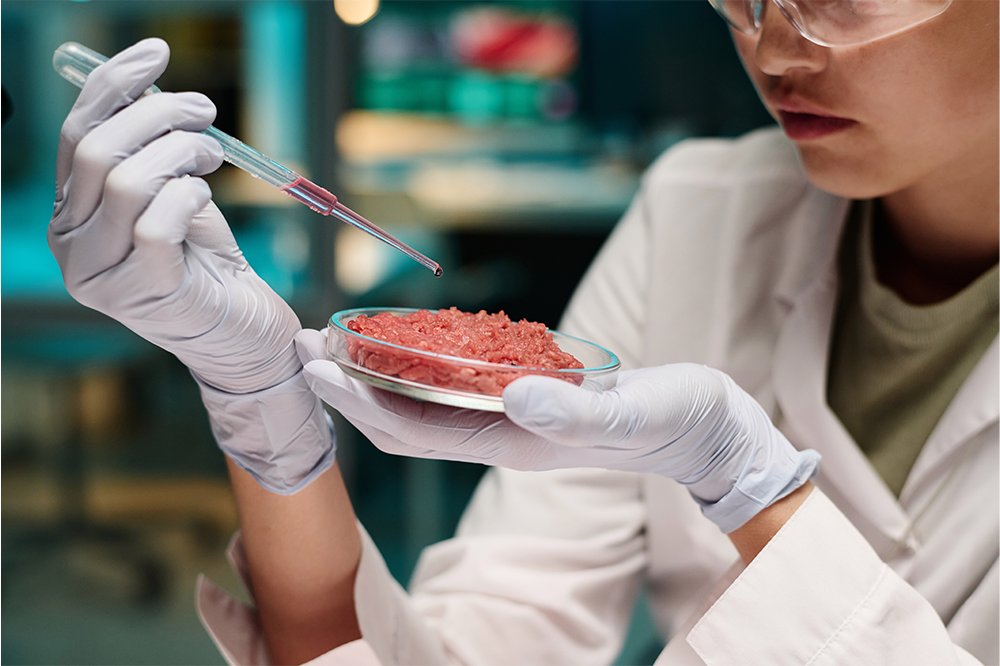
A new report finds plenty of concern over the impact of cultured meat technology on rural communities but it also identifies opportunities for UK farmers. Nick Hughes reports.
Cultured clash. Debate over the future role of cultured meat in our diets has largely been characterised to-date as a war between two intransigent factions. Where some see a novel way of allowing people to continue eating meat while slashing its environmental footprint, others see unnatural ‘Frankenstein’ foods that threaten the future of the countryside and those who produce ‘real meat’. Nuance has barely had a look in.
Spirit of cooperation. But is it really a case of backing one form of meat production over the other? What if there are potential synergies between cultured meat and traditional meat production that can open up fruitful new opportunities? That’s the premise of a new report that explores what UK farmers think about cultured meat and how the technology could impact them in practice – for good and for bad.
Hopes and fears. Published by the Royal Agricultural University, the report’s findings are based on a two-year interdisciplinary study, analysing social media, discussing the technology with groups of farmers, working with diverse farm businesses across the UK, and modelling novel approaches to cultured meat production based on agricultural by-products. Overall, the study found mixed feelings among farmers over cultured meat, from angry reactions on social media and concerns over the technology’s wider impacts, to pragmatic engagement with the specific risks and opportunities it could present. The technology was not seen as an immediate threat to livestock farming, especially in comparison with other challenges over input costs and supply contracts, geopolitical uncertainty, trade deals, policy changes and unpredictable weather. However, there were a number of common fears that farmers shared regarding cultured meat and its commercialisation.
Knowledge gaps. Farmers felt there remained too many unanswered questions about the technology such as the market at which cultured meat is aimed – if cultured meat substitutes are used for cheaper cuts such as beef mince, for example, this will impact the value of the whole carcase. Farmers also felt that unbiased data on cultured meat was hard to come by on indicators like health and environmental impact, while work is needed to map out how new supply chains could work in practice. They saw that commercialisation of cultured meat could have many potential knock-on effects on their business and the local community, for example in damage caused to farming communities through job losses and reduced local services. There were also fears over intellectual property and how cultured meat production could continue to exacerbate the industrialisation of food production and consolidate the power of large food corporations.
Opportunity knocks. Yet the research also found that, under the right circumstances, cultured meat could present opportunities for some UK farmers. It could, for example, sharpen their competitive edge for selling high-value ‘real meat’ and open up new potential markets supplying animal cells or agricultural by-products, like glucose and amino acids, for the growth media used for cultured meat production. Analysis found that switching out the pharmaceutical-grade ingredients currently used in growth media for waste or low-value by-products from agriculture could save money and lower the environmental footprint of cultured meat. In some circumstances, farmers could potentially harness private investment to produce cultured meat on their own farms, according to the RAU.
High steaks. There are implications too for the cultured meat industry. The report noted how the stakes in its relationship with farming may actually be higher than they are for farmers. Until recently, the technology’s implications for farming have largely been taken for granted and the views of farmers mostly overlooked. Yet the report said that understanding agricultural supply chains, and how cultured meat would compete with or complement meat from animals, would be critical to providing insights into the economic viability, and environmental and social impact of cultured meat. It also called on investors to expect cultured meat companies to include farmers in their ESG commitments to support a ‘just transition’.
Slow burn. Billions of dollars of investment has been ploughed into researching and commercialising cultured meat but the market remains tiny. Small amounts are already on sale in Singapore and the report notes how around the world, the pace of regulatory approvals is picking up. Cultured chicken has now been approved for human consumption in the USA and cultured beef in Israel, while in the UK, the Food Standards Agency received its first application to approve cultivated beef in summer 2023.
Watershed moment. Another significant landmark was reached in the UK earlier this month with the approval of lab grown meat for use in pet food – a European first. Regulators approved a product made from chicken cultivated from animal cells by cultured meat producer Meatly.
Collaboration not polarisation. It seems increasingly clear that those pinning their hopes on regulators putting the cultured meat genie back in its bottle are set to be disappointed. Perhaps it really is time for farmers and cultured meat companies to move from a state of polarisation to one of collaboration.