
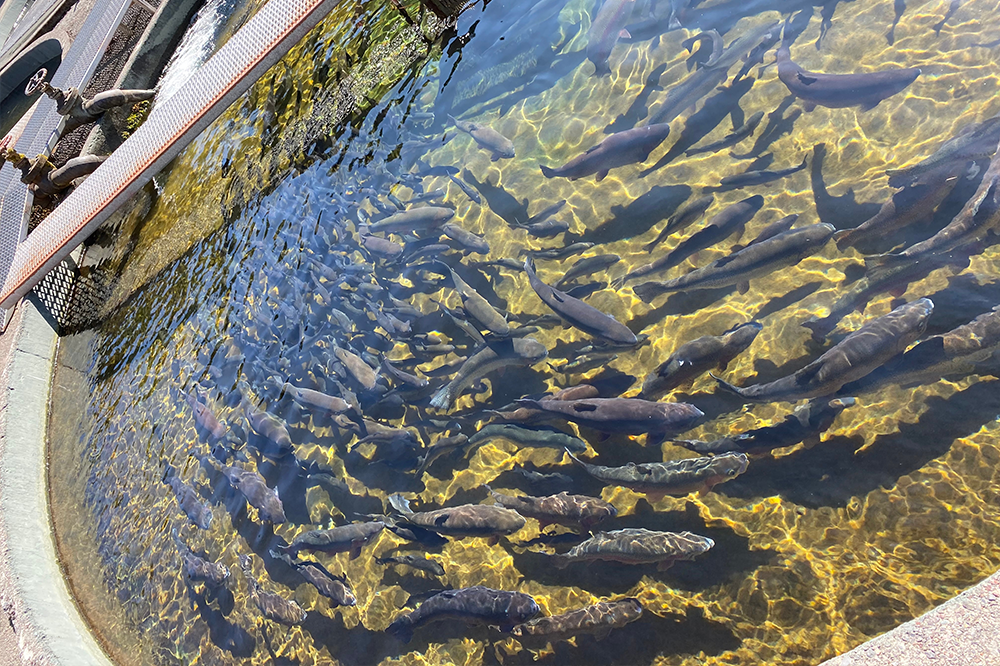
Is aquaculture just the next frontier that the industrial food system is angling to cash in on, despite risks to humans, animals, and the environment?
Some of us may be familiar with the ethical concerns around eating meat produced on land, like beef, poultry, and pork. At large-scale industrial livestock operations, animals are confined and raised in concentration, which can harm them, as well as the workers, neighboUrs, and surrounding environment. In poultry operations, for example, birds are often cramped into less than a square foot of space, leading to aggression, waste buildup [as reported by Footprint], and disease.
But have you ever thought about ethical concerns when eating [or sourcing] farmed salmon? What about farmed shrimp? Instead of barns, some aquatic species are concentrated in large net pens, where they too can become agitated and potentially generate pollution or encounter problems with disease.
The practice of aquaculture has long been a way to farm aquatic animals and plants. However, in recent decades, large-scale industrial forms of aquaculture have rapidly grown into a booming global industry that some have hailed as the future of protein production. On the surface, it could be perceived as a sustainable and scalable solution to help address food insecurity and environmental degradation. For others, it is a long-awaited answer to numerous problems associated with our current food system — which is vulnerable, inequitable, and unsustainable.
But regardless of the role aquaculture can play in food systems, it is not off the hook in terms of ethical concerns.
Ethical debate
The ethical debate surrounding aquaculture is not straightforward. Some proponents argue that aquatic animals require less food than land animals, making them more efficient and less resource-intensive. Second, many believe them to be less sentient than, say, a pig or a cow. And third, they provide nutrient-dense foods around the world, especially in the Global South, at what is perceived to be a lower environmental cost than land animals.
But critics are concerned that industrial-scale aquaculture operations are creating a similar set of harms to industrial livestock production on land, such as damaging the health of inland waters and oceans, potentially causing animals to suffer, and contributing to antibiotic resistance through misuse of these critically important drugs. Such concerns may be warranted. If industrial livestock production has taught us anything, it’s that efficiency often comes at the cost of public health, ethics, and ecology.
Is aquaculture just the next frontier that the industrial food system is angling to cash in on, despite risks to humans, animals, and the environment?
There is no simple answer to that question. While there is reason for concern, some of the backlash against aquaculture is misplaced. Aquaculture is an extremely diverse activity and can occur on a spectrum from small- to large-scale. Nearly 600 species are farmed, including seaweeds, molluscs, shrimps, herbivorous fish, and carnivorous fish. Production methods range from extensive systems requiring little or no external inputs like backyard ponds, to highly intensive industrial farms involving confinement of fish in net pens, commercial feed inputs, and veterinary drugs. Some of these practices may give rise to concerns, while others raise very few ethical red flags.
David and Goliath
For instance, small-scale aquaculture occurring in backyard ponds contributes to the fight against malnutrition, as do other forms of inland aquaculture, particularly throughout low- and middle-income countries. These forms of aquaculture also pose fewer ecological, animal, and human harms.
On the other hand, large-scale industrial aquaculture may cater more to the demands of Western consumers and carries higher potential ecological and animal risks. As such, there is no one-size-fits-all ethical truth about aquaculture.
Whether experts deem all forms of aquaculture ethical or not, it is happening — and fast. Global aquaculture has grown at an average annual rate of 7% over the last three decades, and animal aquaculture production surpassed wild fisheries for the first time in 2022. It is important to seize the opportunity to shape the industry, especially large-scale industrial aquaculture, as it evolves and matures to avoid the harmful trajectory that industrial agriculture on land has followed.
This is why the 2025 Oxford Summer School on the ethics of animal captivity, and its special attention to aquaculture, is so timely. The event brings together an interdisciplinary group of scholars to discuss the ethical considerations of activities that hold animals captive and how to influence responsible policies moving forward.
Through open dialogue, and by resisting the urge to make binary moral declarations, we can wade the ethically murky waters with one certainty in mind: we should not allow industrial aquaculture to follow the same trajectory as its counterparts on land.
Jessica Barth is a PhD candidate at Michigan State University, US; Anne Barnhill is an associate research professor at the Johns Hopkins Berman Institute of Bioethics, US; Liz Nussbaumer is the project director of aquatic food systems & public health at the Johns Hopkins Center for a Livable Future (CLF), US; Dave Loveis a research professor at the CLF; Andrew Thorne-Lyman is an associate professor at Bloomberg School of Public Health, US.





Once again, we see a fundamental misunderstanding of the values being promoted. Some counter-intuitive realities present themselves when we look at sustainability through the lens of carbon footprints. One might be tempted to assume that low-input, low yield aquaculture would generate minimal carbon footprints, but it has been shown in many instances that intensification of crop production (be it aquaculture or agriculture) generally results in substantially lower carbon footprints. This results from calculating values as kg of CO2 emission per kg of product, and higher yields often tend to spread the inevitable releases across more units of production. Researchers in China reported similar results for rice-fish co-culture. Small farm production units actually generated higher carbon emissions than larger-scaled operations. Moreover, a team of researchers from the Netherlands and Vietnam found that fish from small family-owned pangasius farms generated carbon footprints that were roughly 14 percent higher than those of fish from corporate farms (6.73 vs 5.91, respectively). “Industrial” doesn’t always mean dirty or inefficient; in the case of aquaculture it typically is associated with even higher scores in terms of sustainability.