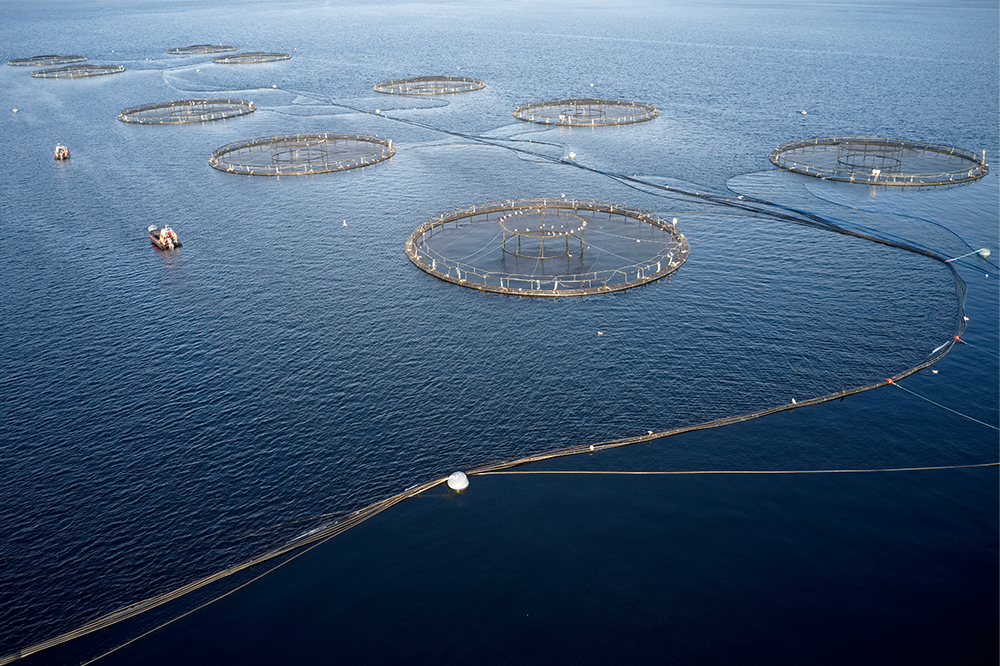
The UK government has successfully defended its move to erase the word ‘farmed’ from Scottish salmon products. The lack of transparency puts consumer trust at risk, says David Burrows.
Salmon story. Like Champagne, Baklava and Sauerkraut, salmon products from Scotland receive protection under the Protected Geographical Indication (PGI) labelling. The product has had this award since 2004, which means only farm-raised Atlantic salmon from Scotland can be called ‘Scottish Farmed Salmon’.
Captive audience. Wild Scottish salmon is not sold in supermarkets, with farm-raised salmon now supplying 100% of the increasing demand for fresh Atlantic salmon. It is the UK’s top food export, worth £600m, and with a domestic market value of £1.2bn a year. A 2021 survey of the UK’s top chefs suggested that farm-raised Scottish salmon is “the best in the world”.
Name drop. In October 2023, Salmon Scotland, which represents producers in the country, questioned whether the PGI “reflects what consumers understand our product to be”. In 2024, the PGI was changed, and the word ‘farmed’ was dropped. So, ‘Farmed Scottish Salmon’ became ‘Scottish Salmon’. This despite just 6% of consumers knowing that Scottish salmon is farmed in the UK, according to surveys conducted by Fidra, an environmental charity.
Fish fraud. Salmon Scotland said in its application that Scottish salmon “is facing increased competition from imported, commoditised product, often of lower quality, and this is leading to increased risk of food fraud”. The amendment of the PGI label would, it said, “remove potential labelling ambiguities” and “allow the Scottish salmon sector and our supply chains, regulators and enforcement to act more quickly and definitively when investigating possible food fraud cases”.
Troubled waters. Abigail Penny, executive director at Animal Equality, said the move to amend the label was “deeply troubling”. She explained: “Scottish salmon are farmed; this undeniable fact must not be deliberately hidden from consumers who deserve to know the truth.”
Name-calling. Penny and her team, together with campaigners at Wildfish, appealed against the decision, claiming it amounted to ‘greenwashing’. Indeed, during the hearing held on November 27th 2024 in London, Defra’s legal team implied that the word ‘farmed’ might be considered by some to be “pejorative” and that there was “no evidence before this tribunal or secretary of state of a product which includes pejorative language”.
Case dismissed. Last month, a tribunal dismissed their appeal. The judge said the new label did not risk confusing consumers as to the breed of fish or where it was produced, reported The Guardian. The packs will under wider labelling rules still need to indicate the fish was ‘farm raised’, but this can be hidden away on the back. Caterers and restaurateurs have no need to mention it at all.
Consumer clarity. Research by Fidra has showed that around 70% of consumers want to have access to information about the salmon products they buy on packaging. However, consumers are unable to easily find clear information about the salmon they are eating and how its production impacts the environment. Its campaigning work – BestFishes, which ran between 2016 and 2023 – has improved transparency among leading supermarkets in the UK.
In foodservice, growing numbers of chefs have joined the ‘Off the table’ campaign, which argues that the popularity of salmon “has come at a cost for the environment, fish welfare and the health of the planet”. Lex Rigby from Wildfish recently told the Sustainable Restaurant Association that “[s]almon has been misrepresented as a sustainable food source for far too long, due to clever marketing and claims of ‘responsible sourcing’. By harnessing the food industry’s power and influence over consumer awareness, we’re seeing people starting to recognise what a high environmental price we pay for farmed salmon, and it’s one that many are increasingly unwilling to pay,” Rigby added.
Rules Britannia. Fidra’s assessment of environmental legislation across the largest Atlantic salmon aquaculture nations in the world – including Norway, Chile, Scotland, Faroe Islands, Canada, Australia and Iceland – also showed not one “has sufficiently addressed all environmental impacts of salmon aquaculture”.It called for a moratorium on the sector’s expansion until things are tightened up and cleaned up.
Net survival. Farm-raised salmon spend up to 18 months in the waters off Scotland’s west coast and islands. In October, Salmon Scotland reported that a £1bn investment in fish health and welfare had produced the best survival rate (98.18%) for the farmed fish since 2020. This compares with “a survival rate of 1-2% [in the wild] given the many challenges in the natural environment”, the industry group noted.
Feeling blue. This kind of stat doesn’t wash with campaigners (not least because the numbers can fluctuate wildly from year to year). Having spent years campaigning about the environmental impact of these farms, they are now are ramping up pressure on policymakers and politicians to put in place legal protections for Scottish farmed fish. Welfare issues tend to grab consumer (and media) attention more than pollution problems. “An estimated 77 million fish are farmed and slaughtered in the UK annually – most of them Atlantic salmon in Scotland – making them the second-largest group of farmed animals after chickens,” noted Animal Equality UK at a Scottish Parliamentary reception in January. “Yet, without clear legal protections, these animals are at risk of enduring extreme and prolonged suffering in their final moments on earth.”
Cull me quick. Farmed fish currently have some legal protections under the Animal Health and Welfare Act in Scotland, which protects fish from unnecessary suffering and requires that their welfare needs must be met, such as the need for a suitable environment. They also need to be spared avoidable pain and suffering at the time of killing. The issue, explained the Animal Law Foundation, is there has been “no clarity on what these protections mean in practice, for example what is a suitable environment for a farmed fish?” That perhaps explains why there has never been a prosecution or official care notice issued for breaches of animal welfare law, despite investigations revealing what campaigners claim are “significant concerns”.
Clear waters? Penny has claimed that the “inescapable reality is that tens of millions of Atlantic Salmon suffer at the hands of the Scottish farmed salmon industry every year. As a society, we must prioritise transparency.” Speaking after the tribunal last month, Rachel Mulrenan from Wildfish said that “referring to this intensively farmed product as ‘Scottish Salmon’ instead of ‘Scottish Farmed Salmon’, gives consumers less information about how that fish was brought to supermarket shelves and plates”.
Trust. The change certainly reduces transparency. However, it also puts consumer trust at risk at a time when farmed salmon producers are fighting to protect their reputation. “[…] Defra’s decision appears to go against the spirit of the EC regulations on protected geographical indication,” wrote professor ManMohan Sodhi in December. “So, there is a serious risk that what was a premium product will eventually become known as the same commoditised, low-quality product that Salmon Scotland is claiming to fight against.”
Big business. Scaling up salmon production seems to matter most, currently. Growth is the name of the game. But as Sodhi noted, such commoditisation – placing more focus on quantity than quality – puts smaller Scottish producers at a disadvantage against global producers operating in Scotland like Norway-based Mowi and Faroe-based Bakkafrost. Worth noting too is that consumers say they will pay less for farmed fish.
Bum deal. The letter of the law might permit the erasing of those six letters (f-a-r-m-e-d), but the law is occasionally, an… you know. As one wag pointed out on social media: dropping the word farmed from this product is way more misleading than calling Oatly’s product a ‘milk’, isn’t it?