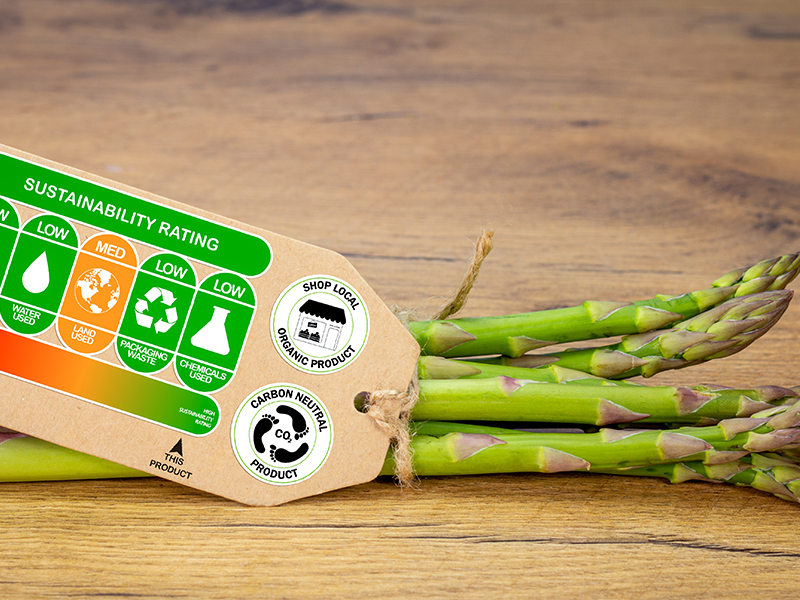
Shifting towards more sustainable diets is a sticky business, but a universal ecolabel could actually help.
That’s according to research by Wageningen University in The Netherlands, which showed that the presence of the Eco-score label helps consumers identify more sustainable food products.
When presented with photos of pairs of food products and asked to indicate the more sustainable option, 52% managed to select correctly. However, when a front-of-pack Eco-score was added this increased to 72%.
“This study showed that without a label, even for motivated consumers, it might be very hard to choose environmentally friendly products,” lead author Dieuwerke Bolhuis told Ingredients Network.
To recap, eco-labelling is a way to transparently communicate a product’s environmental impact. There are hundreds of labels and schemes, and the pros and cons of a universal scheme have been hotly debated (as detailed in previous Footprint Intelligence reports and almost weekly on social media platforms among food policy wonks and life cycle assessment specialists).
Supporters believe the labels offer a way to cut through the mixed messages fired at citizens in shops, restaurants and on social media. Critics wonder if we are asking too much of consumers to tip the balance towards more sustainable diets and consumption patterns. Relying on such behaviour change also lets companies off the hook, reducing their investment in stealthier approaches behind the scenes – such as substituting some of the beef in recipes for beans (see again Footprint reports past).
Eco-score, recently renamed Green-score and growing in popularity across Europe, was the label used in the study. Dieuwerke Bolhuis and her colleagues assessed the effectiveness of the labels by asking people to indicate the most sustainable food out of two options from similar food categories, in two online choice tests. Reaction times were also included as an additional, “more objective” measure to explore respondents’ ease of identifying sustainable products (decisions are made in seconds at supermarket shelves, for example).
As well as showing that consumers rely on the labels to correctly select more sustainable options, they also found that a simple one-letter version of the label (on a sliding scale of A to E) is “at least as effective” as the full traffic light version, “and might even be more understandable, especially for the lower-educated population”.
Respondents were also presented with products that had both an Eco-score and Nutri-score label. This presence of both labels had a slight impact on respondents’ ability to correctly identify the most sustainable option when scores conflicted, but “the overall effect of Eco-score on sustainability identification remained strong”.
There was confusion in other ways, though, for example when trying to compare meat and plant-based alternatives. The choice between plant-based mince and organic minced meat proved tricky, which is in line with previous research showing that “people generally underestimate the environmental impact of animal products”.
Writing in the journal Appetite, the team concluded “that consumers rely on a sustainability label to be able to identify sustainable food products. A transition in more sustainable diets is being hampered by a lack of standardised and uniform eco-labelling.”
Consider that can of worms still very much open, then.
This week we also have news that alcohol consumption is on the slide “everywhere”, while Capgemini’s latest research shows many businesses are “confusing planning with concrete climate adaptation”. A new investigation also shows how banned EU pesticides are simply being shipped overseas, harming communities and biodiversity, with some then arriving back on our plates as residues in imported food and drink.
Exported pesticides return “like a toxic boomerang” to our plates. More.
Mixed approach to net-zero as budgets bite. More.
Health concerns driving sustained alcohol slump. More.


The research as reported is frustrating because it fails to address two critical questions:
1. Evidence citizens actually buy labelled products preferentially is more important than measured intention or recognition.
2. Simplistic choices between meat – not-meat fails to recognise what farmers actually do and leads directly to the problem mentioned which is things like confusion between plant-based and organic.
We don’t need an impossible-to-achieve omni-label that provides all the answers, we need more widespread use of what already exists – a consistently applied label that highlights farmer’s positive actions. Something that says “this is better meat” for example. A sustainability label acting on its own is not the right mechanism to tell people what diet they should be eating.
Further, it only seems to be in the food sector that we apply this comparative approach to choice (e.g. meat vs plant-based), rather than indicating relative performance per type. In other sectors we have A – E labels for energy efficiency but we don’t have a label that says “this TV has a higher footprint than a radio”. Doing two things at once seems a big challenge technically as well as confusing for citizens and may not be the best option.