July’s package sounds like a story that should come with a moral. It doesn’t (but probably should). By David Burrows.
The great and the good descended upon Cornwall last month for the G7 summit. Supermarkets, food manufacturers and environmental NGOs pushed world leaders to discuss a global plastics treaty as they sipped flat whites from, er, single-use cups. The 2,000 made-to-order cups were reportedly “truly sustainable” though with “40 to 51% less plastic than standard or compostable cups” and suitable for standard paper recycling streams.
Thankfully, the meet took place in June rather than plastic-free July. Hadn’t heard of it? Well, you still have five days to go. Some 326m people from 177 countries apparently took part in 2020, but it’s not really one the big food brands here have embraced.
Some do love the plastic-free chat though. Iceland boss Richard Walker is chief among them. He has been blogging about how covid has “increased the demand for packaged goods in stores” and “created mountains of discarded PPE”. July 19th marked the day we could start leaving our masks at home voluntarily (rather than mistakenly). But can we trust corporates to tackle all the other single-use packaging?
The government really, really wants to. Its waste prevention plan for England (for which a consultation has just closed) is a Rorschach test for proponents and critics of such industry-led approaches. Wrap (the go-to body for such schemes) says it has plenty of evidence of them working (though we’ve been told there’s at least one assessment that is gathering dust in an unmanned office somewhere).
Voluntary volley
The likes of Green Alliance, however, have capably poo-pooed the figures used in support of voluntary commitments. So too Changing Markets – the campaign group produced a 58-page report that basically said all these pacts were simply “all talk and no action”.
Still, (effective) change takes time. “To reduce the use of food packaging it is necessary to develop food systems in which social and ecological well-being are prioritised over increased economic growth,” wrote researchers in a recent paper for the journal Ecological Economics. Recycling and fancy new biodegradable materials won’t cut it, they concluded. Instead, “structural changes” are needed, such as “redesigning and decentralising food systems”.
That sounds a bit difficult though, doesn’t it? Especially for a government that continues to struggle with a deposit return scheme. The new extended producer responsibility scheme is also increasingly likely to slip past the 2023 deadline, according to Ends Report. A cynic might say the government has lost its way on waste.
Still on track though is the plastics tax – much to the chagrin of compostable fans. They want the inclusion of their packaging within the scope of the tax to biodegrade – and fast. Tipa has polled 2,085 adults, 80% of who said (raises eyebrows and feigns shock) that the tax should treat compostable materials differently to traditional plastic. Recycling of plastic films was also mocked as an “illusion”.
Others feel the same about compostables. “We are not keen on compostables,” says Alice Rebondy from Hubbub, a charity. She argues that the infrastructure isn’t ready for these materials yet.
On-the-go bins are going
Hubbub has been working on various projects in a handful of major UK cities and towns to encourage recycling on-the-go. The pandemic also means 12 months of data-gathering and trials have been lost (no one was commuting and cafés and restaurants were closed for months on end). They’re hoping to trial their solutions “in a town/small city environment, as well as in a London borough”, Rebondy says.
Boosting on-the-go recycling is harder than you might think. People are confused or in some cases just don’t give a damn. Street bins are also disappearing: 47% of local authorities have on-the-go recycling bins in their area, according to Recoup’s latest survey, down from 51% in 2019. Hardly any could say where this material ended up and only 8% could report material quantities.
Hubbub is focusing on a limited range of packaging – bottles, cans and sometimes cups. Recoup and Valpak have estimated that 317,000 tonnes of PET drinks bottles were sold in 2018, of which around a third (111,000 tonnes) were disposed of out of home. Just 9%, or 10,000 tonnes, were collected for recycling, “leaving over 100,000 tonnes of potentially high-quality, recyclable PET bottles not going into the recycling stream”.
Recycle it like Ronaldo
Thank goodness for Coca-Cola, then, which is, in the words of its press team, “continuing its sustainability journey” (whether Cristiano Ronaldo likes it or not). Coke’s smaller, on-the-go bottles will from September all be made from 100% recycled plastic. The company has also promised to use “the power of its brands and advertising in order to encourage people to recycle more”, and if they drink more Coke in the process then presumably all the better.
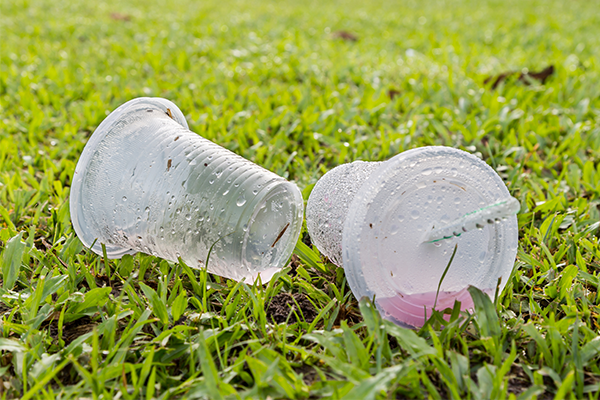
On-the-go packaging was in the headlines recently following new research published in Nature Sustainability. The study, picked up by most mainstream media, classified 12 million items of litter. Some 80% were made from plastic. What’s more, 50% to 88% were ‘take-out consumer items’, like wrappers, cutlery, bottles and cans.
“The combination of irresponsible production of single-use plastic goods, inappropriate behaviour by end users and flaws in recovery systems has resulted in disproportionate leakage of plastic items to nature,” they wrote. “Litter from take-out food and beverages is often discarded outdoors after a short use and should be prioritised by waste management actions that aim to mitigate global litter.”
The Foodservice Packaging Association didn’t like the researchers’ tone. What is takeaway packaging, its representatives wondered in a Shakespearean-like statement published on its swish (and far more functional) new website. “Is a pot of hummus purchased from a grocery store takeaway food if consumed out of the home?”
If only we had time to quibble over semantics. We don’t.
Flat-pack pasta
And finally, stories emerged recently of a revolutionary new ‘flat’ pasta that could reduce the amount of packaging needed. “We were inspired by flat-packed furniture and how it saved space, made storage easier and reduced the carbon footprint associated with transportation,” said Lining Yao, director of the Morphing Matter Lab at Carnegie Mellon University’s School of Computer Science in the US.
So, the team stamped “grooves” into flat pasta sheets that lead to them shape-shifting as they are cooked. “The groove side expands less than the smooth side, leading the pasta to morph into shape,” explained Teng Zhang, an assistant professor at Syracuse University who led the modelling analysis. They calculated that space-savings in packaging could be between 59% and 86% (material use and transport emissions both fall).
The flat-pack pasta also cooks quicker than its tubular equivalent, so reducing the carbon footprint of the product. The instructions are also likely to be easier to follow than for your average cupboard.