
DAVID BURROWS
Impressive progress from businesses in reducing scope 1 and 2 emissions contrasts with slow progress in decarbonising supply chains. Now is the time to move the needle on scope 3.
Compass Group managed 7.5%. Sodexo achieved 44.5%. Members of the Zero Carbon Forum (ZCF), which includes the likes of Burger King, Nando’s, Mitchells & Butlers and WSH, mustered 7%.
These are the latest greenhouse gas emissions reductions reported across the UK hospitality and foodservice sector. They mark the midpoint in this so-called decisive decade of action on climate change and offer a sense of whether the rubber is hitting the road or, as some of the mainstream and financial media reporting suggests, the narrative on net-zero has gone a bit flat.
So, which is it?
“I think we have made the progress we wanted,” explains Bob Gordon, director at ZCF, which has over 70 companies engaged in its sector-wide programme to hit net-zero by 2040. “Has this come through in the [emissions reduction] results yet? No, not really.”
Foodservice is not alone in this respect. The ESG reports of food companies in grocery and FMCG also paint a picture of painfully slow progress based on carbon reduction figures alone. This explains why many continue to spotlight specific parts of their footprint where they have come on leaps and bounds. Shifts to renewable energy tariffs and the installation of energy efficient equipment have, for example, brought steep cuts in direct carbon emissions, also known as scopes 1 and 2. This shouldn’t be sniffed at: across 70 operators and their 35,000 sites, ZCF’s members have slashed scope 1 (gas) and scope 2 (electricity) emissions by 22% and 52% respectively, saving a combined 600,000tCO2e. This has been achieved through investment in electric kitchens and renewables as well as behaviour change initiatives to reduce energy demand.
However, this remains the low hanging fruit. Scope 3 emissions, which lie up and down business supply chains, were always going to be harder to crack: just 225,000tCO2e have been abated in the five years to date across the forum’s members.
Measurement of these emissions has improved considerably, according to Gordon, as has engagement with suppliers, including the farmers who will be essential in achieving scope 3 targets, a large chunk of which come from food (50% of members are putting an engagement plan in place this year).
Across scope 3 emissions, 40% of the reductions needed to achieve net-zero could come from supplier engagement and regenerative agriculture, with another 20% reliant on the evolution of menus and 10% from food waste reduction (which continues to be a quick win for those chasing scope 3 cuts, according to other businesses Footprint consulted). Food innovation could make up the other 30%.
Glass half full
There is much to do but Gordon’s glass is half full. Five years ago, discussions at the forum revolved around the need to talk about scope 3 but were then dominated by scopes 1 and 2, he tells Footprint. “Today, we don’t talk about scopes 1 and 2. There is still work to do on those but that carbon reduction is happening,” he adds.
The focus now is on the scope 3 emissions that tend to make up 90% or more of the average food business’s total. This is where the leaders are now headed and where they hope to really move the needle on net-zero.
“Most businesses have spent time trying to measure their emissions rather than reduce them,” explains Matthew Isaacs, co-founder of footprinting firm MyEmissions, which works with the likes of Wahaca and Just Eat Takeaway.com. “The opportunity now is to shift focus: use the data you have, embed it into procurement and NPD, and make reduction a business-as-usual activity.”
Sodexo is currently among the best in class in this respect. The contract caterer has just released its latest greenhouse gas emissions report showing a huge 43.8% reduction in scope 3 emissions, from 769,027tCO2e in FY17, the baseline year, to 432,564tCO2e at the latest count in FY25.
It has been a bumpy ride, with emissions falling as low as 316,125tCO2e to a high of almost 600,000tCO2e during the past five years. That latter figure in FY24 was “a real wake-up call” for us, explains Sodexo UK&I sustainability director Claire Atkins-Morris, who like many is discovering that the path to net-zero is far from linear.
No sustainability or net-zero lead wants to miss a target but that jump in emissions motivated Atkins-Morris and her team to dig deeper. Data has been key, but not in the way you might expect: input to the company’s site engagement assessment tool was improved to ensure it was treated seriously rather than with complacency by employees (20.1% of Sodexo’s scope 3 emissions are from client site energy, with emissions cut 72.8% so far against the baseline). Food waste has been dramatically reduced – by 50.2% compared to 2017 – and the company seems to be on the way to achieving a target to ensure 70% of main dishes are classified as ‘low-carbon’ by the end of the decade.
Low-carbon chow
A low-carbon meal for Sodexo is 0.9kgCO2e or less – a figure established by its partner WWF, the environmental NGO. Sodexo’s data show that emissions from purchased goods and services (category 3.1, according to the GHG Protocol’s scope 3 definitions) have been reduced by 27% since 2017, including those relating to forest, land and agriculture.
These so-called FLAG emissions have been harder to tackle and they will require action on menus, through innovation and behaviour change, as well as on farms, through wider uptake of regenerative practices and, more controversially, changes to what is produced.
Regenerative agriculture is en vogue as a carbon mitigation tool. Fewer chemical inputs can help reduce emissions and improve resilience in the face of increasingly extreme weather. There are also emissions savings to be made through regenerative beef and dairy farming, with Nestlé among those betting big on this shift as a means of achieving its net-zero target.
ZCF has calculated that decarbonising UK hospitality beef supply chains will remove 4mtCO2e, representing an 11% reduction in the sector’s emissions.
An analysis commissioned by WWF and carried out by Farm Carbon Toolkit, Cumulus Consultants and the Andersons Centre last year showed that “the transition to regenerative dairy farming can result in a profitable business model – better able to withstand input and milk price shocks, while also cutting greenhouse gas emissions, improving biodiversity, and reducing pollution from farming activity”.
How far food businesses are willing to go on their regenerative journey and where this will take their carbon emissions remain hotly debated. And the pressure to make gains from ‘regen ag’ will only intensify if menus continue to shift back towards meat, as The Guardian reported recently.
Less or more?
The concept of ‘less meat’ regardless of whether it is better – for the environment, for the farmer, for the business buyer or for the consumer – remains hard to swallow for some businesses and consumers, but there have been some bold moves nonetheless.
Isaacs cites the example of client Simply Lunch, which has achieved a 10.4% reduction in food and drink emissions by intensity while continuing to grow the business. Key to this success has been the removal of high-carbon products “even when they are bestsellers”, he explains.
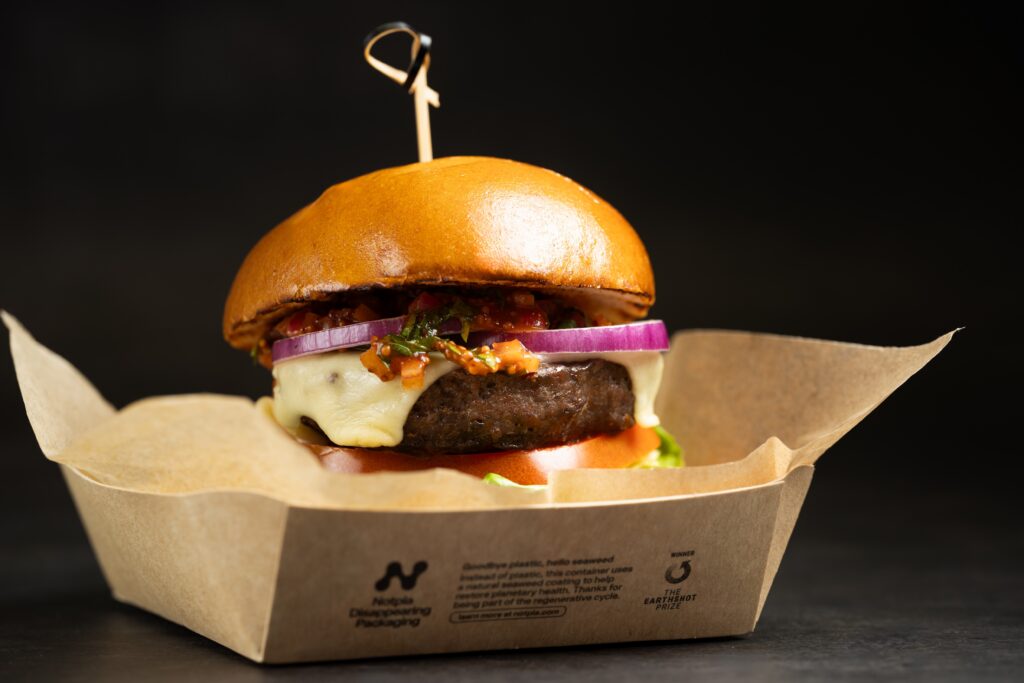
Levy, which is part of Compass Group UK & Ireland, has posted impressive emissions reductions thanks to its ‘game on’ and ‘signature’ burgers. In the former, available at Premier League football clubs Brentford and Wolves, as well as at The Allianz Stadium (Twickenham), beef has been replaced with venison, boasting 85% fewer emissions.
The latter, a collaboration between Levy culinary director James Buckley and director of decarbonisation Vincent Walsh, is half beef and half mushrooms. This mix makes it “nutritionally superior” – lower in saturated fat and salt, less calorific and higher in fibre than a standard beef burger, according to Levy’s ‘Serving the future’ report, published in 2025.
The carbon savings are considerable. Between FY19 and FY24, emissions from beef burgers fell by 71.5%, from 4,855tCO2e to 1,383tCO2e, driven by the 50:50 burger and a reduction in overall beef burger sales. The emissions intensity of beef burgers has also been cut from 31.7kgCO2e/kg to 27.4 kgCO2e/kg. The feedback on both burgers has been “amazing”, Levy UK&I managing director Jonathan Davies explained during a panel session at SFC2026, the sustainable food conference held in London in January.
Levy didn’t offer a choice to its customers. That would arguably be a harder sell for a BigMac or a Burger King Whopper, though the impact of going ‘50:50’ for those burger giants’ overall footprints would be startling.
“For contract caterers, it is generally easier to make changes to menus and recipes, because consumer and brand loyalty is not tied to specific products,” explains Anya Doherty, founder of environmental tech firm Foodsteps, which works with the likes of CH&Co, Chartwells and Zizzi to deliver scope 3 assessments. “However, all food companies are going to need to make changes both in what they sell and what they buy,” she adds.
Sensitivity and sustainability
Recently, there have been signs of foodservice companies becoming more nervous about sharing their news on net-zero. One caterer admitted that a press release to present results went through nine iterations – and this was to highlight positive results.
Companies are under the microscope for the way in which they measure and report on their emissions, including decisions to rebaseline and extend deadlines. Compass Group UK&I is one of those that has recently run this gauntlet, the caterer having moved its net-zero target out from 2030 to 2040. The baseline has moved from 2019 to 2025 too. The reset is on the back of considerable growth and acquisitions and remains aligned with guidance from the science-based targets initiative. “Our next emissions-related targets are 2035,” a spokesperson explains. “If we didn’t include acquisitions we would have achieved an emissions reduction of circa 23% [against our 2019 baseline.”
In reality, Compass managed 7.5%, with scope 3 emissions down 6.5%. The company’s current footprint is 1,100,274 tCO₂e, with scope 1 and 2 now representing just 0.2% of that. This diminishing share is in part thanks to a reduction in scope 1 (84%) and scope 2 (81%) emissions but scope 3 was always going to be the most material area of the caterer’s decarbonisation efforts.
It’s a stark example of the challenge the sector’s largest companies face in delivering decarbonisation at scale. The next five years will tell us much about how committed caterers, fast food chains and hospitality businesses are to making good on their net-zero ambitions.