
There is no hiding from the fact that carbon offsets are risky, so are UK-based projects a safer bet for food companies? By David Burrows.
TotalEnergies, a business energy provider, has “silently abandoned” a forest planting project to offset its emissions in the Republic of Congo. Just 12% of the promised trees were planted there, with questionable effectiveness, according to independent media outlet Reporterre.
“Batéké Carbon Sink (BaCaSi), the only industrial tree plantation financed by TotalEnergies in Africa to offset its carbon emissions, is in the process of collapsing: after more than four years of activity, this controversial project has been at a standstill for several weeks. Foreign personnel who operated on the site, located in the center of the Republic of Congo, left the country,” according to the report.
Dubious carbon offset schemes and big fossil fuel companies have come hand-in-hand these past years, and whoever thought there might be a quick fix to the scandals that have startled this market has clearly been mistaken.
“The latest evidence calls on policymakers as well as investors and supporters of carbon offsets to reckon with why such liability is being taken to continue to worship the voluntary carbon market, and for what real purpose – if it is not likely to lead to emissions reductions?” said Rachel Rose Jackson, director of climate research and policy at Corporate Accountability recently, as she presented the advocacy association’s latest assessment of the voluntary carbon market (VCM).
This research dives deep into 47 of the top 100 global carbon offset projects by credits retired for 2024, a snapshot that alone accounts for over a quarter of the entire VCM last year. The idea was to determine if VCM 2.0 is working; whether the reforms are deep and meaningful or PR puffery? It’s no surprise that the findings lean towards the latter with VCM 2.0 “fundamentally flawed”. Only four of the 47 had a higher than “moderate” likelihood of achieving 1 tonne of CO2e avoidance or removal, for example.
This is not just one or two bad apples: Jackson is among the growing number of campaigners, scientists and experts that feel the VCM is rotten to the core. As well as taking aim at the market registries, like Verra, at least 17 verifiers were also involved in approving these problematic projects for VCM trading, for example, with the checks and balances designed to secure high integrity credits not yet working. There is now, thanks to this assessment and the many others like it in recent months, “broad consensus that after decades of trial and error, the VCM appears to be grossly ineffective – meaning that the bulk of carbon credits retired are not meaningfully reducing emissions”, the authors noted.
There are several studies now that synthesise what the scientific evidence has to say about credits, “which mostly is not very flattering”, Andreas Kontoleon, professor of environmental economics and public policy at the University of Cambridge, told me recently. His study, published in the journal Nature Communications in November 2024, used data-driven methods to evaluate the efficacy of 2,346 carbon mitigation projects across 14 studies, covering one fifth of the credit volume issued to date, and comparing them with 51 comparable projects for which no credits were issued. The results: of the 972 million credits issued across the projects assessed, 812 million “likely do not constitute real emission reductions”.
Credit check
Food companies have certainly taken note, drifting away from carbon credits – especially those from projects in far-flung corners of the world – or increasingly hesitant to invest in them as criticism increased. Corporate Accountability’s research shows 93% of the projects retiring problematic credits – those not likely to lead to the promised emissions reductions – are in the Global South. Ones involving forestry and land use presented the most concerns. This is not surprising: previous research published in the journal Science has found 94% of scrutinised forest carbon offsets were “non-performing”.
Those findings contributed to the investigation by SourceMaterial, Die Zeit and The Guardian in 2023 which blew the whole market apart, and led to the likes of Leon quietly dropping their credits and the claims associated with them. Supporters of carbon credits have been fighting their corner ever since – and with good reason. “We recognise that few (if any) such global schemes are perfect,” noted the World Land Trust, which provides offsets, in 2023. “However, the real issue here is that funding for forest conservation has, for decades, been far below what’s required to protect these vital parts of Earth’s life support system.”
With a huge gap in climate financing needing to be plugged, throwing the baby out with the bathwater is a considerable risk too. Food companies have in the main been watching and waiting (how the money previously allocated to carbon credits has been spent is moot) but the itch may need scratching soon. As a recent Footprint Intelligence report noted: “Some businesses dropped their carbon neutral claims and pulled their funding from the voluntary carbon credit market. Others have either kept investing in credits or avoided them. Some told us they will be revisiting carbon credits in the near future.”
Those that are still investing in credits see them as a way of internalising the cost of carbon, which helps incentivise reduction. That’s a worthy approach. But when credits can be picked up for a few quid it becomes too easy (and too tempting) to game to system. “There are huge vested interests pushing this market,” said Kontoleon.
Still, there is some evidence to suggest that buyers are beginning to realise that quality credits come at a cost. Research by Ecosystem Marketplace in 2023 showed trading of credits fell by 51% but the average VCM credit prices were higher than they had been in 15 years, rising 82% to $7.37 (£5.36) in 2022, before falling away slightly in 2023. Credits connected to nature-based solutions, including forestry and land-use and agriculture, attracted notable premiums, as well as those that additional co-benefits, including social benefits.
The findings marked a “critical, increased shift in market behaviour towards integrity and quality”, said Stephen Donofrio, MD at the marketplace service provider. “Buyers in the voluntary carbon markets are becoming increasingly sophisticated, and they want to know the true impact of their dollars,” he added.
This seems to have continued – at least among those buying credits here in the UK. “All the concerns about quality and offsetting in the Congo mean people are now looking at the UK,” Chris Winter, director of natural capital at Oxygen Conservation, told me recently.
Suck it up
Oxygen, which invests in land to protect and restore natural capital, has been buying up big areas – 45,000 acres to date, from Cornwall to the Highlands, at a cost of £150m – focussing on native broadleaf woodland creation and peatland restoration, ecotourism (where appropriate), and renewable energy regeneration. Seriously degraded land is perfect as the potential carbon and biodiversity benefits are bigger. “When the carbon price hits £100, £100-plus, I think the whole market makes a lot more sense financially and becomes more of an attractive proposition,” he explained.
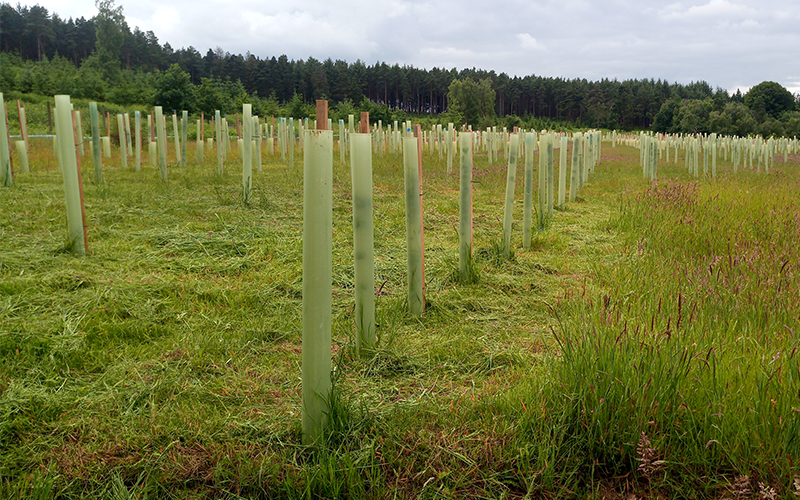
Arup’s recent £1m investment in part of Nattergal’s 617 hectare Boothby Woodland project in Lincolnshire is one example – a move that secures 10KtCO2e of high quality carbon removal credits over the next 30 years. For comparison, the global price is around £5 while a credit from the much-respected Woodland Code here in the UK is just over £26 – up from £11 in 2020. This premium is “due to the integrity of our projects and units and the wider social and environmental benefits our projects provide”, notes the code’s website in its latest update.
Indeed, you also have the feeling that selling credits has become less transactional and more inspirational; as Wilder put it: “impactful projects that are part of a climate transition plan”. Which will certainly appeal to nervous food companies with high scope 3 emissions, some of which will be tricky to get rid of.
There are pitfalls and problems ahead, mind. Sequestering carbon in the soil has attracted a lot of interest (both good and bad). Turn up to an agri-tech, sustainable food or regenerative farming conference these days and the largest group of representatives is often start-ups offering to measure, verify and report carbon emissions. The Guardian has reported that this trade in soil carbon credits is where capitalism meets environmentalism but marrying this with the movement towards regenerative agriculture and agroecological farming is not going to be easy.
“The carbon market system is not built for the kind of agriculture we set up to support,” wrote Climate Farmers co-founder Ivo Degn on social media recently as he announced the start-up was stepping away from carbon markets. “We believe regenerative agriculture deserves better,” he added. “One that values multiple ecosystem services. One that shares risk. One that sees farmers as stewards, not just carbon suppliers.”
Credible
The warning should be heard loud and clear in Whitehall. The UK Government is making a big deal about the potential farmers have to “measure and monetise carbon sequestration in diverse habitats”. This “has the potential to change how farmers earn income from sustainable land management”, Defra noted in its farming blog in March.
A consultation, that ended on July 10th, “seeks to clarify and test the UK Government’s proposed policy and governance framework for helping to ensure the integrity of voluntary carbon and nature market credits and the use of credits”. That would be a decent start but what seems increasingly clear is there is a long way to go until offsets form part of a credible climate transition plan.