
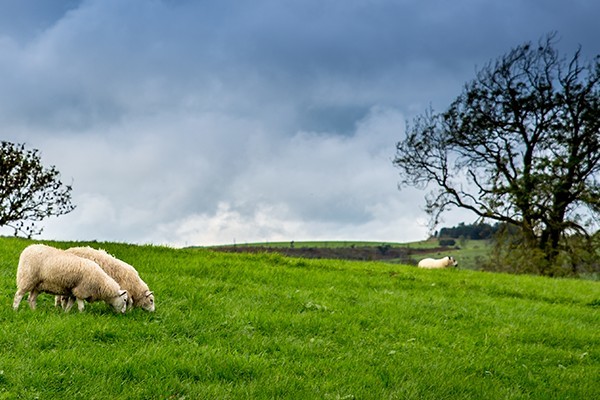
England’s first ever land use framework aims to maintain domestic food production while freeing land for nature, development and energy. Can it carry off such a delicate balancing act?
“Government is clear that food security is national security.”
This short, sharp political statement will come as relief to the growing number of experts concerned that complacency still abounds over the vulnerability of the UK food system to a cocktail of known and unknown future risks. The fact it was buried on page 36 of the UK Government’s new ‘Land use framework for England’ only slightly discredits the notion that messages around resilience – and the UK food system’s apparent lack of it – seem finally to be cutting through in Whitehall.
The land use framework itself shows a government thinking seriously about how to balance the long-term competing – and sometimes complementary – demands on England’s finite land from food production, housing, energy infrastructure and recreation, while allowing space for healthier ecosystems that restore nature and help meet climate goals.
A plan for how best to optimise England’s land was a key recommendation from Henry Dimbleby’s national food strategy back in 2021. A draft was consulted on at the start of last year and earlier this month the government published England’s first ever land use framework – a genuinely landmark moment and a document widely welcomed across the food, farming and environmental spheres, regardless of differences over the details.
Agriculture accounts for around two thirds of England’s land area meaning questions of where and how we produce our food form the backbone of the framework. So how does the document answer these questions and what does it mean for future food policy?
Informing not telling
From the start, the government is clear to stress that the purpose of the framework is not about telling people what to do with their land but rather to inform better decision making. The framework itself will not determine individual planning decisions but its four principles – multifunctionality; right use, right place; future-ready decisions; and adaptive by design – will be taken into account as ministers prepare key policy documents like the ‘National planning policy framework’ and ‘National policy statements’, as well as future iterations of the ‘Environmental improvement plan’, the forthcoming ‘25-year farming roadmap’ and other relevant documents. Over time, financial incentives under environmental land management (ELM) schemes will also become more closely aligned with the framework.
In her foreword, Defra secretary of state Emma Reynolds made the point that the analysis – and this really is a serious piece of modelling work – clearly demonstrates we have enough land to build the homes needed to address the housing crisis, maintain domestic food production, restore nature at scale, and build clean, homegrown power to provide energy security. “These are not competing demands,” wrote Reynolds. “With the right data, the right tools, and the strategic direction this framework provides, they are complementary ones.”
However, she goes on to note that, to-date, many of these challenges have been addressed in isolation, leading to a confused picture and missed opportunities for land to deliver multiple benefits. The document details how inefficient land use has locked us into false choices between infrastructure and nature, or homes and food. Those who responded to the consultation identified a lack of information, join-up, and long-term direction that has slowed delivery down and led to inefficient decision-making, and trade-offs not being properly understood or managed.
The result is often seen in heated arguments that play out in the media, for example over solar panels displacing productive farmland. In fact, the analysis shows both of these demands on the land can be met, including by exploiting opportunities for solar or wind generation to be integrated with livestock grazing and arable farming.
No change to food
From a food perspective, a key finding is that the projected scale of land use change can be achieved without reducing domestic food production, providing the most productive land can be used more efficiently. In reality, this means delivering a substantial increase in yields on the approximately 80% of currently utilised agricultural area that will largely be left untouched in the modelled scenario, save for small changes to the way the land is farmed such as planting cover crops to reduce soil loss or reducing fertiliser use to prevent water pollution.
A further 5% of land will remain primarily for food production but with some set aside for environmental and climate benefits like agroforestry, or the creation or restoration of species-rich grassland habitats.
Another 9% of the least productive land will be largely taken out of food production and used to deliver environmental and climate benefits through restoration of peatland or creation of woodlands and heathland habitats, while an additional 4% (2% each) will be dedicated to renewable energy and urban expansion.
Whether the assumption that current levels of food production can be maintained under such a scenario will survive contact with the real world is one of the biggest question marks surrounding the framework. In its consultation submission, the National Farmers Union (NFU) noted how volatility in yields has been increasing in recent years as more extreme weather becomes more common. “With climate change likely to result in ever more extreme weather, we may expect yields to reduce rather than grow in the future,” it suggested.
There was scepticism too among those pioneering nature-based approaches like regenerative agriculture and rewilding. Representatives of the Belmont Estate in Somerset, which describes itself as a regenerative business, took to social media to express doubts that overall food production can be maintained while reducing the overall area of farmed land, writing: “High-input, high-yield monocultures on our best agricultural land can deliver monster yields in the short term. We know this. We also know, from the land itself, what that approach does to soil health over decades. It depletes it, and depleted soil doesn’t recover quickly, cheaply or easily. You cannot build long-term food security on degraded land. That should be the first sentence of any land use framework.”
The government says it plans to use the new ‘Farming and food partnership board’, established following Baroness Minette Batters’ independent ‘Farming profitability review’, to drive growth, productivity and long-term profitability across the farming sector. The group met for the first time this week with the seven initial members – comprising heads of leading industry bodies, including Kate Nicholls, CEO of UKHospitality – discussing the board’s mission, purpose, ways of working and the scope of proposed sector growth plans.
These bespoke plans will look at opportunities to improve productivity, profitability and resilience across a range of farming sectors, beginning with horticulture and poultry. In many ways, they will be an acid test for how the framework is able to navigate competing priorities given the many trade-offs – between key commercial, environmental and social indicators – inherent in rearing chickens at scale.
Tonal shift
Doubts over delivery aside, the shift in tone over the importance of domestic food production and its role in long-term prosperity is noteworthy. There are even hints of joined-up thinking where dietary change is concerned. In its 2050 scenario for food production, the framework states: “We will produce more of what we consume, partly because more of our land will be efficiently growing the high value food that people recognise on their plates, rather than ingredients for processed and unhealthy food or animal feed and farmers will see more of this value.”
Sustain, the alliance of food and farming NGOs, had previously highlighted the failure to model demand-side changes such as dietary shifts towards healthier, more planet-friendly diets as a significant gap in the original consultation document. This hasn’t been fully addressed, yet in drawing a distinction between food that “people recognise on their plates” and “ingredients for processed and unhealthy food”, the government seems to tacitly acknowledge societal concerns over ultra-processed foods and how supply-side and demand-side food policies will need to be better joined up in future. (On last week’s episode of The Small Print podcast, The Food Foundation’s chief executive, Anna Taylor, suggested that Defra and DHSC are better aligned than at any time in recent memory over the need to deliver public health benefits from domestic food production).
Focus will now turn to what the framework’s principles mean for real world policy, including the government’s long-term vision for food and farming. “From the ‘25-year farming roadmap’ to the delivery of the ‘Farming and food partnership board’, we want to work with government to drive these policies forward to create confidence and profitability for farming and growing businesses and ensure 2026 sees British farming achieve all it is capable of,” said NFU president Tom Bradshaw.
England’s first ever land use framework is a timely and landmark piece of work, and serves as welcome recognition that policy made in silos is destined to drive negative outcomes. But arguably what’s most important about the framework is what comes next – a sentiment expressed by its original champion, Dimbleby.
“It arrives in a week when the Iran conflict has pushed up fertiliser prices and reminded us how exposed our food and energy systems are to global shocks,” the food strategy author wrote on social media. “The case for using our land more intelligently – reducing dependence on imported inputs, building a more resilient food system and accelerating the shift to clean, homegrown power – is no longer theoretical. It’s urgent. This framework provides the evidence base to do it. Now we need the implementation to match.”
Further reading
Land of opportunity?
A new framework for how England balances nature with food production and other land use priorities has been broadly welcomed, but not everyone is fully on board with the detail
Farming headwinds blow along supply chains
Despite a New Year charm offensive by government ministers, 2026 looks set to be another challenging year for farmers with implications for the entire food system
