Regulators are urging businesses to restrict sales of drinks containing the additive glycerol to young children after analysis identified potential health risks. Nick Hughes reports.
What exactly is glycerol and why are we talking about it? Glycerol (E422) is a food additive used in the production of slush-ice drinks. It’s favoured by manufacturers because glycerol maintains the slush properties of the drink preventing the liquid from freezing solid. The Food Standards Agency (FSA) has recently issued updated industry guidance which now advises that slush-ice drinks containing glycerol should not be sold to children aged four years and under. Manufacturers are also being advised to tell retailers not to offer free refill promotions to under-10s, to prevent young children being exposed to excessive amounts of the additive.
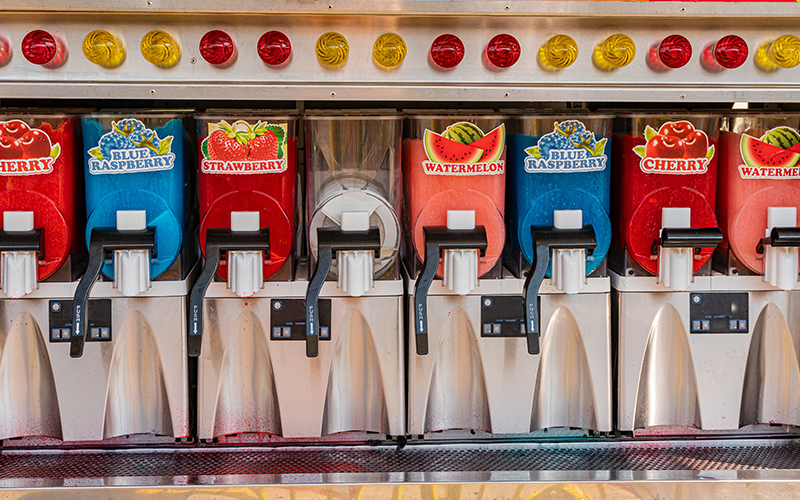
Remind me again what slush-ice drinks are? They’re the neon-coloured liquids you’ll often see churning around in large dispensers behind the counter of out-of-home food and drink outlets. They’re an especially common sight at venues popular with young people such as cinemas, bowling alleys and theme parks.
Because children love them, right? Exactly. Many a parent will have experienced how the presence of a slush-ice drinks display turns young minds giddy with delight, not to mention little tongues various shades of bright blue, green, red or indeed any other colour you can imagine.
But now we’re being told not to buy them for kids? Not exactly. The FSA’s new guidance is targeted at sellers (businesses) rather than buyers and is voluntary, not legally binding (although the FSA says it will be monitoring how widely the guidelines are adopted and hasn’t ruled out taking further action in future). The agency has also updated its advice to consumers with the recommendation that children aged four years and under should not consume slush-ice drinks.
So why is the guidance changing now? The FSA recently carried out a risk assessment which found that children below the age of ten may suffer from headaches and sickness caused by exposure to glycerol. The agency also cites two cases in Scotland, one in 2021 and one in 2022, where children were hospitalised because of glycerol intoxication. At very high levels of exposure – typically when several of these products are drunk by a child in a short space of time – glycerol intoxication could cause shock, hypoglycaemia and loss of consciousness, hence the new voluntary restrictions on slush-ice sales.
Why is the advice different for under-5s and under-10s? Because the effects of glycerol are related to body weight. The FSA’s risk assessment and advice considered the average weight of children at different ages and found that those above the age of four are considered unlikely to suffer ill effects from drinking just one slush drink.
Hence why it’s asking retailers to restrict sales of free refills to this age group? Correct. The official line is that “the business model of free refills is not recommended in venues where children under 10 years of age will consume them”.
But hasn’t the government already banned free refills of sugary drinks? Well remembered. Back when the government announced plans to ban promotions of products high in fat, sugar and salt (HFSS) by location and price (including BOGOFs) in its 2018 obesity strategy it said it would also ban free refills of sugary soft drinks in the out-of-home sector – specifically those defined as HFSS or ‘less healthy’ by the government’s nutrient profiling model. The law was due to come into force in October 2022 but was shunted back a year along with the ‘BOGOF’ ban. Then in June, the government announced a further delay to its BOGOF ban until 2025 but there was no mention in the official announcement of free refills. Footprint has subsequently learned that these are also subject to the further delay until 2025.
What else has changed in the new guidance on glycerol? Beyond the advice regarding age-related sales, brand owners are also being asked to formulate slush-ice products to contain glycerol at the minimum quantity technically necessary to achieve the required ‘slush’ effect. They should also ensure customers are fully aware of the FSA’s risk assessment of the use of glycerol, while those selling slush-ice drinks containing the additive should make sure they display a written warning visible at the point of sale along the lines of – ‘Product contains glycerol. Not recommended for children 4 years of age and under’.
So can we expect sales of slush-ice drinks to thaw in future? That will ultimately be up to parents who at least now have an extra excuse in their armoury as they seek to persuade their children to choose a healthier alternative.