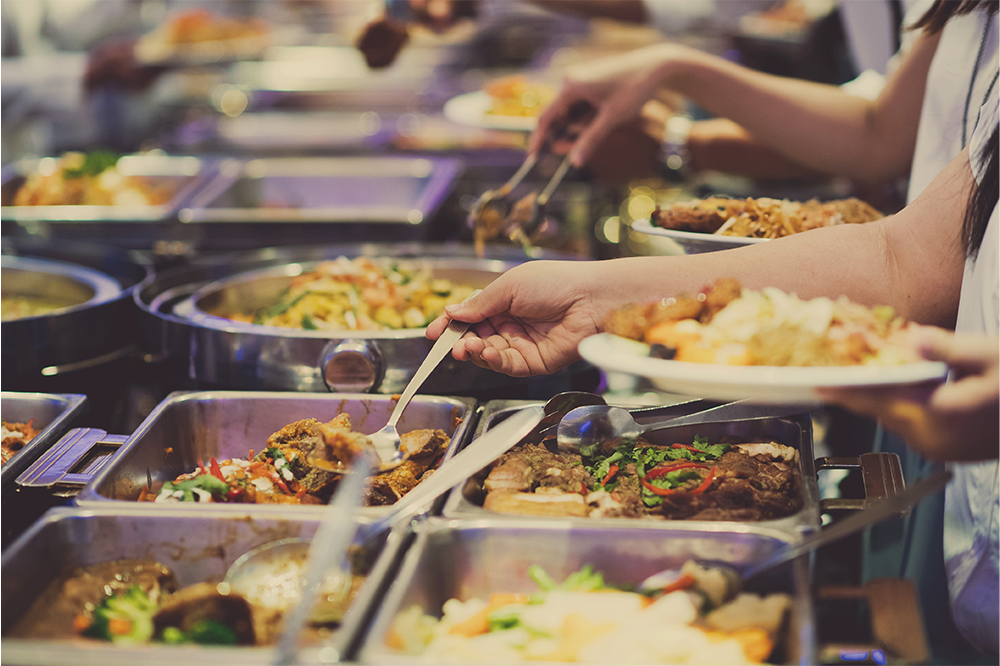
All-you-can-eat buffets generate a substantial amount of food waste at hotels and other venues. But using signs to ask diners to not overfill their plates do not stop the leftovers piling up.
A research team led by experts at the University of Queensland tested several messages on table signs in a survey experiment with 500 people, against a control at a hotel breakfast buffet, where average plate waste per guest was measured in grams.
The messages included:
- a belief-based fact to raise awareness (‘10% of all carbon emissions are caused by food waste. Please take only what you can eat.’);
- a belief-based fact and ascription of responsibility (‘10% of all carbon emissions are caused by food waste. You can help to prevent environmental harm caused by uneaten food that is thrown away. Please take only what you can eat.’);
- a belief-based fact and habit (‘10% of all carbon emissions are caused by food waste. At home, you only plate up what you know you can eat. Keep up this habit. Please take only what you can eat.’); and
- a belief-based fact and effort (‘10% of all carbon emissions are caused by food waste. It takes no effort to go back to the buffet for a second or third time to get more food. Please take only what you can eat’.).
Several messages appeared promising in the survey, the team wrote in their paper for Tourism Management. “However, none reduced plate waste in the field, and two of them lowered guest satisfaction,” they wrote. “With table signs widely used in hotels, this study demonstrates that this might be a risky strategy, which fails to achieve the intended outcome and can backfire in terms of the guest experience,” they added.
This study shows these interventions “do almost nothing”, explained Sophie Attwood, a behavioural science consultant who was not involved in the research. “Across four message types tested against a control in an Australian hotel, there were no meaningful reductions in plate waste,” she added.
Food production accounts for 26% of the world’s total greenhouse gas emissions.