Downton Distillery, set on the West Wiltshire Downs, is proving that premium spirits and sustainability can be inseparable. Founded by former Scots Guards officer Hugh Anderson, the distillery’s mission is simple: to create spirits that give back more than they take. What began as a small rural operation has become a respected example of how circular design and ecological restoration can underpin a drinks business.
The wider drinks sector still runs largely on a linear model: extract, produce, discard.
Heavy flint glass, single-use logistics and imported ingredients remain standard practice. For small producers, the barriers to change cost, scale and supply-chain complexity can appear insurmountable. Yet as consumers demand transparency and regulators tighten environmental scrutiny, the business case for sustainability has become undeniable. Downton Distillery recognised that early. Rather than trimming emissions at the margins, it rebuilt its operations from the ground up around circularity, conservation and local value creation.
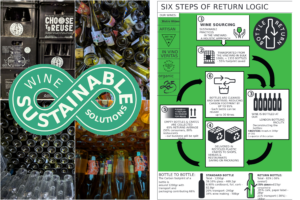
In 2021, the distillery launched its Bottle for Life programme a deceptively simple idea with significant impact. Customers buy a premium recycled-glass decanter once and refill it using flexible pouches made from post-consumer rPET and sugarcane polymer. Each refill cuts emissions by around 80%, lowering per-unit carbon from 2.1 kg CO₂e to just 0.4 kg. The scheme reduces packaging weight, shipping emissions and cost, while increasing customer loyalty through the satisfaction of reuse. The Wine and Spirit Trade Association has benchmarked it as a model for refill systems in the sector.
Beyond packaging, Downton looked to its roots quite literally. Its Orchard Spirits range transforms surplus Wiltshire fruit into Eau de Vie, Apple Brandy and Pommeau, capturing the flavour of the Downs while preventing waste. Working with local growers, the distillery rescues imperfect or excess fruit that would otherwise rot or be composted. Each bottle tells a story of regeneration economically for the farmers and ecologically for the landscape.
The same ethos runs through Great Bustard Gin, which celebrates and funds the reintroduction of Britain’s heaviest flying bird on Salisbury Plain. Through partnerships with the Great Bustard Group and Habitat Aid, Downton contributes directly to habitat restoration and the propagation of native juniper, the very plant that defines gin but has become increasingly rare in southern England. By connecting its product to the land that inspires it, the distillery has built authenticity that few larger brands can match.
Operational changes have been equally decisive. Since 2021, Downton has reduced its Scope 1 and 2 emissions by 83% and now runs entirely on renewable electricity. Distillation waste is reused as compost in the local vineyard or as jams with a local business. Water comes from their local spring and is returned via a seep into the water table. Sustainability is not treated as a side project but as a core performance metric. Results are verified annually and form part of supplier and distributor reporting.
The environmental numbers speak for themselves: an 83% reduction in operational carbon, 80% lower packaging emissions, and more than 100 of juniper plants restored since 2022. The achievements have been recognised across the industry with awards including Gold at the IWSC 2024, Gold at Taste of the West, a Spirits Business Ethical Award finalist place, and the Special Achievement Trophy at the 2025 Drinks Sustainability Awards.
Crucially, these initiatives have strengthened the bottom line. Lightweight packaging and short, local supply chains have cut costs by 15–20%, protecting margins against inflation and logistics volatility. Refill customers repurchase faster and recommend more readily, showing that environmental design can drive commercial advantage. Sustainability is not a moral premium for Downton it is a business model that pays.
For others in the food and drinks trade, several lessons stand out.
The first is to start with systems, not slogans. Rather than chasing certifications or offsets, map your inputs and outputs and redesign for efficiency and reuse. The second is to recognise that sustainability can be a profit lever. When environmental performance aligns with consumer behaviour as with refill incentives growth follows naturally. Thirdly, localisation reduces risk. Regional sourcing and shorter supply chains secure traceability, cut transport emissions and build community trust. And finally, collaboration accelerates innovation. Downton’s network of orchardists, conservationists and material scientists shows that shared expertise can deliver scalable change even at micro-distillery level.
Measurement is the final piece. In an age of greenwashing, transparency builds credibility. Downton’s commitment to carbon accounting, Scope 3 analysis and biodiversity metrics creates data that partners, regulators and consumers can trust. That trust translates directly into resilience: when markets tighten, verified environmental leadership becomes a differentiator.
Looking ahead, the distillery continues to experiment. The ambition is no longer simple sustainability but regeneration producing spirits in a way that leaves the ecosystem richer and more biodiverse than before.
Anderson summarises the mission succinctly: “We’re not chasing carbon neutrality; we’re chasing carbon positivity. The goal is to prove a distillery can enhance its environment, not just minimise harm. Sustainability isn’t an accessory to craft, it’s the craft itself.” It’s a philosophy that resonates with a sector under increasing pressure to decarbonise and demonstrate purpose beyond profit.
Downton Distillery’s journey is therefore more than a boutique success story. It’s a practical roadmap for transformation in the food-service and beverage industry proof that ambition, data and design thinking can deliver measurable gains without scale or corporate budgets.
The business challenges the outdated notion that sustainability erodes competitiveness; its experience shows the opposite. Done right, circular systems cut costs, deepen loyalty and future-proof operations against tightening regulation.
In a market flooded with vague eco-claims, Downton stands out for its clarity and conviction. It has turned environmental responsibility into brand value, backed by data not rhetoric. The message for the trade is direct: stop treating sustainability as compliance and start treating it as strategy. Those who adapt early will define the next decade of growth; those who wait will be forced to catch up. Downton Distillery has shown that small can be mighty and that genuine circular craft can lead the way to a more resilient, regenerative drinks industry.
And for anyone wanting to see proof of this impact first-hand, it can be witnessed on Salisbury Plain. The Great Bustard Group runs guided visits where visitors can observe these extraordinary birds thriving once more in their natural habitat a living, breathing testament to what regenerative business can achieve when craft and conservation work hand in hand.