With two state-subsidised restaurants due to open in Nottingham and Dundee, opinion is split over the role they should play in the eating out landscape
In 1940s Britain, as bombs rained down on cities and German U-boats prowled the open seas, Winston Churchill’s government devised a new scheme to help keep people fed.
The idea was state-subsidised restaurants serving nutritious, affordable and popular meals; healthy food for Brits from all walks of life who were drawn to the restaurants by the prospect of eating a tasty meal in a convivial setting.
These ‘British Restaurants’ – so named by Churchill himself to avoid associations with communism attached to labels like ‘community kitchen’ – were clearly popular. At their peak, there were more than 2,000 across Britain – almost as many as there are Greggs outlets today – some serving thousands of meals a day.
While in the UK they eventually closed under mounting political and economic pressure, elsewhere in the world the idea of public restaurants is still going strong. Now, calls are mounting for the UK to rejoin the ranks with a new report backed by leading economists calling on the government to open 9,500 government-funded restaurants.
So are we set to see a revival sweep the British high street?
Public infrastructure
For José Luis Chicoma, a senior advisor to the UN, the argument in favour of public restaurants is fairly straightforward. Food needs public infrastructure just like healthcare, transport and education. We build hospitals and schools because the market alone does not guarantee adequate access. We also build public libraries, public parks and public transit; “So why not public restaurants?” he asks.
But if the UK were to bring them back, it would first need to decide exactly how they’re run. In Turkey, public restaurants are run by local municipalities who do everything from hiring staff to developing menus, while Polish ‘milk bars’ are privately run but sell a small range of publicly-subsidised meals at a lower price on the menu. In Brazil, they are primarily health-focused and serve nutritious meals using produce sourced from local family-owned farms.
The early British Restaurants could also offer a framework for today. Back then, all restaurants had to comply with national nutrition standards, set prices at two thirds of commercial alternatives and pay workers a nationally agreed union rate.
“There’s lessons in the skeleton of what that program was because it was one of the first provisions of the modern British welfare state,” says Abigail McCall, the coordinator of an international network for public restaurants.

Pilot sites
Two pilot sites in Dundee and Nottingham are about to open and will perhaps give the best indication yet of the feasibility of public restaurants in modern Britain. Anna Chworow, deputy director at Nourish Scotland which is running the Dundee trial, says the restaurants will be embedded in their local community and run by a not-for-profit caterer.
That means prices will not be so high as to price people out but not too cheap either to avoid sending the wrong message – that the restaurants are designed purely for people experiencing food insecurity. Chworow suggests prices for a main meal will probably land around the £5 mark. There might also be concessions and loyalty schemes.
For the menu, there will likely be one meat and one vegetarian option each day, perhaps with a soup and salad as well. The main thing people say they want is home-style cooking and recognisable dishes, Chworow says. “It’s not a fancy fine dining experience. It’s just what you might cook at home but you don’t feel like it so eat there instead.”
How the restaurants feel inside will be just as crucial as what’s on the menu. The researchers behind the Dundee and Nottingham trials are putting a major focus on ensuring they feel like places everyone would want to eat and avoid the potential stigma if they come to be seen as emergency-style soup kitchens.
This was also a priority for the early British Restaurants back in the 1940s which were seen as vehicles for raising morale, writes the food historian Peter Atkins in his book ‘Communal Feeding in War Time’. This meant paying attention to interior design features like décor and lighting, while some restaurants had live music playing and newly painted murals on the walls.
Diners will also be able to eat locally-grown produce with both restaurants planning to source at least a quarter of their food from nearby agroecological producers. Nottingham is facing a slight obstacle, however, with the team struggling to find enough local producers.
“There’s a lot of capacity building to be done but public restaurants would be a good end point for that food,” says Marsha Smith, a researcher running the trial at Nottingham University.
‘Ludicrous idea’
How should private sector operators view the idea for public restaurants? For some, the idea alone poses a direct threat to a sector already buckling under the weight of surging costs and falling customer numbers.
Hugh Osmond, the co-founder of Pizza Express, told The Telegraph last year that plans for government-backed restaurants were a “ludicrous idea”, arguing they would “cost a lot of money, provide absolutely terrible food and, in the end, fail”.
Gail’s chairman Luke Johnson said in the same article the industry was already “highly competitive” and “the very idea that state-backed restaurants could operate more efficiently than the private sector is surely a bad joke”.
Such concerns are understandable. Many restaurants are already backing a campaign for the government to cut VAT to help them keep their head above water in turbulent times. It would feel a bitter irony if money from taxation were used to subsidise a rival down the road.
However, advocates of the idea insist public restaurants are not trying to compete with casual dining restaurants themselves but rather the takeaway and convenience industry worth a combined £63bn in 2025, Lumina data shows.
This has dictated the location of the two trials with the Nottingham site deliberately chosen to be away from any family-run restaurants. While it is situated next to a popular café serving tea and cake, these items will not be on the menu to avoid any competition, says Elise Wach, a researcher at the Institute of Development Studies who is involved in the trial.
Ultimately, says Wach, they want to be seen as a public compliment to a strong private sector, much as libraries and book shops happily co-exist, as do cars and public transport, or parks and gardens.
“Private gyms are fantastic but they don’t replace public leisure centres. Book shops are fantastic but they don’t replace public libraries,” Chworow agrees.
The other big potential objection is political. The recent UCL report estimated the annual cost of 9,500 restaurants at £4bn, meaning advocates must both win the ideological argument that the government should pay for people to eat out, as well as a pragmatic argument that this is a better investment than money put into the NHS.
These two trials could at least give some indication on the latter. Each pilot restaurant is receiving £240k from the government to cover start-up costs and daily operations, but the teams believe if customers numbers grow sufficiently then the economies of scale could mean they become self-sustaining. Many British Restaurants broke even within three years of opening, says McCall. If there is clear evidence of local benefits to dietary-related ill health on top of that, then the argument that this is a positive public investment should become a little easier to make.
Community assets
But even if it fails, there could still be another way. Carly Trisk-Grove is a former restaurateur now looking to “prove you can serve really good food at a really affordable price” via her public-interest organisation The Public Plate.
Similar to others, this has led Trisk-Grove to envisage a national network of public restaurants, although rather than rely on state-subsidises, she wants them to be commercially run as social franchises, owned by local communities and more akin to the pubs of old.
“The British Restaurants during World War Two, the main reason they ceased to exist was because they were seen as anti-capitalist,” she explains. “We still exist in a highly capitalised system so I don’t see any value in trying to persuade the state to pay for people to eat out at restaurants.”
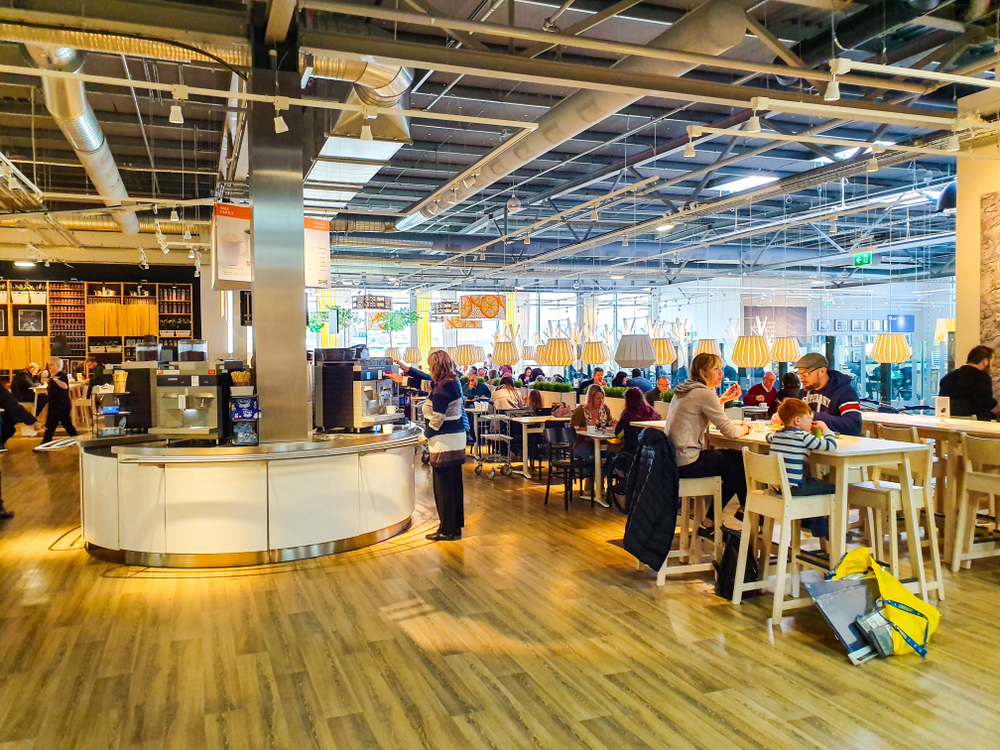
Trisk-Grove envisages big food halls filled with long tables where people go spontaneously after work or school to meet friends and neighbours. The food would be local, seasonal and healthy but the primary selling point will always be the social, she insists. Prices would be kept low thanks to a casual canteen model, similar to that operated by Ikea, while a central team would take care of business support for the entire network.
It’s an attractive vision but one yet to take its first step. While Trisk-Grove believes it could eventually become an investable model, no investor is going to be interested until there’s evidence of a return – something that can only really come once a few restaurants already exist. The same goes for charities. Trisk-Grove is therefore hoping house builders required to deliver social value as part of their developments could potentially provide some early funding. “We can’t keep talking about our high streets being broken but what are the models that are going to fix it?” she asks.
Clearly whether such restaurants are publicly or privately funded, motivated to address food insecurity or social cohesion, there is still a major step to be taken to prove they are feasible in modern-day Britain. And for all the talk of financing models, politics and ideology, and benefits to individual health and wellbeing, their success or failure could ultimately be decided not in Whitehall but on the high-street, where the British public will vote with their mouths.
Further reading
The return of the public diner
The UK Government will provide funding for two public restaurants to be piloted in Dundee and Nottingham from 2026 as part of a UK-wide project to tackle food inequality.

The schools turning canteens into community hubs
Future Foundations has an ambitious plan to scale its social canteen concept across the whole of the UK. School caterers will have a big role to play