
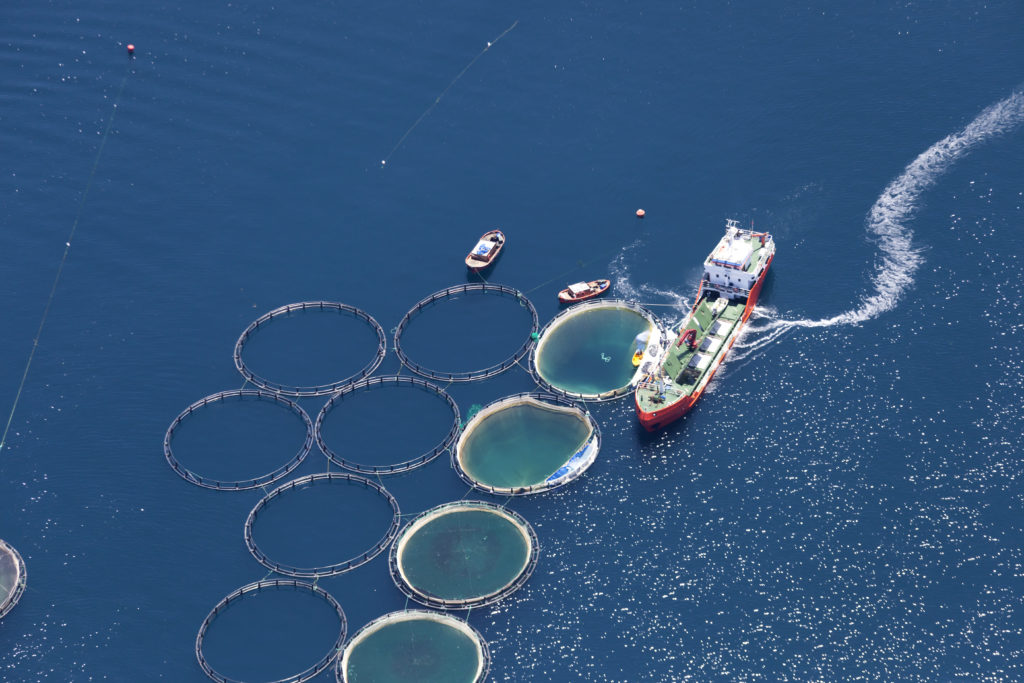
The long-term future of the global farmed salmon industry is at risk from an over-reliance on wild fish stocks for feed, new research has found.
Despite progress in the use of fish by-products as feed sources, five major salmon producers increased their absolute use of fishmeal or fish oil (FMFO) made from whole fish by as much as 39% between 2020 and 2024, according to new analysis by the Fairr Initiative, the global investor network.
Aquaculture is the fastest-growing segment in global food production but without urgent investment in sustainable feed alternatives, Fairr said rising production will continue to put pressure on marine ecosystems, escalating environmental, regulatory and supply chain risks.
With farmed salmon production alone expected to grow 40% by 2033, and with nearly 90% of wild fish stocks already overexploited or fully exploited, Fairr warned the industry faces intensifying pressure to secure sustainable feed sources. It said the sector’s dependency on a limited and increasingly strained resource exposes investors to material supply chain risks that could undermine long-term growth and profitability.
Despite some marginal improvements in feed efficiency, Fairr’s analysis of seven publicly listed salmon producers showed growth in salmon production has outpaced these gains. Only three companies have reduced the proportion of FMFO in feed since 2020 – and none by more than three percentage points.
Five companies increased their total use of fishmeal or fish oil derived directly from whole wild-caught fish over the same period, with Grieg Seafood increasing its use of fishmeal by 39%. The only exceptions were Multi X and Salmones Camanchaca, which use livestock by-products in salmon feed.
“The salmon industry’s reliance on wild-caught fish for feed will continue to cause cost volatility in the near and mid-term as production scales, but feed supply remains constrained,” said Laure Boissat, oceans programme manager at Fairr Initiative. “Without urgent investment in sustainable feed ingredient alternatives, this increased competition for limited natural resources puts profitability and resilience at risk.”
To reduce reliance on wild-caught fish, companies have to-date mainly used two strategies – increasing their use of fish trimmings (the parts that are usually discarded) and novel alternative ingredients like algal oil, single cell proteins or insect meal. Such ingredients have so far failed to gain traction and take on a meaningful market share of feed due to negative trade-offs such as price, scalability, nutrition, carbon footprint and consumer acceptance, according to Fairr.
In the UK, the Soil Association has threatened to stop certifying organic farmed salmon unless progress is made on improving welfare and environmental standards within the sector. It is proposing that organic salmon producers should no longer be permitted to use whole fish from certified sustainable fisheries and instead only able to use sustainably sourced waste and trimmings to feed salmon in marine sites.
Related articles

Will salmon’s growth come at environment’s expense?
As the UK negotiates lower tariffs for exports to India, the body certifying organic salmon has warned of unacceptable welfare outcomes on salmon farms
Does seafood hold the key to future food security?
With land under pressure from food production many believe our oceans can help meet the world’s nutritional needs
