
Foodservice operators have been central to the rapid growth of the business which is bringing regenerative agriculture to a mainstream audience. By Nick Hughes.
“The long road to Greggs” is how Andy Cato wryly summarised the growth strategy of Wildfarmed, the regenerative flour and bread producer that is fast becoming the darling of UK foodservice buyers.
Cato was speaking in conversation with Henry Dimbleby at June’s Groundswell festival, a mecca for regenerative agriculture devotees. Six years after he co-founded the business with former TV presenter George Lamb and city financier Edd Lees, Wildfarmed has arrived at its destination with the bakery chain confirming in April that it is using Wildfarmed wheat in a number of its bread products, including its classic ham and egg roll.
The story of Cato’s unconventional journey from music star (he is one half of the electronic music duo Groove Armada) to regenerative wheat farmer has reached a wider audience in recent months following his starring role in the third series of Clarkson’s Farm.
Wildfarmed also made headlines earlier this year by launching its first branded loaves into Waitrose in another landmark moment for the business, but it is in foodservice where it first seeded the idea that it is worth paying a premium for flour that has been produced in harmony with nature.
‘Concentric circles’
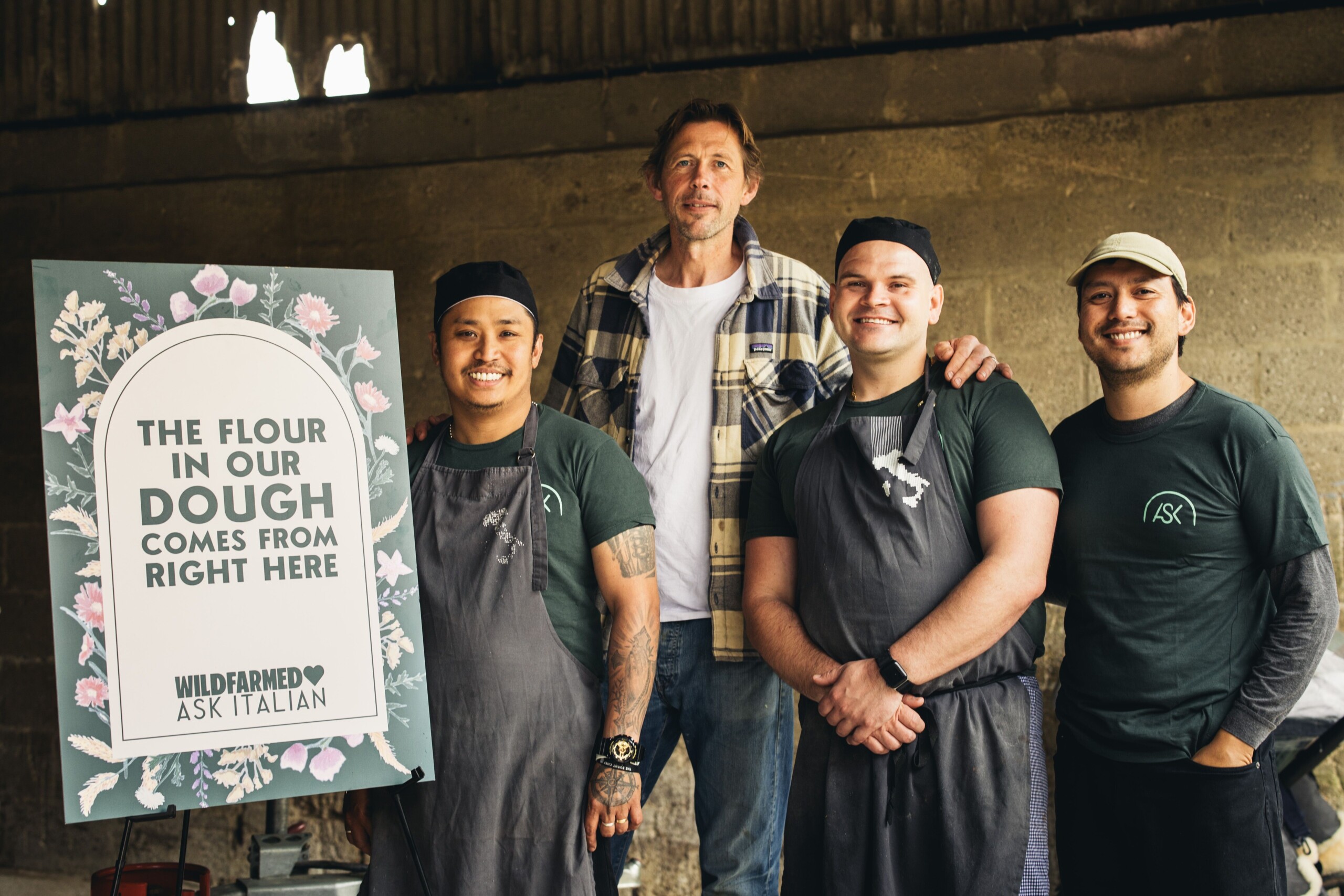
Having started out selling flour produced from the wheat grown by its network of farmers to artisan bakers, Wildfarmed moved on to partnering with small chain restaurants with a social conscience like Franco Manca and Pizza Pilgrims and has more recently started supplying Ask Italian and Zizzi owner, Azzurri Group, along with wholesaler Brakes.
Speaking to Footprint at Groundswell, where the Wildfarmed stand was a constant hive of activity, Lees says this approach was carefully conceived and executed. “In any walk of life – fashion, music, food – there are the taste makers; the people everyone is looking to and saying ‘I want to start doing it like that’. You start with the artisans, then the smaller independents and then it scales out in concentric circles.”
What makes Wildfarmed’s growth especially eye-catching is the unglamorous nature of the product it is selling. Wheat is in many ways the ultimate commodity crop; once harvested it disappears into an arcane supply chain before invariably emerging as a highly processed loaf of bread or breakfast cereal.
Lees says the vast majority of people involved in making and selling cereal-based products “have no idea” where the wheat comes from. Yet Wildfarmed has made businesses think twice about provenance by promoting the quality and taste of regeneratively-farmed wheat as well as the environmental benefits of ditching insecticides, fungicides and herbicides, and adopting practices such as cover cropping and companion planting that help build natural soil fertility without the need for artificial inputs.
Lees namechecks Fever Tree’s marketing slogan – “If ¾ of your drink is the mixer, mix with the best” – to help explain why businesses like Azzurri Group and Franco Manca are willing to pay what is quite a significant premium for Wildfarmed flour. “The pure economics are that the flour, while it’s 70% of the pizza, is less of a cost than anything else – the dough costs less than the topping.” Indeed, Lees says one of the appeals of flour as a point of entry to regenerative farming is that “you can have huge impact levels for the extra amount you have to charge”.
Carbon saving
To illustrate the point, Azzurri Group recently moved to using Wildfarmed flour for all of the dough products sold by Ask Italian including pizzas and garlic bread. “There was definitely a cost premium to it but we absorbed it because it was an incredibly important ingredient to us,” Claudia Candiotto, head of responsible business at Azzurri Group, explained in the recently published Footprint Sustainability Index. “It was a 50% increase in our costs but it was also a 50% reduction in our carbon emissions,” she added.
This carbon saving potential is another key incentive for foodservice businesses to join Wildfarmed on its journey to bring regenerative flour to a mainstream audience. Many businesses within the sector have set targets to slash their greenhouse gas emissions as part of stretching net-zero commitments. Scope 3 value chain emissions typically account for around 90% of the total for a restaurant or caterer, of which food accounts for the lion’s share. That leaves businesses with effectively two options to reduce their food-related emissions: switch out higher carbon ingredients like meat and dairy and replace them with lower carbon ingredients like vegetables and pulses, or source ingredients from lower-impact farming systems.
Figures published last month by Zero Carbon Forum and Wildfarmed suggest that 3.6 million tonnes of carbon could be saved by 2030 if every operator across the UK hospitality and brewing sector switched to regenerative flour and barley by both reducing inputs and sequestering more carbon in the soil.
The science of soil carbon sequestration, it should be noted, is constantly evolving and there are some experts who question the large figures being attributed to it. Lees is happy to concede that the science is not perfect but Wildfarmed has people on the ground at its farms taking measurements as part of its own regenerative standards and he believes “the data is improving all the time”.
Farmer appeal
Arable farmers have been attracted by the opportunity to be rewarded for growing wheat in a way that works in harmony with, rather than against nature. Over 100 farmers across the UK and France – where Cato first began experimenting with regenerative techniques after reading an article about the environmental cost of conventional food production – now grow for Wildfarmed, including David White. The Cambridgeshire-based farmer had been experimenting for some years with direct drilling and cover cropping and says he was motivated to grow for Wildfarmed by a desire to show that growing wheat is possible without chemical inputs and to get paid a premium for farming in a better way and taking more risks. “Wildfarmed solved two of those problems for me,” says White. “They were paying me a premium for my output and, effectively, the premium and the support of the grower group [a network of Wildfarmed farmers who share their collective experiences and learnings] was helping me to learn to farm without “cide” products and eliminate glyphosate in the rotation.”
Wildfarmed is celebrated in food and farming circles as much for its stakeholder engagement as the product it sells. Earlier this month, it invited over 700 bakers, chefs, buyers and restauranteurs to its headquarters at Colleymore Farm, Coleshill, on land rented by Wildfarmed from the National Trust, to see regenerative practices in action.
Brakes is another business attracted by the potential to reduce the environmental impact of the foodservice supply chain in which it forms a key link between producers like Wildfarmed and operators. The wholesaler is now offering its customers a range of artisan breads made with a blend that includes Wildfarmed flour along with a complementary range of Wildfarmed flour.
The decision to partner with Wildfarmed was driven by a combination of demand from customers to reduce the impact of the ingredients they are buying and the potential to contribute towards Brakes’s own sustainability targets. “The biggest influence that we can have in sustainability is what ends up on the plate,” explains Pete Statham, head of sustainability and government relations, GB, at Brakes-owner Sysco.
Statham has been impressed by the way in which Wildfarmed is communicating the value in farming regeneratively. “We’ve been talking about regenerative farming for ages. It’s a geeky term [that] no one really understands, but Wildfarmed seems to have captured the meaning of it and is communicating it in a really effective way that helps people begin to understand why you would do it and the benefits of farming in that way.”
Nutrition discussion
To-date, the environmental benefits have dominated the public discourse around regenerative farming. Nutrition, by contrast, has tended to be absent from consumer messaging around food produced using regenerative practices. Lees says Wildfarmed would like to start talking more about nutrition to help shift the narrative away from protein – a health trend that more than any other has shaped the last decade of food innovation – to fibre. “I think the environmental stuff will work well with big corporations who have made big commitments and need to deliver on those commitments,” he says. “But I think the consumer engagement will come from fibre – high quality fibre from healthier crops that have greater macro and micronutrients. For me that’s a total unlock.”
Another ambition is to make use of the beans that often form part of a wheat bi-crop. Currently there is no end market for them but Lees says a “beans on toast” style collaboration with a supplier like Hodmedod’s or Bold Bean Co would be a dream future scenario.
More immediately, the job is to continue scaling the Wildfarmed brand and building public awareness. “There’s a long way to travel,” Lees says. “If you walked down Oxford Street and asked 100 people, at least 99 won’t know who we are yet.”
With Greggs now having boarded the Wildfarmed wagon, the journey to wider recognition is surely within reach.
