
“Cake out. Lentils in.” So read the headline on the Schools Week website on Tuesday as ministers set out proposals for “the most ambitious overhaul in a generation” of school food standards, with a raft of changes that will limit foods high in fat, salt and sugar.
“The updated School Food Standards set out clearer rules about the food and drink that schools can provide,” the UK Government explained in a blog accompanying the long-anticipated announcement. “They focus on improving the nutritional quality of meals by increasing the amount of fruit, vegetables and wholegrains, and reducing foods that are high in fat, salt and sugar.”
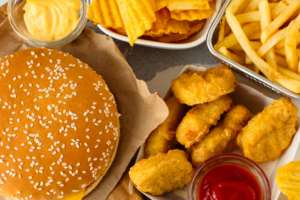
Under the plans – supported by food campaigners, charities and nutritional experts including Bite Back, Tom Kerridge, Chefs in Schools, Emma Thompson and Henry Dimbleby – schools will no longer be able to offer unhealthy ‘grab and go’ options like sausage rolls and pizza every day, while deep fried food will be banned completely. Fruit will also need to be served instead of sugar-laden treats for the majority of the school week.
There are also changes to the requirements to serve certain proteins on three or more days each week. “Schools may choose to serve pulses as a source of protein, allowing for more choice and flexibility,” the consultation reads. “Schools may also choose to use this flexibility to swap some of the meat and poultry served for pulses to enable more opportunity to source higher-welfare seasonal produce, which high quality British producers will be well-placed to supply.”
However, there will be restrictions on the frequency of vegetarian or plant-based products which are marketed as meat alternatives. There will also be limits to the number of times cheese can be offered as a main ingredient.
The government has also pledged to introduce a “national enforcement mechanism” to ensure the new standards deliver healthy change on the plate and in the canteen. At present there is no formal monitoring or reporting system, with the quality of school meals varying widely from one school to another, even within the same local area, according to Sustain.
Sample new menus include “a colourful range of tasty, health-packed meals – including spaghetti bolognese, Mexican style burritos, cottage pie with root-veg mash, jerk chicken with rice and peas and roasted chickpea, vegetable and mozzarella wrap”.
The revised standards, now subject to a 9-week consultation, could be game-changing, helping raise the quality of food provided across England, but only if they come with increased funding for support and training, said campaigners.
A coalition of organisations – Chefs in Schools, The Food Foundation, Bite Back, School Food Matters and the Jamie Oliver Group – have also teamed up to create the School Food Project, which will develop “a holistic support programme that can turn school lunches into a source of national pride”.
The government highlighted how many schools “are already leading the way with delicious, nutritious meals that children love – proof that higher standards are both achievable and popular”. The new standards “level the playing field”, it added.
The proposals were tested at a group of schools in autumn 2025. This showed that some secondary schools face more challenges than primary schools because of their reliance on a ‘grab and go’ food culture, which is often shaped by limited space and tight timetables. Secondary schools will therefore have an extra year to meet certain standards, allowing caterers, cooks and chefs to try out different options and approaches.
Small Bites
Investors push out of home on health
Investors have, for the first time, called for the healthiness of foodservice companies’ portfolios to be reported annually and weighted by total sales volume. In a public statement, the group of 33 investors with over $1.1trn (£0.8trn) in assets under management, noted how the out-of-home sector “plays a significant role in shaping modern diets” and yet transparency on the healthiness of sales remains “extremely limited, lagging far behind that of food manufacturers and retailers, despite high levels of less healthy food sold across the sector”. In an interview with Footprint in 2022, ShareAction, which has coordinated the investor statement, warned that investor scrutiny would intensify. However, attempts at “constructive engagement” with a number of large businesses have to-date failed, according to the new statement. The group called on companies to credibly disclose the healthiness of total sales annually using an internationally recognised nutrient profiling model (NPM), such as the UK NPM, the health star rating, or the nutri-score; and a measure of calories.
Greggs evolves green goals
Greggs has pledged to “explore the right metrics for understanding the healthiness of our sales over time”. The new commitment is included in the bakery chain’s 2025 sustainability report, published this week. A number of the company’s targets have evolved, including a pledge to reduce packaging weight by 25%: “As the work progressed, it became clear that the most responsible path wasn’t simply about using lighter materials, but using better materials,” the report reads; with the focus now on “improving recyclability”. Single-use cups remain the major headache as “the UK’s recycling infrastructure struggles to collect and reprocess these”. Greggs said it continues to work on the Better Chicken Commitment, which a number of foodservice companies recently abandoned. Scope 3 emissions, unsurprisingly, remain a challenge (no total emissions appear to have been reported since 2023), though Greggs has “deepened engagement with suppliers of our most carbon-intensive ingredients (e.g. meat, dairy, cereals and coffee) and high-impact categories (e.g. oils and fats and packaging)”. A strategy on nature is also being developed following mapping work with consultancy 3Keel.
EUDR driving action on deforestation
Talk of a widespread ESG rollback last year is folly – at least when it comes to limiting the risks of deforestation. That’s one of the main takeaways from new data published by Global Canopy, which shows that in 2025 only 14 companies reduced their ambition on deforestation. Indeed, the incoming EU Deforestation Regulation (EUDR) is seemingly steering business expectations, galvanising investment and driving supply chain action by some of the most influential businesses in the deforestation economy. Publicly reported evidence on traceability mechanisms – a key EUDR requirement – increased for eight of the nine ‘Forest 500’ commodities, according to the annual ‘Forest 500’ report. More than a quarter of companies reported forms of implementation action in 2025 which they had not reported in 2024. “The data points to companies gearing up for the prospect of the EUDR even before its implementation,” said Global Canopy research associate Chloe Rollscane. And there is likely more action going on in private, she added, as companies prepare for regulation to bite. Nestlé was among the ‘leaders’ (scoring 71%), with McDonald’s (44%), Yum! Brands (37%), Starbucks (36%) and Ikea (32%) among those with work still to do. Domino’s (28%), Restaurant Brands International (17%) and Subway (6%) lagged further behind. The UK Government was urged to push through its own deforestation regulation, now delayed for almost five years, to level the playing field.
Chef’s Special

Fast food chains have reportedly cooled their interest in plant-based burgers and the like. Whether vegans were ever convinced by lunch under the Golden Arches or at a Burger King is unclear, but the patties were pitched at flexitarians. Indeed, BK’s soy-based version of the Whopper came in for a grilling for the way it was cooked: on the same grill as meat, which wouldn’t appeal to vegans or many vegetarians. New research by Ethical Consumer suggests fast food lovers should also be careful where they buy their chips: “All the fries, wedges, potato tots or potato bites sold by the chains in this guide were vegan in terms of their ingredients. But a couple of outlets – KFC and Pizza Hut, both owned by Yum! Brands – cooked their fries in the same oil as they fried chicken (KFC) or fried dairy products (Pizza Hut). Which makes KFC fries unsuitable for both vegetarians and vegans and Pizza Hut fries unsuitable for vegans.” The analysis also showed Itsu and Pret offer the widest range of plant-based mains (10 and 9 respectively). However, Itsu was among 10 of the 17 chains to not offer plant-based milks.
Last Orders
Coffee shop tastes are changing from sweet to savoury, according to an analysis of hospitality trends by beveragedaily.com. Operators in the out-of-home space tend to be closer to consumers, offering a little more freedom to experiment, and this summer will see them do just that with iced tea (for a nostalgia hit), iced turmeric lattes and ube (aka purple yam lattes). Matcha is also set to remain popular (so popular has the drink been that it almost ‘broke the supply chain’ last year, raising concerns over low quality substitutes flooding the market). Customers are looking for low-sugar, well-made and well-served – and interesting – drinks, Gail’s Bakery operations director Edyta Stec told the website. Will Kenney of 200 degrees coffee said the sweetness of menus past is being swept aside by a demand for more “neutral” flavour profiles. This weekend Glasgow is the place to be for coffee purists as the city hosts its annual coffee festival, spanning everything from barista competitions and the coffee sector’s role in social change to the benefits of using organic dairy milk for your cortados.