
“Fertiliser prices jumped €50-70 per tonne this week. If you’re in food and beverage, this affects you, even if fertiliser has never been on your radar,” explained Ana Maksimovic, an advisor to EU food and beverage brands on sustainability, in a blog published last week. Crude oil has surged in price and fertiliser supplies have been reduced to a trickle as the food system once again goes into ‘shock’ mode.
This time around it is conflict in the Middle East rather than Ukraine that has food companies focused on fertiliser – the input that runs through the global food system and is embedded in pretty much every ingredient that ends up on our plate.
Newspaper ‘op-eds’ relating to the impacts of the US-Israel attack on Iran have snowballed. Meanwhile, the UN Food and Agriculture Organisation has produced a 40-page briefing on the implications of the conflict for global agri-food. “The Strait of Hormuz, a critical chokepoint for oil, gas, and fertilisers, has already seen disruptions that are raising energy and agricultural input costs worldwide,” the paper reads. “Fertiliser shortages and higher energy prices threaten crop yields, while remittance losses and potential shifts to biofuel production could amplify food price volatility, particularly in Africa, Asia, and other import-dependent regions.”
The longer the conflict drags on, the tighter the pinch on these inputs – and in turn business profits – will be. “[…] fertiliser shocks do not register with the same immediacy as oil shocks. Petrol prices change overnight. Crop yields reveal themselves months later. Yet the latter may prove more destabilising,” wrote UN University experts on The Conversation.
Raj Patel, a food system expert at the Lyndon B. Johnson School of Public Affairs at the University of Texas, posted a fertiliser import vulnerability map on his website, showing the chokepoints and seasonal vulnerability of different countries to import shocks. What the map does not show is that “agroecological food systems are resilient to exactly these kinds of geopolitical shocks”, Patel wrote.
Could this mean more grist to the mill of regenerative agriculture? The popularity of regenerative wheat has grown rapidly across foodservice, with positive initiatives also in play for beef and dairy. The savings in terms of chemical inputs, like fertilisers, could be considerable, while improving yields.
Some are yet to be convinced. At January’s Sustainable Foods conference in London, Tom Bradshaw, recently re-elected president of the National Farmers Union, said “we are in danger of victimising fertilisers” as interest in regen ag spreads. And yet once again it is those who rely on them who seem to be left most exposed.
And the knock-on effects go beyond oil, gas and fertiliser. The price of packaging is likely to be impacted too: virgin plastic is made from fossil fuels, while glass and aluminium have considerable energy demands. The availability of carbon dioxide could also be an issue for soft drinks manufacturers and brewers, as well as abattoirs.
Small Bites
Carlsberg reviews sustainability goals
Carlsberg has become the latest food and drink company to adjust some of its environment, social and governance (ESG) targets. The brewer’s target for sourcing raw materials from regenerative agriculture has been increased from 30% to 50%. A 2040 ambition for 100% has been removed “for simplicity”. Instead, the brewer has “one overarching 2040 target of a net-zero value chain. Regenerative agriculture plays a key role in achieving this.” The net-zero target is one of those to remain unchanged, however an interim target to reduce greenhouse gas emissions has been extended by two years following the 2025 acquisition of Britvic. The purchase of the soft drinks manufacturer has added nearly 1MtCO2e to the company’s value chain emissions (a 16% increase). The resulting portfolio of beverages is “more complex”, said Carlsberg in a statement, adding: “To credibly adapt to these significant changes, while meeting the elevated ambition of reducing absolute carbon emissions, the target year for ‘Brewing Tomorrow’ [its sustainability programme] has moved by two years, to 2032.”
Cartons cut carbon according to study
The relative sustainability of drinks cartons versus plastic bottles has long been a source of debate within the packaging community. Now, new data has shown that, at the very least, manufacturers of cartonboard have been successful in cutting their own greenhouse gas emissions. Data released by Pro Carton, the European association of cartonboard and carton manufacturers, shows an 8% reduction in fossil fuel carbon footprint between 2021 and 2024. This means each tonne of cartons produced emits on average 854kgCO2e. The calculations, completed by RISE (Research Institutes of Sweden) and verified by Ifeu (Institut für Energie- und Umweltforschung, based in Heidelberg, Germany), used data from 70 production sites across Europe, representing approximately 60% of European cartonboard production and 16% of folding carton converting. Around 73% of fossil emissions arise during cartonboard production, converting into folding cartons accounts for approximately 21%, while transport represents around 6%. Emissions reductions came from investments in renewable energy sources at the cartonboard mills where there has been a shift away from fossil fuels to biofuels for generating heat and electricity. There has also been an increase in purchasing of low carbon electricity.
Organic enjoys growth – but not in foodservice
Sales of organic food across the UK foodservice sector fell 1.5% in 2025, according to figures compiled by Soil Association Certification. The 2026 ‘Organic market report’ showed overall sales of organic have increased 4.2% to £3.9bn. The major driver of this growth has been in supermarkets, with sales up 7% as grocers expand their ranges and promote more organic products. “Hospitality had a mixed year,” the report reads. “Cost-of-living pressures reduced high street footfall, while Food for Life’s success in Scotland demonstrated how public procurement can offer huge opportunities for organic in settings such as schools and hospitals.” Last year, the Food for Life Served Here scheme celebrated 15 years of bringing more organic food into schools, hospitals and workplaces. It bucked the wider foodservice sector trend with a record year: driving an expected 1.5 million meals in 2025 – a quarter of a million more than in 2024. Overall, the UK organic food and drink market has registered its 14th year of consecutive growth and doubled in value in the last decade. The positive results in the UK reflect “the strong consumer demand for healthier, more nature-friendly food”, said Soil Association Certification commercial director Alex Cullen.
Chef’s Special
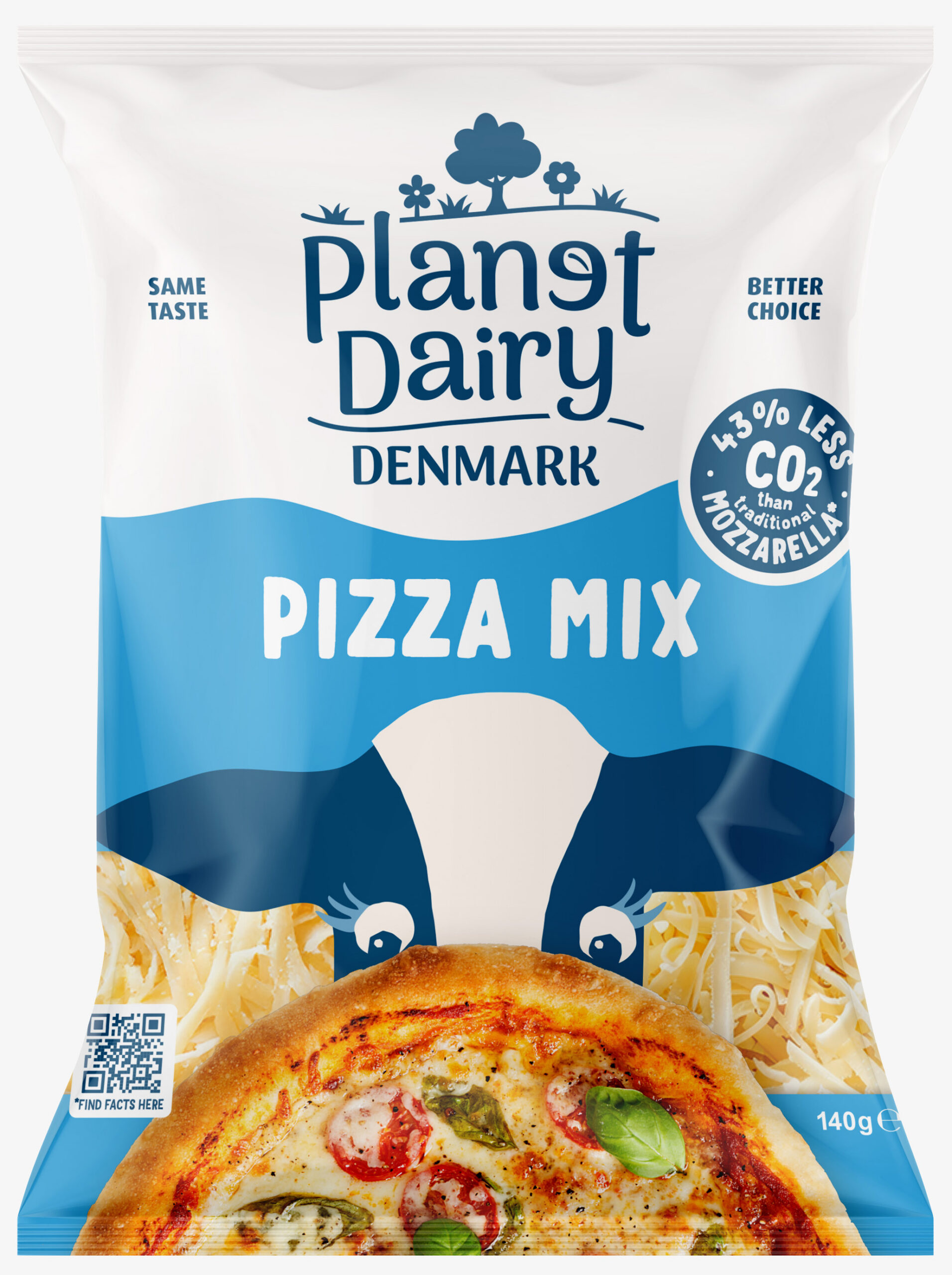
Hybrid meat and dairy products are gaining market momentum as businesses seek to offer customers lower-impact alternatives to pure animal proteins that don’t compromise on taste. At January’s Sustainable Foods conference in London, Jakob Skovgaard, co-founder and CEO of PlanetDairy, presented his company’s new hybrid milk and cheese proposition. Based out of Denmark, the company blends traditional dairy with plant ingredients such as fava bean protein, potato flour, rapeseed oil, and coconut oil – providing “the best of both worlds”, according to Skovgaard, and a much-reduced carbon footprint. On offer was PlanetDairy’s mozzarella, which boasts a carbon footprint of 5.17kgCO2e per kilo. This is versus 8.58kgCO2e for conventional mozzarella, according to Carbon Cloud, a GHG accounting firm. Footprint asked professional pizza chef and founder of Edinburgh-based East Pizzas, Roland Simpson, to put the product to the test. The hybrid mozzarella “has a butter-like consistency and melts well”, Simpson told us. “Like all of these things, if it’s judged on its own merits it’s good pizza cheese, but it’s not mozzarella. I don’t think that’s a bad thing,” he added, “it’s just apples and oranges”.
Last Orders
Drinks brands should prepare for more packaging pain on the back of the conflict in the Middle East (see main story). With prices for oil rising there will be inevitable impacts on the cost of plastic packaging, which is made from fossil fuels, as well as glass and aluminium due to the energy required in processing. With the plastics recycling sector in a continuing crisis too, maybe more drinks brands will look to paper as an attractive alternative? This is the hope of Frugalpac, which makes a bottle consisting of 94% recycled paperboard, lined with a food grade plastic pouch. In a new report, ‘Reshaping the bottle’, the company claims its bottle produces 84% fewer carbon emissions (92gCO2e v 558gCO2e) and attracts 77% less extended producer responsibility (EPR) fees compared to glass. Sainsbury’s, Aldi, When in Rome and Avallen are among the UK companies to have switched to the paper-plastic bottle for a range of wines and gins.