
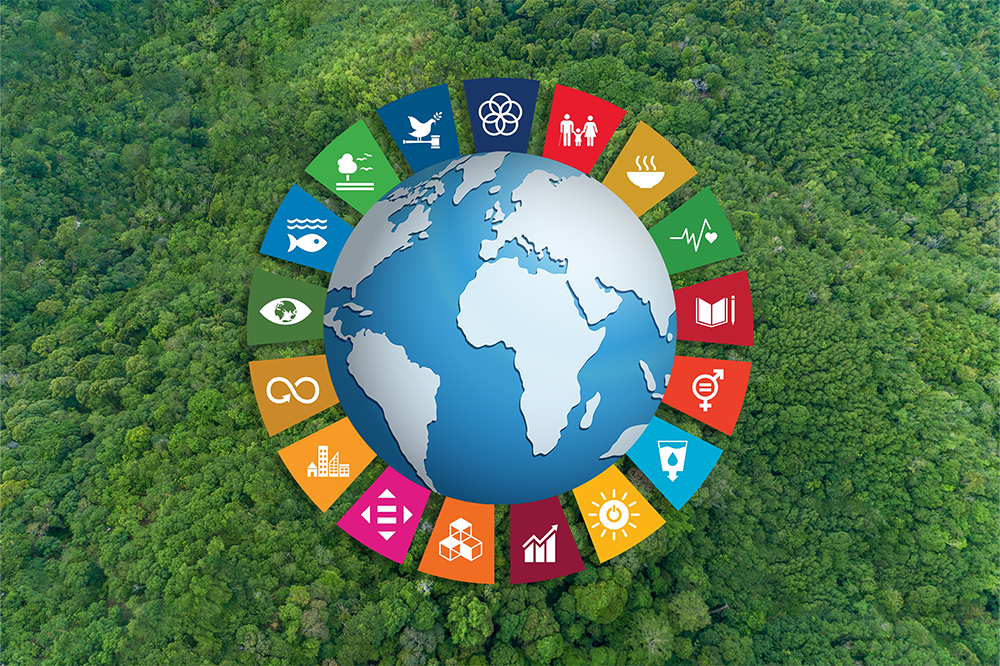
Food-related targets are set to be missed across the board, however sustainability leaders suggest raw data alone doesn’t tell the story of the goals’ value. By Nick Hughes.
As another COP summit looks set (at the time of writing) to close without a concrete commitment to transition away from fossil fuels, it increasingly feels like 2015 was a high water mark for environmental multilateralism. That was the year the landmark Paris Agreement was signed with the aim of limiting global warming to 1.5°C, and the United Nation’s Sustainable Development Goals (SDGs) came into being as “a shared blueprint for peace and prosperity for people and planet”.
Ten years have passed since 17 overarching SDGs were adopted by all UN member states, spanning key environmental and social development goals including zero hunger, gender equality, and sustainable production and consumption. There are just five years remaining until the 2030 deadline hoves into view. Yet, just like action on climate change, efforts by the international community to achieve the goals look like falling well short, prompting questions about how impactful, and frankly how relevant, the SDGs remain.
Food cuts across many if not all of the goals either directly or indirectly. In August, the Food and Agriculture Organisation (FAO), which acts as the custodian agency for 22 SDG indicators spanning six goals, published its latest assessment of progress. It made for grim reading. Just one quarter of the indicators are close to being achieved with roughly half “at moderate distance” and another quarter “very far from being achieved”.
On some key indicators, the world has actually gone backwards. An estimated 8.2% of the global population faced hunger in 2024 compared with 7.7% in 2015. Those affected by food insecurity has also increased to 28% of the global population – nearly 2.3 billion people – versus 21.4% (1.6 billion) in 2015.
Growing food insecurity can partly be explained by instability in global food markets, driven by political tensions, military conflicts and weather-related disruptions to supply that are becoming more frequent and extreme due to climate change. The proportion of countries with moderately to abnormally high food prices is now three times higher, at around 50%, than the average figure (16%) for the period 2016-2019, according to the FAO.
Warning signs
Wherever you look, the warning signs are flashing red on the dashboard. The world remains a “moderate distance” from achieving productive and sustainable agriculture, despite a slight improvement since 2015 thanks to progress in areas like nitrogen use efficiency and crop diversification. The sustainability of global fishery resources continues to decline, while the world has made no apparent progress in tackling food waste. “The available data points to an overall stagnation, if not deterioration, in the progress to reduce food losses,” states the FAO report. This is despite an ambitious target to halve per capita global food waste at the retail and consumer levels and reduce food losses along production and supply chains, including post-harvest losses.
One of the few silver linings is to be found in water use efficiency, which has shown “significant improvement” having increased by 23% between 2015 and 2022.
Failure to keep on-track with the SDGs is not just a food problem. The UN’s latest update shows that only 35% of targets are on track or making moderate progress, while nearly half are moving too slowly and 18% have regressed. “The Sustainable Development Goals are still within reach. But only if we act – with urgency, unity, and unwavering resolve,” said UN secretary-general António Guterres when this year’s progress report was published in July.
UK adrift
It’s important to state these are global figures that may disguise more impressive progress by individual nation states. Many of the indicators for success have been directly or partially translated into national targets thus providing a useful sense for whether countries are ahead of or behind the global SDG curve.
The UK, for example, has signed up to the SDG 12.3 target to cut food waste in half by 2030 but is currently on a trajectory to achieve just 30% by 2030, according to Wrap’s latest progress report for the Courtauld Commitment 2030 (recently rebranded as the UK Food and Drink Pact). Despite improvement in reducing operational food waste from businesses, household food waste remains stubbornly high with the amount of food wasted similar to 2012 levels on a per person basis.
UK progress on emissions reduction remains similarly adrift of where it needs to be. Between 2015 and 2022, Wrap recorded just a 12% overall reduction in food system emissions against a target of 50% by 2030. “This means the future reduction rate would have to double compared to the reduction rate to 2022 in order to meet the Courtauld target,” noted Wrap in its latest annual summary report.
Laying the foundations
Based on data alone, it would be easy to dismiss the SDGs as a failure by their own terms both globally and nationally. Yet at a company level they are seen by some sustainability professionals as having been key to building the foundations of their own ESG strategies.
Back when the SDGs were first adopted, WSH sustainability director Mike Hanson was involved with the UK Stakeholders for Sustainable Development (UKSSD) platform that was created with the aim of driving progress towards the goals in the UK. “We had all of the goals and indicators laid out on a spreadsheet,” he recalls. “It gave you an opportunity to look at your own business and understand how you were contributing to each of the targets. In hospitality, we play a part in everything: whether it’s zero hunger, climate action, or life on land.”
WSH has since established its own ‘Second Nature’ strategy based on four pillars closely related to the SDGs. Although Hanson suggests the business has “moved on” from focusing on the SDGs specifically, he still uses them as a “check in” to ensure WSH continues to address a broad spectrum of environmental and social issues.
Perhaps there’s an argument to be made that the value now of the SDGs is less about the indicators themselves and more about the impetus they provided for businesses to embed ESG within core business strategy, albeit that impetus risks being lost amid growing political opposition to net-zero, DEI (diversity, equity and inclusion) and other core ESG pillars, and a watering down of commitments by certain companies.
Food leadership
The Global Compact Network UK, which took on the work of UKSSD when it folded during the Covid-19 pandemic, published a report in October in which it assessed the performance of six priority UK sectors against the SDGs. It concluded that the “consumer staples” sector, in which food and drink is the mainstay, is the only sector demonstrating leadership across all SDGs, “suggesting companies are embedding sustainability across business models and value chains”.
As an example, the report cited private sector momentum behind regenerative agriculture (supported by public policy for nature-friendly farming like the Sustainable Farming Incentive) and “sector leadership in waste reduction and climate accountability”.
As we’ve seen, national level data (on which the report is light) doesn’t always support such enthusiastic claims. Indeed, the Global Compact Network UK cautions that “datasets are based on small samples, making results more sensitive to outliers”. Moreover it acknowledges that certain goals, like ensuring access to nutritious food, remain a challenge for businesses.
So are the SDGs still relevant in 2025? The unsatisfying answer is, yes and no. There seems little doubt they have focused the minds of governments and businesses on where their focus should lie (notwithstanding gaps in areas like animal welfare), yet most of the targets are almost certain to be missed and 10 years into their lifespan the structural barriers to delivering the goals remain stubbornly in place. As the FAO report notes: “Countries across the globe are grappling with an array of complex and interconnected challenges, including ongoing conflicts, health crises, biodiversity loss, the escalating impacts of climate change, and political and economic tensions. These multifaceted challenges are having profound effects on the goals.”
Multilateral efforts to address these challenges continue, but they feel increasingly impotent when set against the ascendant forces of nationalism and protectionism. The US Government, lest we forget, didn’t even send a delegation to COP30.
The SDGs were designed to act as a north star for sustainable development when they were created in 2015. That star is fading fast. It’s the obligation of governments, businesses and citizens to ensure it doesn’t disappear from view entirely.
