
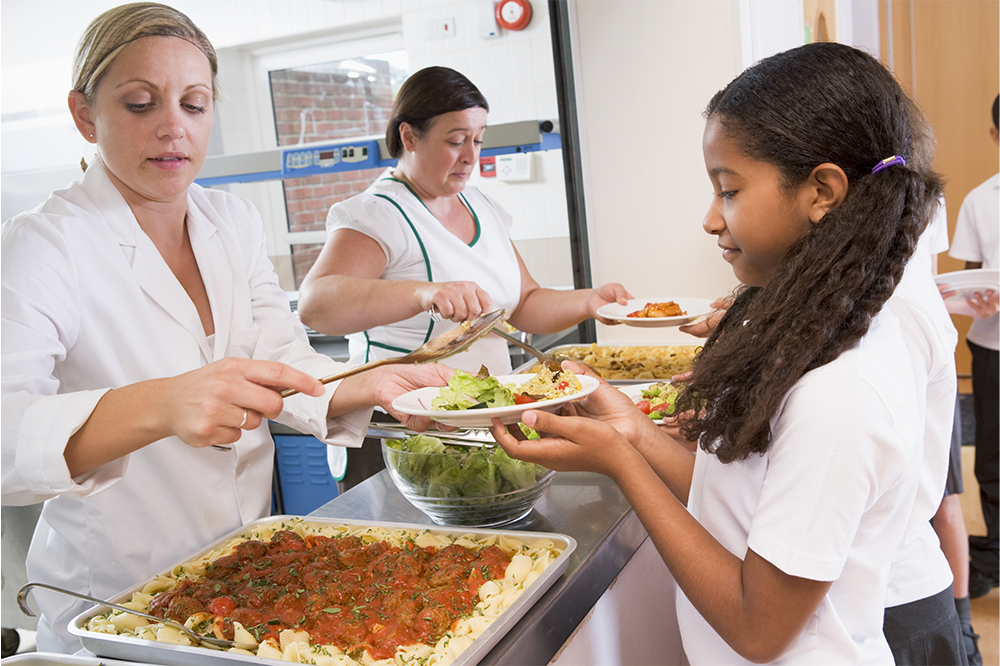
Plans to improve the nutritional quality of school meals have been widely welcomed by campaigners but businesses worry that the sums won’t add up
In a primary school in Portsmouth just before Christmas, a young child opened their packed lunch to find two packets of biscuits and a can of Guinness 0.0.
The shocked teachers phoned the parents to ask why they’d sent their child to school that day with a large can of stout. But the parents didn’t see the problem – it was a zero-alcohol beer after all.
In the end, the teachers were left shrugging their shoulders, unsure of how to deal with such a situation. But for many school food experts it will have served to illustrate a now familiar point: that a hot school meal – as opposed to a packed lunch – can often be a child’s only opportunity each day for a nutritious meal.
That is why proposals for healthier school meals received widespread approval when launched back in April. A raft of changes to school food standards in England will see further restrictions to foods high in fat, salt and sugar and requirements to serve more fruit, vegetables, wholegrains and pulses.
There is little argument that school lunches containing fewer pizzas, more fruit and veg, and a bit less sugar is a good idea. But good ideas do not always translate into effective policy. In this case, many school caterers worry the standards are broadly unworkable without additional funding and education. They fear the new rules run the risk of some children going hungry, others eating more junk food, and well-intentioned school catering providers sinking further into the economic mire.

Other experts are more upbeat, believing stronger school food standards can lead to an improvement in children’s health over the longer-term so long as they are not treated as a silver bullet solution.
‘Commercial suicide’
For school meal providers already operating on wafer-thin margins, the requirement to adhere to stricter standards poses an extra financial headache. “From a public health perspective, the standards are great,” says a director at a major school caterer, speaking on condition of anonymity. “But from a business perspective, some changes are commercial suicide.”
The financial strain felt by caterers is already affecting children’s health. Amid a shortfall in funding and soaring costs, some caterers say they have already been forced to cut portion sizes and withdraw ingredients from kids’ plates. “At one point last year, we took broccoli off the menu completely,” says the director. “It was just too expensive.”
The fear is the new standards will exacerbate these pressures even further. This is partly due to the higher cost of sourcing healthier ingredients with the likes of brown rice and wholewheat bread often costing more than their white alternatives. Similarly, the requirement to serve fruit and yoghurt as a dessert will likely be more expensive than flapjacks or cakes, caterers say.
But the challenges go beyond just the food. The new proposals require schools to offer a portion of salad or veg with every meal, including a mid-morning ‘grab and go’ option. In one caterer’s initial trial, they served a tomato salad alongside a breaktime panini. The salad was largely ignored by the students, yet it still created additional costs for ingredients, packaging and labour.
All in all, several caterers told Footprint they estimate the new standards will add at least 20% to their current costs, yet so far there has been no mention of extra funding. The government has previously announced it will raise the amount given for each free school meal in England from £2.61 to £2.66 in September but has made no additional funding commitment linked to delivery of the new standards.
As well as escalating costs, caterers also fear falling incomes. Twelve English schools piloted the rules last year on behalf of the government with the companies involved nearly all reporting fewer children eating the meals as a result.
One primary school in Brighton saw uptake fall 15% during a six-week trial, according to Luke Consiglio, CEO of The Pantry, while another primary school dropped out after three weeks over fears children were going hungry.
As a result, the government has already tweaked the proposals, watering down a requirement for one day’s food to be entirely pulses-based to one that requires pulses to be served as an option one day a week. This means schools could still offer a beef bolognese with lentils in it, for example, as opposed to pulses being the primary source of protein that day.
In primary schools, another concern is that parents will see the loss of daily sweet puddings as a loss of value, with fruit judged to be less worthy of the expense of a school meal. “The fear is it makes it much less attractive to families and young children in terms of what they perceive a meal to be,” says Brad Pearce, managing director of co-op provider CATERed and national chair of The School Food People, the sector’s representative body.
There is particular concern among caterers about the impact on secondary schools due to their widespread reliance on a ‘grab and go’ food culture. This was recognised by the government in its proposals with secondary school caterers granted an extra year to phase-in healthier options.
Cheese is one of the biggest concerns as the new rules state schools must limit its use throughout the week. As it stands, cheese sandwiches, cheese paninis, and cheese and tomato baguettes are prolific in school food, leaving some shelves looking rather sparse in the government-backed trials. “We’re likely to see students not happy with the new range of food and so making a decision to get the food from elsewhere,” predicts Pearce.
Caterers fear this will also be true for drinks if they can only offer water, milk, and sugar-free drinks from 2028 as planned. While the existing standards already prohibit soft drinks like Coca Cola, some schools in the trial sought to take it one-step further by restricting the options to just milk and water.
“We make so much money on drinks,” says the big caterer’s director. “And I don’t think they should be having [flavoured drink] at school but a lot of kids will end up buying a Coca Cola on the way to school as opposed to a Radnor Fizz.”

Fear not
Of course, no-one wants to see teens ditching school meals in favour of a takeaway Coke and fried chicken. Fortunately, there is good reason to think such fears may be overblown.
Naomi Duncan, chief executive of Chefs in Schools, told Footprint’s The Small print podcast recently that schools the charity is working with are already serving the kind of meals required in the new standards and are not seeing a drop in demand; on the contrary “we’re seeing an increase in uptake”. She encouraged schools “not to go really hard and do it all on day one” but rather to “introduce kids to new flavours and menu items over time”. A phase-in period of over a year allows caterers to do just that.
Myles Bremner, CEO and founder of consultancy Bremner & Co and director of the original school food plan for England back in 2013, says he is wary of reading too much into short-term trials that show a drop-off in school lunches. “When school food standards were first introduced following Jamie Oliver’s campaigning, uptake did go down but then it went up and it continued to go up,” he says. “And actually, if you look at the long-term curve, the initial dip was more than compensated by the longer-term uplift.”
The reason, Bremner argues, is that it takes time for chefs to understand what the new standards mean in practice, to develop tasty recipes at an appropriate cost, and support children if they are being introduced to new foods.
“It involves the commitments of schools to persevere with children and provide effective food education, training, guidance, and support. Without that, standards are fairly meaningless,” he suggests.
Few caterers disagree with this but there are concerns over how long it will take. Most of the changes come into force from September 2027 meaning even if uptake does slowly rebound, there could still be a financial hit in the meantime.
“If it was a five-year plan that included education for parents, students, and head teachers, then yes I think that would work,” says Bryan Lygate, chief operating officer at Impact Food Group.
As it stands, however, Lygate fears the extra cost will place a burden on all parts of the school budget. “The English system is very commercial so services need to be viable. If not, the school is paying a subsidy towards that.”
That means a drop in income could force more schools to divert funding away from teaching and other classroom necessities, he says.
“If someone says we will give more funding to supply nutritious foods, schools would buy into it. But at this point in time, schools are not because a downturn in sales means they will have to fund the service.”
Tougher enforcement
Under the current standards, this is not necessarily a huge problem. While mandatory in theory, a lack of enforcement means schools can often feel under little pressure to implement the rules properly.
“Secondary schools are where the current standards fall down,” says Pearce. “Most probably won’t be applying the standards.”
That is why the government’s latest proposals include a new system of enforcement, including the possibility for schools to appoint a lead governor responsible for school food across the board.
It is a mighty ask, however. There are around 30,000 schools in the UK and the government must somehow find enough enforcement officers to monitor them all from a standing start. Trials have seen responsibility fall to the Food Standards Agency (FSA) but local councils say they cannot afford to add the extra workload onto their existing teams, Footprint understands.
It therefore leaves the sector waiting for clarification about how it’s all going to work with some already doubting the feasibility. “[Enforcement] is the area that always gets cut,” says Henry Leveson-Gower, a former Defra advisor who suggests giving more power to parents to complain.
“They have an interest in monitoring food and what’s happening. Whereas you’re going to have an inspection once a year and the schools can always just say: ‘that was a bad day, come again and we’ll do better.’”
It is one of several problems still to be resolved as the clock ticks down to the launch of the new standards next year. More positively, there is strong consensus behind the end-goal of ensuring more children get reliable access to a healthy meal. The main area of disagreement is over how difficult it will be to get there.
Further reading

Ministers set out proposals for “the most ambitious overhaul in a generation” of school food standards, with a raft of changes that will limit foods high in fat, salt and sugar
The new School Food Standards for England: the good, the gaps and the consequences
School food standards in England are set for their first overhaul in over a decade following the publication of a government consultation
