Despite a New Year charm offensive by government ministers, 2026 looks set to be another challenging year for farmers with implications for the entire food system. By Nick Hughes.
Every year, the trade journal Farmers Weekly asks its readers what was the greatest challenge they faced over the past 12 months. In each of the last three years, “extreme weather” has occupied the top spot.
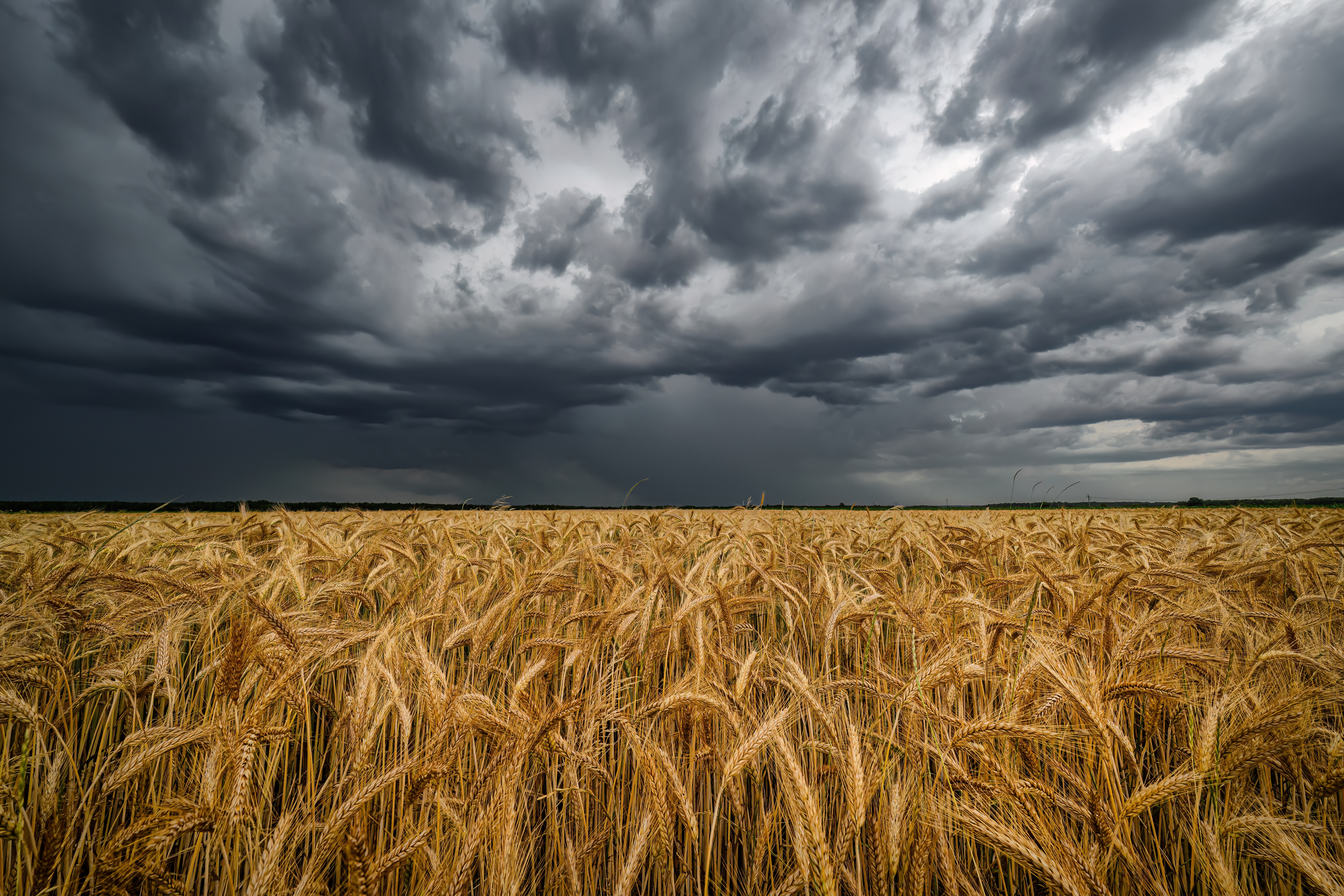
This should come as little surprise given the havoc extreme weather has wrought on recent harvests. Having suffered the wettest winter on record in 2024/25, farmers entered the spring of 2025 hoping for a change in fortunes but instead found themselves faced with the UK’s warmest and sunniest year on record. Drought-affected arable farmers lost an estimated £828m in revenues, according to the Energy & Climate Intelligence Unit, while livestock feed prices soared as grass failed to grow.
Four of the five warmest years on record have now occurred since 2022 (the fifth was 2014), a statistic the Met Office says would be virtually impossible without climate change.
Beyond the effects of persistent heat and drought, 2025 also featured four storms that brought extensive, heavy rain to regions of the UK causing severe, localised flooding, including the most powerful wind storm – Éowyn – for over a decade.
Yet when farmers were asked by Farmers Weekly to predict the greatest challenge they expect to face in the 12 months to come, the weather took a backseat. Just 8% of respondents cited floods, droughts and storm-force winds as their primary concern for 2026 compared with 50% who cited government policy.
How to explain such apparent dissonance where the impacts of climate change are concerned? Perhaps farmers have already baked in the inevitability of extreme weather so that it no longer counts as a distinct challenge? Perhaps the politicians in Westminster who spend their days hiking taxes and imposing regulations are a more visceral target for farmers’ ire?
Whatever the reason, 2026 is set to be another challenging year for the farming sector with extreme weather just one of a range of headwinds whose impacts will blow along the supply chain to manufacturers, retailers, foodservice and hospitality businesses, and ultimately the general public.
New deal for farming
In her newly published Farming Profitability Review, former NFU president, Baroness Minette Batters, meticulously laid out the assortment of challenges ranging from government policy, including loss of direct payments and changes to inheritance tax, to complex regulations, problems in the planning system, uneven trade deals, access to a reliable workforce, and power imbalances in supply chains.
She called for a “new deal for profitable farming” that recognises the true cost of producing food and delivering for the environment, and urged the UK Government to put farming at the heart of Defra, as it was under the Ministry of Agriculture, Fisheries and Food (MAFF, which was dissolved in 2002).
Batters’ review contains no fewer than 57 separate recommendations but it’s the first of these – calling for a reappraisal of the value of farming – that cuts to the heart of why many people feel farmers have consistently received a raw deal from politicians.
“In my time at the NFU, the one question that often had a recurring negative answer from Whitehall, was asking if farming matters,” wrote Batters. “The answer often was, ‘no, because it’s only 0.6% of GDP’ (gross domestic product).”
A key theme running through the entire review is that agriculture simply doesn’t garner enough interest in Westminster due to an institutional preoccupation with one single metric – GDP. Farming’s paltry contribution to the economy is dwarfed by that of manufacturing (16.7%) and the services sector (72.8%). When economic growth is the guiding principle of the government of the day, is it any wonder that farming is treated with such apparent disdain?
Batters wants the full value of farming to show up in GDP by having official data measure the value of primary and secondary food processing alongside agricultural output. But more than that, she wants to see a fundamental reassessment of why farming matters and why its value can’t be clinically reduced to measures of pounds and pence, but must also encompass nature, biodiversity, water quality, public health and other wider indicators of economic and societal wellbeing.
She points to deteriorating health and the impact of treating diet-related illness on an already stretched NHS and suggests part of the solution lies in a “dietary step change” that restores whole foods as the foundation of the national diet. “The intrinsic metric for the 10 Year Health Plan for England should be increasing sales of fresh, whole food, grown here [in the UK], including the production and consumption of more fruit and vegetables,” writes Batters.
Foodservice focus
Some of the review’s recommendations have direct relevance to out of home food businesses such as caterers, restaurants and pubs. Batters wants the groceries supply code of practice (GSCOP), which governs fair trading relationships between supermarkets and their suppliers, to be extended to the out of home sector. She also wants businesses to provide greater transparency around the origin of food sold via the sector as part of a push to buy more British produce.
The government, meanwhile, should show the way in increasing demand for home-grown food by updating the government buying standards for food and catering services. A year ago this month at the Oxford Farming Conference (OFC), former Defra secretary of state Steve Reed pledged that Labour would bring forward a requirement that 50% of public sector food is produced locally or to higher environmental standards and to introduce monitoring of where public sector food comes from. Twelve months on we remain none the wiser as to what this policy will look like in practice. When asked about the pledge at this year’s OFC, held last week, Reed’s successor Emma Reynolds said only that “we are working on that across government” with the Cabinet Office taking the lead.
Farming and food board
This is set to be a blockbuster year for food and farming policy with a new 25-Year farming roadmap, a final land use framework and food strategy delivery paper all expected within the next 12 months. Labour’s first play of the New Year has been to establish a new Farming and Food Partnership Board, tasked with driving growth, productivity and long-term profitability across the sector. It’s a direct response to Batters’ call for closer collaboration between farming, industry and government, and for greater clarity and certainty for farm businesses looking to grow and invest. A key focus for the board will be to develop bespoke plans for sectors, like horticulture and poultry, “where there is significant untapped potential to increase home-grown production”, according to Defra. (The animal welfare and environmental implications of increasing UK poultry production were strangely absent from the government press release).
Setting up new advisory groups is a favourite pastime of governments, not least when they want to kick the can of real reform down the road. To the trained eye, the Farming and Food Partnership Board looks conveniently close in purpose and ambition to the Food and Drink Sector Council, the Defra-led stakeholder group established by the Conservatives which has quietly ceased to convene since Labour came to power. The last meeting of the council took place in October 2024 and Footprint understands a formal update on its future is expected soon.
Cynicism aside, what can’t be questioned is how the government is seeking to build bridges with farmers following a fractious 2025. Reynolds’ speech in Oxford last week struck a notably conciliatory tone and was smattered with announcements designed to grease the wheels of a more cordial relationship with the sector. A new £30m farmer collaboration fund will support groups of farmers to build partnerships and share best practice, while reforms aimed at simplifying the Sustainable Farming Incentive, which was abruptly closed last year, will be accompanied by two new application windows in 2026. These follow the announcement before Christmas that the threshold at which farmers start paying inheritance tax will increase from £1m to £2.5m following a fierce backlash against the original proposal.
“Good governments listen. And when they hear real concerns, they act,” Reynolds told delegates in Oxford.
Farmers are telling the minister that their sector isn’t properly valued. Will she listen? And, if so, can she and her government colleagues deliver real change within a political system still in thrall to narrow measures of economic success? Events of the next 12 months will go a long way to providing us with the answers.