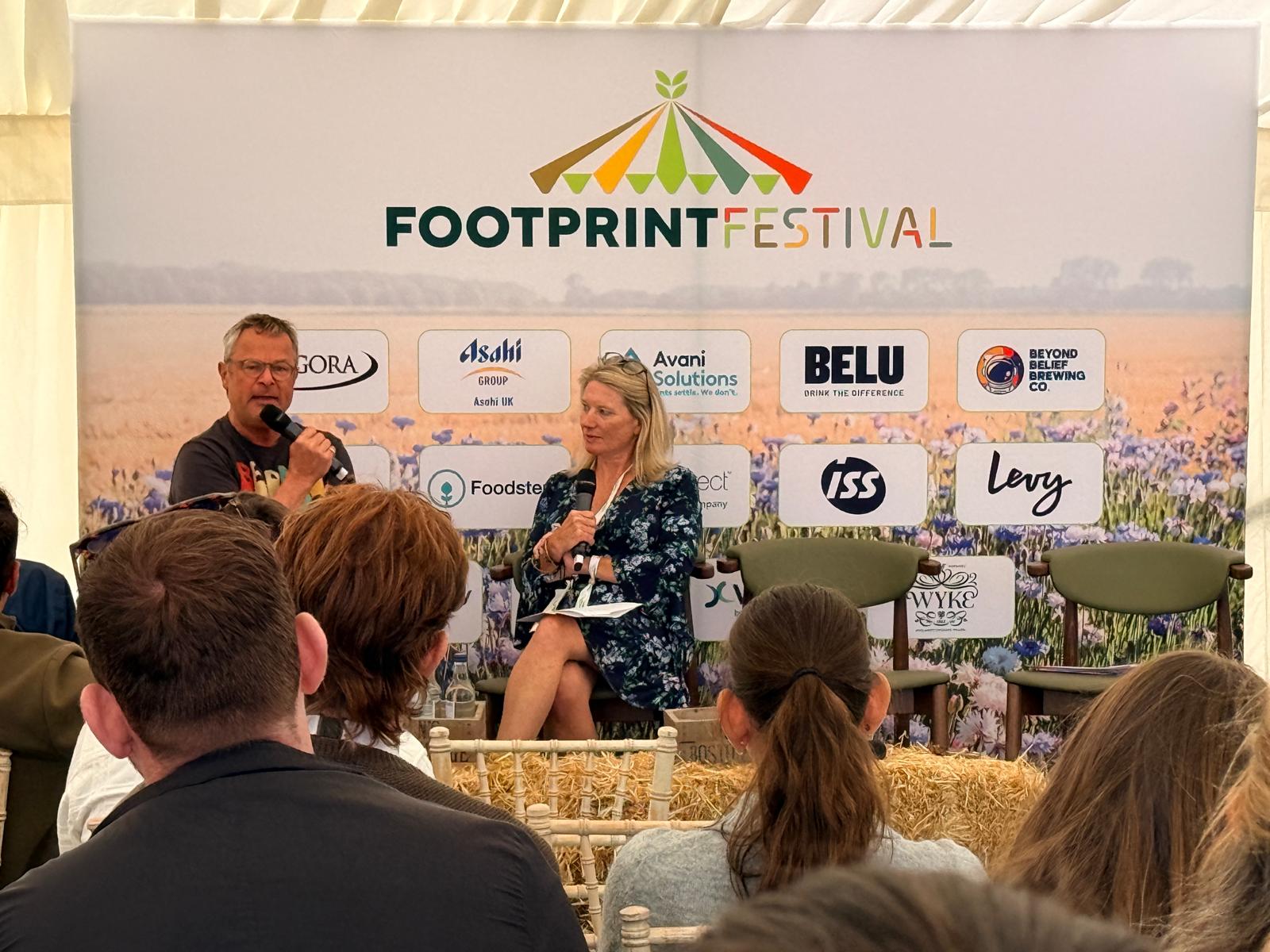
The stage was set at Barnsgrove in Hampshire last week for the inaugural Footprint Festival. Professionals from across the worlds of business, policy, civil society and academia came together to explore the Future of Sustainable Innovation in Foodservice & Hospitality. And what a memorable two days it was, with a programme packed full of speaker sessions, presentations, workshops, culinary demonstrations, entertainment and so much more. In this week’s episode, Nick is joined by Footprint’s director of insights and special projects Amy Fetzer – who masterminded the festival’s programme – to mull over some of the key takeaways from the event and hear the reflections of those who took part.
Subscribe to the podcast



Transcript
Amy Fetzer: What we had tried to do with Footprint vestment is bringing the kind of diversity of opinion. So to get, you know, the different parts of the value chain, the suppliers, the farmers, the. The operators and the different types of operators, you know, we had the commercial hospitality and the casual dining and the fine dining, as well as the contract caterers, and kind of see how all those people, you know, are working together to tackle these issues and how they’re tackling them. So what we wanted is that everybody in the audience to go, okay, you know, that, that applies to me because my voice is up there.
Nick Hughes: Hello and welcome to the Small Print, a podcast by Footprint Media Group. I’m Nick Hughes, Footprint’s Editorial director. Each week we delve beneath the headlines of an issue impacting the hospitality and food service sector through our unique lens of environmental and social affairs. The first ever Footprint Festival took place last week at Barnesgrove in Hampshire. Professionals from across the worlds of business policy, civil society and academia came together to explore the future of sustainable innovation in food service and hospitality. And what a two days it was, with a programme packed full of speaker sessions, presentations, workshops, culinary demonstrations, entertainment, and so much more. In this week’s episode, I’m joined by Footprint’s director of insights and special projects, Amy Fetzer, who masterminded the festival’s programme to reflect on some of the key takeaways from the event. Amy, firstly, how are you feeling three days on from the festival? Have you caught up on sleep yet?
Amy Fetzer: Yes, yes, I have got some sleep, which was a very welcome thing, seeing as I did not get very much at all in the run up. But, no, I’m feeling really good. I mean, what was really lovely is the number of people that came up to me and said, how do you think it’s going? And I kept on just switching it back at them and saying, tell me what you think. I don’t care what I think. And. And everybody just said how much they were getting from it, how they felt the conversations were really valuable and moving the debate on and the connections that they were making with people away from the stages and the food that they were eating. Everybody was, like, wowed by the jolly allotment food offer and what was being cooked up on the. The live kitchen. So I think I’m feeling really happy. I’m really happy because everybody told me they. They got lots of good, good things from it, which is exactly what we wanted. And it didn’t seem like it was an echo chamber. It felt like people got something energizing and tangible out of it. Which is really what we were trying to do from the beginning.
Nick Hughes: Yeah, absolutely. I got exactly the same kind of feeling from speaking to people over the course of the two days. And I mean, there was so much going on across the different spaces, the festival tent and the, the breakout rooms and the, like you say, the demonstrations. How do you reflect on, on what you heard, I guess, over the two days? Because there was so much going on and so much insight shared both in and outside of the sessions themselves.
Amy Fetzer: Well, so the funny thing is, is as similar to you, Nick, I was chairing, I think, sort of five sessions each day. So I think I had like one free period a day to just go and listen without being involved. So I guess I haven’t had too much time to reflect. But what I really loved is what we had tried to do with footprint vestment is bringing the kind of diversity of opinions. So to get, you know, the different parts of the value chain, the suppliers, the farmers, the operators and the different types of operators, you know, we had the commercial hospitality and the casual dining and the fine dining as well as the contract caterers and kind of see how all those people, you know, working together to tackle these issues and how they’re tackling them. So what we wanted is that everybody in the audience to go, okay, you know, that, that applies to me because my voice is up there and. But also that’s something that’s not exactly in my sector. But how, wow, I can really apply that in the work that I’m doing. And I felt that, you know, we had so much expertise from everybody, you know, from Forum for the future to WWF to the WRI to, you know, people within Compass, Levy, Sodexo, FreshDirect, you know, all these different amazing brands doing different things to shift the dial on whether it’s Sudan diets or, you know, who pays change in farming. And they just had, you know, and everyone really took to the brief of the action. You know, we want to like, look at the action. What are the tangible things you can share from what you’ve done, what you’ve learned, the mistakes you’ve made that can help people in the audience. And I think that, you know, it was a little bit of a bit spicier and at times than maybe had I had, I had anticipated. But, you know, again, some people love that. But, you know, I think it was really good that everybody on the whole came together with that. Let’s put all our different perspectives and our experiences together and help each other and. And actually that was reflected that a Few people said to me, oh, it feels a bit like a self help, you know, because we’re all here together, we’re all tackling this and just getting to the heart of all these thorny issues, from finance to water to food systems transformation, to getting, you know, eat Lancet onto the plate, you know, all of these different things. And we are here kind of brainstorming and sussing it out together. And I feel that that really spoke to people. I mean, apart from the kind of the sessions on Burnout that we had Claire Osborne run and things that were very specifically tailored to help people with that feeling. But the kind of, the whole vibe of it seemed to really speak to people as well.
Nick Hughes: Yeah, I agree with all that. And one of the things I love about this industry is just actually how open everyone is to share their challenges and jointly explore solutions. I’m not sure you see quite the same collaborative ethos within other sectors. The grocery retail sector, for example. And like you said, I really liked how difficult conversations were had and the debate did occasionally become rather tense. But as I wrote on LinkedIn, you know, it’s far healthier to disagree respectfully than, than agree dishonestly.
Amy Fetzer: There was a couple of times it maybe wasn’t as respectful as it should have been. Yeah, perhaps.
Nick Hughes: Yeah, yeah, no, I, I’d agree with that, but. And I think one of the core tensions was between what I term the agitators and the incumbents, if you like. And I think we often see this divide in food system discourse between those who, who believe fundamentally that the system is broken to the extent that we almost need to burn down its entire edifice and start again, and those who accept that the current way of doing things is imperfect, but are taking it upon themselves to try and change things from the inside. And my feeling is that we need both of these types of people working on food systems change. We can shout and scream that the world is on fire while at the same time trying to tackle the blaze, I guess. And I don’t accept the narrative that those trying to change business motivations and incentives from the inside are unequivocally a part of the problem. You know, and I guess I feel much the same about the NGOs ecosystem. And you have your green pieces and your friends of the earth whose job is to agitate for change, and then those NGOs like Forum for the Future and WWF who take it upon themselves to work with businesses to resolve some of the issues the agitators are campaigning on. So that’s not to say that we’re going fast enough, nor that there are businesses whose perhaps whose public pronouncements mask a private cynicism. But ultimately, I don’t think we make progress by prosecuting the same arguments over and over again about what the problems are. And like you said, this festival was relentlessly focused on solutions, which I think is so important. And it’s not always the case at these type of events.
Amy Fetzer: I think. Well, I think that’s what I really loved. And that point that you made about the sharing, I mean, so Doug McMaster, you know, the legend that is the founder behind Silo, you know, he, his presentation, I mean, the number of people that came up to me afterwards and said like I was in tears or nearly in tears, you know, just the raw honesty. And he had this amazing sort of lyrical eloquence about the way he talked about his journey and how, you know, he came up with this bonkers idea of a kitchen with no bin, you know, and the challenges and the. But it was just, you know, that, that, that kind of. And you know, even, you know, when I was speaking to Claire from Sodexa, you know, she again was so human, so honest. I think we had told everyone, we want, we don’t want anyone to sell anything here. We want everyone to share. And they really did, with real genuine care, to kind of try and make sure when they were sharing a story or sharing an insight that it was something that people could take something from and learn from. And you know, and definitely, you know, there was lots of resources that people were directed towards lots of other organizations, but just that openness and as you say, away from the stage. I mean, so many people also came up to me telling me, oh my God, I’ve made this great connection here and this great connection there. And we had some great sort of focus networking sessions in the program. But it made me think, I think we want, you know, even more of that next year. And kind of, we had a lot of workshops this year, but I feel like maybe even more workshops and maybe where we have a panel on topic and then we build on that with a workshop afterwards. Because, you know, I think what was really unusual is that ability to get all these brilliant minds who are working on these issues from so many different angles together in that really open spirit. And to have, because it was a two day event, to have a bit more time to interrogate and get deeper. So. So loads of kind of exciting ideas to have to evolve it for next year as well.
Nick Hughes: We’re going to hear some reflections now from those who attended across the two days of the festival, starting with Clare Clark, Sustainability director for Oak View Group.
Amy Fetzer: What I found really valuable, which is why I actually came, is the content is so specific to both sustainability and food service, which in my role is really important. So often with conferences or these types of things, the content is great from a sustainability perspective, but it’s maybe not as specific and tackling the very specific challenges we have in food service. So I found the content really valuable from the perspective. It’s exactly the challenges I’m facing and the solutions that I might need to adopt.
Nick Hughes: Mike Hanson, Sustainability Director for WSH what an amazing, absolutely amazing couple of days. It’s just been a, as an inspiration. First of all, it’s great to catch up with so many old colleagues and friends and people you’ve met along the way, but also it’s so energizing. Learning new, new stuff, speaking to new people. And it’s tiring because it’s full on, but it’s unbelievably energizing. I just love this type of event.
I’m Jenny Chandler and I’m a freelance chef and food writer and I’m here with Humane World for Animals. She’s all about putting more natural plant based food onto menus. I came with expectations of listening to lots of big players in the kind of sustainability side of things. And I mean, wow. I really loved the chat this morning with Mike Hanson and Chantal Nicholson. There are all sorts of people that I’ve, you know, that I admire from afar and actually it’s just been great to be able to ask them questions in person. You know, Hugh Fernley, Whittingstall, Guy Singh Watson. There were so many of the really big players and Patrick Holden. I just, I just felt it was a really amazing opportunity to be in, you know, in small rooms with people where you could really have a conversation. And yes, I mean, I’m just going to go away feeling very excited and I’m going to be putting lots more fiber on the plate.
Amy Fetzer: Thank you, Hugh.
My name is Josiah Meldom and I’m a co founder of a business called Hodmedod. And the festival has been extraordinary. We supply some of the hospitality businesses that are here, but we haven’t met most of the people that are here and it seemed like they were all here and it was fantastic. And I think what was really exciting is how everyone here is really pushing themselves to do better and to do more. And the conversations were not about what are the limits to what we can do, but how much further can we go? So there’s been a lot of conversations about beans, which I’m delighted about, because that is what we do. But there’s also been a lot about everything from tackling with issues like modern slavery, which are very real and present in the uk, as well as from overseas supply chains, but also the details about how we deal with the climate and biodiversity crisis that’s coming up. How are we going to create resilient businesses that are able to continue into the future without pushing beyond planetary boundaries?
Hi, I’m Sophie Robbins. I’m the food lead at form for the Future, a sustainability nonprofit. I’ve loved today. I haven’t been here before, and I’ve really enjoyed the balance of thinking about how we’re growing food and procuring it and what we’re feeding. And I’ve had some really interesting conversations about actually how you connect the two together, both through better procurement challenges, better local sourcing and better collaboration, and through talking to consumers about it as well. That’s come up a lot. That’s something we were reflecting on on stage earlier. There’s a narrative that we can start to talk to consumers about how planetary and people health are fully interconnected. And the reflection that there’s some really passionate voices, which is fantastic about the
Amy Fetzer: current model doesn’t work.
And I think we’re a systems change charity. And when you think a lot about how do you change it so that these new models can come through, how do you get the incumbents to adapt and change? And there’d be some, like really great glimmers of actually people are doing what they can to shift this system, examples of how that’s working in practice and these new models and new ways of doing systems actually working. So what can we learn from those?
Nick Hughes: I’m Bob Gordon from Zero Carbon Forum. I’m energized by the way the sector is evolving, reinventing itself, and the way that we are prepared to share those ideas with each other so that we can all go further and faster. I’ve enjoyed the diversity of thought. I’ve enjoyed the honest debate. I’ve enjoyed learning from experts in the field. I’ve enjoyed talking with my peers. Great to hear those different perspectives and what people took away from Barnesgrove. Amy, were there any particular standout lines you heard over the course of the two days or, or, or, or insights? I mean, perhaps I’ll, I’ll give you one of my favorites while you have time to think about it, because I loved it was in one of the last Sessions on the Friday. It was Bite Back campaigner Dev Sharma. And I don’t remember exactly how Dev phrased it, but the gist essentially was young people are not interested in hearing about sustainability. And by that Dev didn’t mean that young people don’t care about the environment and a healthy society. What I think he meant was that young people see abstract sustainability discourse as almost the adult world’s way of not talking about the real life issues that matter to young people, like how climate change is getting worse, not better, how young people are still struggling to eat healthily. You know, how the, how the profit motive continues to trump all other motivations. I thought it was really, really powerful, clear eyed stuff from a young person navigating the food systems, perversities and pitfalls, if you like, day in and day out.
Amy Fetzer: Yeah, he was amazing. I mean there was a few other nuggets that he said which were so brilliant, which is one was about injustice that, that really gets young people to care. And so if you can kind of frame whatever issue you’re trying to communicate in the kind of the injustice of the waste or the injustice to the people. And then he sort of said that gets them out and agitating. But also he said, which was quite, again, quite bold, was you need Instagram as the one platform that reaches every single demographic basically. And you need one person whose sole job is that platform, no other platform, and that they need to be given free reign with no, you know, no training wheels and no one to even review or sign off what they’re doing. Which is quite a crazy thing to say to a room full of people who, you know, have very rigid, rigorous PR things. But I think it was right, you know, like we needed that. And again, same having the view from, from my Ben Ebrill from Sorted Food, you know, talking about how they make, you know, sustainability. They just weave it into their entertainment channel. They’re a food entertainment channel, but they still manage to talk about all sorts of interesting sourcing, challenge sourcing stories and, and about reducing food waste by kind of cooking up all the sort of stuff left over from all the demos they do. But they don’t, you know, they don’t make it about sustainability. They don’t use that word, you know, again, they just really. So I think I really loved, I loved all the kind of insights we had around really, you know, making sustainability sustainable dishes, the, the most desirable thing on the menu and how we had this range of perspectives to share some insights. And I think in Hugh Fernie Whittingstall was also brilliant. I loved the way he brought that kind of whole food systems lens, but would really drill it down into. He talk about all the food systems things that were happening and the kind of important work we were doing kind of on a top line level to sort of change, change the food system, but then would, you know, drill right down into the detail. I wish I could quite remember the exact four words, but he was, I think it was, he was saying it’s got to be creamy, country crunchy, have contrast in color or so I apologize to Hugh if I get that slightly wrong, but I didn’t have my notes for once because I was too busy talking to him on the stage. But you know, just the fact he was able. And then he would translate, you know, he then translated that into well, here’s a dish that you could do and here is a dish you can do. And he know, because we’d asked him to, he specifically, you know, was talking in a way that could apply to hospitality and food service kitchens, not just the citizens. So I think that was, you know, every single person, whether it was talking about actually how you sell it, what you put on the menu, how you increase the fiber, how you increase the plants, water, finance, you know, power, you know, like even the, the power conversation was really amazing and had some really tangible insights. Like one like, for example, one of the problems that stop people electrifying is that the, the cost, the DNO cost to get on, you know, enough power online is really expensive. And one of the tips there was that you can just, you can use these independent subcontractors, you can kind of bring the price down by absolutely enormous amounts. Make it make, you know, be the difference between signing off a project or not. So, you know, whether it was a sort of kind of quite intangible things like marketing and sales to very specific, you know, like power, energy, energy costs, making things commercial. How do we actually work within a spark gap scenario? You know, there was just so many really insightful, actionable nuggets that came out and, and people seem to really take, be taking them away and finding them helpful.
Nick Hughes: Yes. Yeah, absolutely. And of course a key priority for you in delivering the programme was to ensure that the, the infrastructure around the festival was consistent with the theme of food service sustainability. And I think you achieved that really successfully. Tell us a little bit about the process behind that and you know, the efforts you went to to ensure that the two were aligned.
Amy Fetzer: Yeah, I mean this is what I find really funny because we had such amazing support from the industry and our amazing sponsors and all the people, you know, everybody, when we talk to everybody about Footprint Festival, everybody’s excited. But even with that it was really hard. So we, we worked really hard to find a caterer who was absolutely, kind of embodied all the different elements of sustainable diet. So we, we found Jolly Allotment who sourced, you know, 100% regeneratively farmed or organic ingredients, knows all their suppliers intimately, very much designed the menu like literally it was designed a day or two previously so that it could be what was seasonable with obviously with the drought, it was even less clear what would be available on the day. You know, even the meat came from coals, necessary coals, so that they weren’t, you know, so wild venison, wild boar. Most of the ingredients were British, so British Carlin peas and grains and, and lentils and, and then lots of sort of ferments and, and sauces and pestos and things that were homemade and everything using, you know, root, shoot, nose to tail, you know, nothing kind of. I mean, of course there will be some way somewhere, but very, very, very little wasted. And even the charcoal for the, for the char grilled vegetables was, you know, was sourced from coppicing and managed woodlands and things. So, you know, we had to have a caterer that thought of everything. We also were very keen to have a reasonable solution for the drinks and Colliecup came on board to help with that. And then we also had instruments which was this amazing system where using 25ml of water, water and sorry, 50ml of water and 25 seconds you could clean your cup hygienically and quickly in between coffees. And we also had, then we had the amazing veg wear. So for the disposables we couldn’t, we couldn’t get around for this year we had vegware to supply them and we made sure we had special bins. It was very clear. And Grundig was coming on board to take that away, make sure it went to composting and it will go back on a farm.
Nick Hughes: Yeah, and of course you mentioned the catering and I caught up with Polly Baldwin from the Jolly Allotment to talk about the food on offer at the festival, which I think went down a storm with visitors, didn’t it? And her own culinary ethos. So let’s hear from Polly.
Okay.
It started really as a food, as medicine truck. I was really sick. I was told that nothing in modern medicine would cure me, so I started to look into more nutrition and then I got really into the microbes and the correlation between the gut and the soil. And then I also started to look into the like blue zones of the world and what areas where they don’t have autoimmune diseases and they don’t have, they have very low cancer rates and they all still eat food from the ground that they live on. Caucade of fire here is community that’s really at the heart of what we do. And then I was really lucky to live 2, 100 meters down the road from one of the oldest organic farms in the country in Yorkshire. And I went and sat and had a conversation with a lady called Rosemary who’d been organic farming for 50 years on the North York moats. And just something about that connection to the soil and the food and also her love of the community and sort of circular, you know, what’s the word? Circular economy. It really just hit something. So I then used to be a photographer and I couldn’t eat at festivals anymore. So I was like, oh, I’m going to do a, you know, soil, gut health, celiac friendly food truck. And then I got more and more into like making connections with farmers and producers and growers and I realized where the magic really is in sustainability is in the community of people and the ethos behind what they do. And it’s also where the flavor of the food comes from. It’s how it, how it’s grown. You know, if we’ve got really healthy soil, we’ve got really healthy communities and we’ve got a really healthy planet as well as people. So I then set off on this mission to try and be the most people on planet friendly. And I think all I’ve really proved is actually how hard that is, but also how rewarding it is. So we collect from. Well, I used to grow a lot of stuff myself and then we started to collect from the small growers and producers around us and now we use some local farms. So we use a farm called Middle Ground Growers which is really amazing. They bought a pot of land in Covid and just started growing food. And now they grow some of the best food that we cook. And because the food’s grown really well, we don’t really do that much with it. You know, like the magic really is in the love that goes into the soil and the ground. Love cooking over fire. So that’s my ethos and always my thing. But we also use, we try to use people with the same ethos. So now I think the thing with sustainability is if you put soil health Gut health and community sustainability just comes. And actually, sustainable isn’t really good enough anymore. It’s got to be regenerative, it’s got to generate, it’s got to do no harm, it’s got to put goodness back into community and soil. And, yeah, we need all of these facts and figures to show how much good we’re doing. But it also sparks an interesting conversation around, really around research and common sense. So it’s just been amazing to do the menu here. So we’ve done our usual menu, Buddha bowls, because we collect from farms and we go. So for instance, it changed a little bit on Wednesday and they were cooking up a Thursday because the farmer said to me, the radishes are better than the turnips. And I’m like, great, we’ll take that. Or I’ve got a surplus of collies but not a surplus of courgettes. So we’re like, oh, we’ll take that. And instead of having to do menus months in advance, I. We tend to just get a lot of really good produce that’s really in season on that day and then go, right, what are we going to do with it? The thing with a Buddha bowl is it’s a perfectly balanced plate, which is why we call it a Buddha bowl. And also eating the rainbow is our ethos. The more prudish you eat, the more nutrients you’re getting. Every different macronutrient is a different color. So I teach in schools like fire cooking and gut health and that’s. We just teach, eat the rainbow, grow the rainbow. So, yeah, that’s how it all came about. And then it’s been amazing to be here and work with foodsteps because it’s the first time I’ve really had the science behind our bowls really looked at, because when we’ve used other apps in the past, they didn’t have the ability to cope with the minute ways and special ways in which we work. And what they’ve done is they’ve really waited until I knew what was on my menu. They’ve also really gone into where it’s from, the special circumstances. And it’s been really interesting to see what. What comes out as an A and then where we can improve. There’s room for improvement everywhere.
Nick Hughes: Right, so we’ve got the first Footprint Festival in the bag.
Amy Fetzer: Now.
Nick Hughes: Is it too early to start thinking About Footprint Festival 2027 and how we might take things to the next level even?
Amy Fetzer: Oh, Nick, are you crazy? I’ve already got tons of ideas and loads of people, so as, as a. Something I should have made clear earlier that the program was co created with the industry. I was so lucky. Everyone was incredibly generous with their time and I had hours and hours of calls with people at the beginning to try and get to the heart of what would be the key issues in six months time, what would people want to know and what would move the debate forward. So also, I mean the thing is, we were so lucky, I mean, when Charlie came up with this idea and massive kudos for Charlie for realizing that this was a gap in the market and you know, finding Barnes Grove because again, loads of people really connected with the fact it was in this beautiful farm venue, really lovely and it just, again, I think, you know, you referenced earlier, Nick, how people were being very open and honest and I think the, the environment, then the intimacy, but also the sort of, the beautiful but not so formal, it wasn’t a very formal environment really helped tie into that. But of course we couldn’t have done the festival at all if it hadn’t been for our amazing sponsors. So I think we, we really are always super grateful to these people who backed an idea, you know, before it had a track record. So I do just want to say thank you very much to Sodexo and Levy, Compass Reconnaissance Connect, Avani Solutions, Waste Watches, Fresh Direct, Agora Asahi, iss, Valky Wyke, Farm Beyond Belief Brewing, Foodsteps and every other partner, like all our expo partners as well. But I mean also importantly to all those amazing attendees and like all our speakers, they were so generous with their time. People attended briefing calls and really thought about things and you know, without all those people being part of the program and also turning up and taking part of those discussions and sharing it with us, it wouldn’t have been the same. So yeah, I’m really grateful to every single person and, and to Charlie and to Caroline, you know, for all the work they’ve done. Because it was, it was lovely to hear all that feedback and that’s all because of everybody’s thought and time and consideration. So thank you all very much. It was one of the most enjoyable projects I’ve ever worked on. So I’m very excited to get started on the program for next year once I’ve had a little bit more sleep.
Nick Hughes: Yeah, absolutely. Well, yeah, we will let you catch up on some more sleep before pressing you for further details on next year’s program. But congratulations again, Amy. And yeah, here’s to Footprint Festival 2027. We’ll be back next week with another episode of the Small print. If you like what you’ve heard, please take a moment to rate, share and subscribe.



Leave a Reply