
Image: Richard M Lee / Shutterstock.com
‘Big food’s’ scale may be exactly what regenerative agriculture needs to go mainstream – but that’s no reason for hospitality to ease off the push for healthier menus
One of the punchiest moments at this summer’s Groundswell Festival came when the food policy expert Dolly van Tulleken asked the loaded question: “Is a regenerative KitKat too good to be true?”
“I’d say yes,” added van Tulleken. But is the answer really that clear cut?
The comment, made during a session at the UK’s flagship gathering for regenerative farming, neatly captured a growing tension for the hospitality and foodservice sector – and the wider food system. Operators and manufacturers are increasingly being encouraged to buy regeneratively produced ingredients to support soil health, biodiversity and climate resilience. At the same time, they’re under pressure to improve the nutritional quality of menus and products, and reduce reliance on ultra-processed food (UPF).
In this respect, Nestlé’s much-discussed tie-up with Wildfarmed to supply wheat for its KitKats raises some difficult questions. Does regenerative agriculture need companies of the size and reach of Nestlé to become the mainstream way of farming rather than a niche one? And, if so, how does that square with those same companies’ role in a food system where an estimated 51% of adults’ energy intake, and as much as 68% of children’s, comes from UPF (according to the UK government’s Scientific Advisory Committee on Nutrition) and where the annual cost of diet-related ill health runs to an estimated £268bn?
Discussions inside the tent at Groundswell, and the follow-up conversations I’ve had since, suggest the answer is more nuanced than the soundbites suggest. It’s closer to: yes, we need the scale – but no, that doesn’t mean hospitality and ‘big food’ get to stop pushing on health.
So how might the industry reconcile these two agendas, and where are the trade-offs between improving the environmental impact of less healthy products and the risk that such commitments create a halo effect that overshadows other harms?
The case for scale
On a panel on regenerative supply chains, Richard Pywell, principal ecologist at the UK Centre for Ecology & Hydrology (UKCEH), made the case for big business bluntly: if the sector wants to address the biodiversity and climate crises with “resilient food production, sustainable food production, we have to think globally at the supply chain level, and actually the big multinational companies are probably the key to that, because they have the influence, they have the buying power”.
Fellow panellist Emma Keller, Nestlé UK & Ireland’s head of sustainability, pointed to the company’s partnership with Wildfarmed as proof of the point: “It’s shown that regen can go mainstream, through the scale a mainstream brand like KitKat [can offer].” She expanded on her thinking during a follow-up conversation: the company doesn’t want regenerative farming to stay “niche or inaccessible to many” – its role, Keller said, is “mainstreaming, scaling, normalising… that’s the power of a company like Nestlé”.

The partnership that ignited the debate will see just over half the wheat in the 1.5 billion KitKats made annually at Nestlé’s York factory be grown to Wildfarmed’s regenerative standard. This is the latest step in what Keller called a “hierarchy of impact”: chocolate first, via the Nestlé cocoa plan and income accelerator programme; then milk, through a 20-plus-year relationship with First Milk that has rewarded regenerative practices with a bonus paid per litre for the past six or seven years; then wheat, one of the next key ingredient footprints, via a Wildfarmed partnership three years in the negotiating to guarantee the volumes and consistency needed to reliably produce KitKat’s “snap”.
During Keller’s panel session, Sam Thompson, sustainability and projects director at The Billington Group, a family-owned agricultural supplier and food manufacturer, said seeing Nestlé “showing leadership” gives smaller businesses the confidence to commit to regen too, noting how “action inspires action”. Nestlé is absorbing a price premium on regenerative wheat, Keller added, justified partly by the potential to insulate the business somewhat from commodity price volatility – cocoa prices, she noted, rose to an all-time high, and then softened rapidly within a short period, but still remain higher than pre-covid levels.
The health question

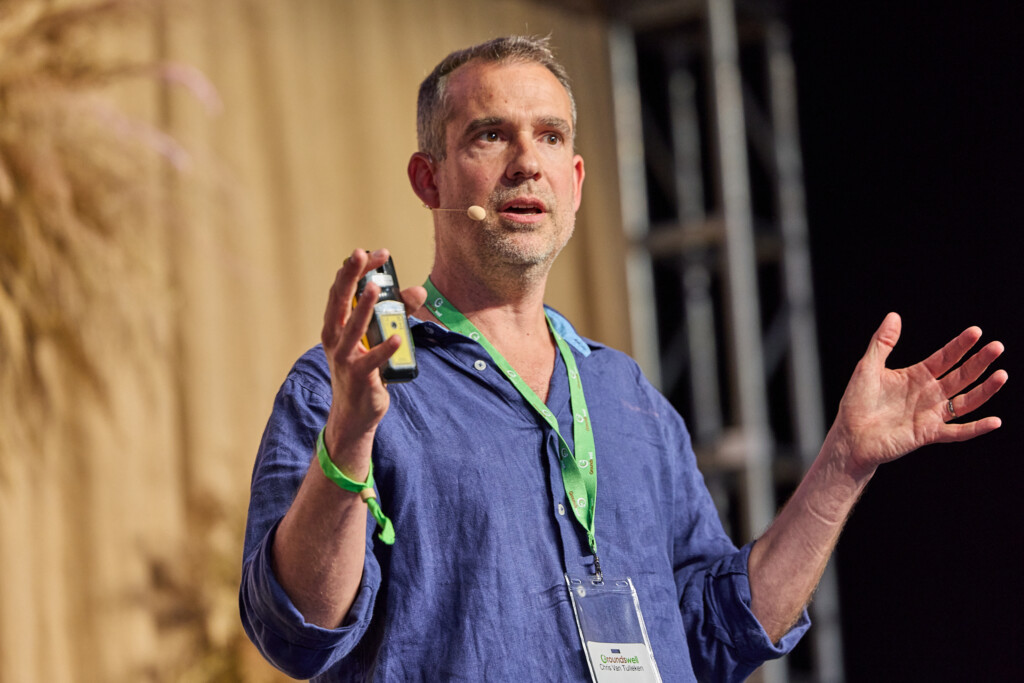
None of that settles Dolly van Tulleken’s underlying concern: soils built to be healthier may carry real benefits – such as higher nutrient density – but a KitKat doesn’t become healthier for containing regenerative wheat. Delivering his own keynote address, Chris van Tulleken, doctor, TV presenter and author of the book Ultra-Processed People, also posited that the movement against UPF is entering a more aggressive phase, with strategic litigation modelled on the tobacco industry playbook and stronger front-of-pack warning labels both now on the table in certain jurisdictions around the world.
Companies producing UPF at scale, Dolly van Tulleken argued, are built to make food with “addictive properties” – a structural pressure a wheat swap doesn’t touch. Her prescription for hospitality was blunt: start with public procurement, getting “properly regeneratively farmed foods” – not confectionery wearing a regenerative label – into schools, hospitals and prisons, backed by fiscal policy.
Ali Morpeth, co-founder of food systems consultancy Planeatry Alliance, made a related point on another panel: sourcing better isn’t enough on its own – the industry also has to “interrupt the demand cycle” that relentless marketing and highly palatable products create in the first place.
Keller was candid that Nestlé isn’t trying to resolve this tension through KitKat itself. “It’s unapologetically a chocolate bar,” she told me – “our job is… [to] make sure those ingredients are not costing the planet.” Work to address the health impacts of products are happening too, and include reformulation, portion sizing, labelling, new product development in food as well as disclosure on the health of the portfolio.
Nestlé has also deliberately not marketed the Wildfarmed wheat on pack or to consumers, partly for practical reasons (packaging space is tight, and the EU’s incoming Empowering Consumers Directive will set a high bar for substantiating sustainability claims) and partly to avoid building brand equity off a single ingredient.
Branding a KitKat as regenerative could have risked accusations of the business chasing a “halo effect”. Chris van Tulleken referenced McDonald’s promoting its use of UK organic milk as an example of where, in his opinion, a narrow, genuine win spills over into broader perceptions of brand virtue. Nestlé staying silent in its consumer marketing avoids that trap, and arguably strengthens the case that this is a real supply-chain shift rather than a marketing exercise – but it also means conscious consumers have no way of knowing which products to choose, and therefore can’t reward the shift with their spending even if they want to.
Keller’s answer is that shoppers aren’t meant to choose ingredient-by-ingredient – they’re meant to trust the brand as a whole, which, in Nestlé’s case, has meant a public commitment to sourcing 50% of key ingredients via regenerative agriculture by 2030. “We’re looking across our whole ingredient portfolio, then looking at where it can make the most impact, and putting it into our products where we can,” she explains.
For many businesses there remains a gap between sweeping statements of support for regenerative agriculture and measurable targets, with recent analysis by FAIRR, the investor network, finding that only 28% of companies with regenerative commitments have set quantified targets, down from 35% in 2023. And that’s before one gets into the weeds of the debate over how regenerative should be defined and what outcomes it should deliver in practice.
Transitional journey
One audience member pushed back on Dolly van Tulleken’s argument directly, suggesting a regeneratively farmed KitKat is arguably the better outcome compared to a conventionally farmed one, and worth celebrating as such. Panellist Ed Horton, who advises farmers through Savills’ natural capital team, agreed, calling Wildfarmed KitKats “a slightly ironic, strange entity” that’s positive overall, “because farmers may be gaining an increase in financial resilience and being encouraged to build their natural capital resilience within their businesses”. Such partnerships are therefore “part of a transitional journey” rather than a final solution.
In another session, responding to a warning from Jimmy Woodrow of Pasture for Life that big food businesses are prone to “input substitution” thinking – buying a different ingredient without changing how they buy it – Emily Norton, AHDB chair, argued that “regenerative agriculture is never going to fix a degenerative supply chain”.
I followed up with Norton to check what she meant. Simply swapping conventional wheat for regenerative wheat, she explained, isn’t enough to transform the food system if the wider supply chain keeps rewarding short-term purchasing, lowest cost and just-in-time procurement over farmers, nature and communities. Regenerative ingredients alone don’t create a regenerative food system.
So what would help? “Supply chain commitments that lead to genuine partnership between farmers and retailers/caterers. Far too many pay lip service to local sourcing commitments (‘made using local ingredients where possible’); far too few genuinely work with growers to underwrite risk and back investment in production,” said Norton.
It’s the same imbalance Ian Wilkinson, founder of FarmEd, raised elsewhere during Groundswell: farmers currently capture only around 10% of the value of the food they grow. Scale from companies like Nestlé is welcome, but it has to be matched by a fairer share of that value reaching the farm, not just a different wheat variety.
One First Milk farmer from a regenerative farmers’ co-op whose milk supplies Nestlé’s KitKats told Dolly van Tulleken’s panel: “[The] partnership with ourselves is a really long-term strategic partnership, and I would really commend them [Nestlé] for their foresight and investment in farmers. They have invested millions of pounds above the normal price that they might have to pay for milk and encouraged and supported farmers to start this journey.”
I subsequently put this price premium point to Dolly van Tulleken. She argued that the problem is one of policy: if appropriate policy mechanisms were in place to support a truly regenerative food system designed to support human as well as planetary health, then it wouldn’t require food businesses to pay premiums because the system would be set up to reward regenerative practices from the get-go.


Where this leaves hospitality
None of this hands hospitality a simple rule, but it does suggest the industry doesn’t have to choose between backing multinational companies’ ability to help scale regenerative farming and continuing to push its own menus toward less processed, more nutrient-dense food – the two can, and arguably should, run in parallel.
Kath Dalmeny, CEO of Sustain, put a number on hospitality’s own leverage in achieving that second goal: with the UK’s catering industry worth £45bn and its grocery market £250bn, each sector’s procurement should be made to work harder for farmers and diners alike, Dalmeny argued. The role of menu design and the foods hospitality normalises should also not be overlooked.
Scaling the use of beans and pulses could offer part of the solution. The Food Foundation’s ‘Bang in some beans’ campaign, championed at Groundswell by the chef Hugh Fearnley-Whittingstall and The Food Foundation’s executive director Anna Taylor, is one of the clearest examples of environmental and nutritional objectives aligning. The campaign demonstrates that diets can be shifted positively, in this case by increasing consumption of beans and pulses, by using coordinated action across farming, plant breeding, procurement, schools, chefs, retailers, influencers and policy.
Back in Dolly van Tulleken’s session, Fay Cooke, chief impact and financial officer for Yeo Valley, offered a practical approach for navigating the debate: judge sourcing and menu choices against WWF’s sustainable diets framework – less but better meat and dairy, more fruit, veg and pulses, greater dietary diversity, less ultra-processed food, as set out in its Eating for Net Zero report, with tailored foodservice guidance also available – rather than treating “regenerative” as an isolated goal.
It’s a useful reminder that – much like a chocolate bar – there are many ingredients that go into making a healthier, more sustainable food system. Growing food regeneratively is just the start.
Further reading

How the stars aligned for ‘regen ag’ to go mainstream
Surging input costs and extreme weather have created the conditions to scale more sustainable agriculture – but care and caution is needed
Inside the tent: what did we learn from Groundswell 2026?
Nick Hughes reports from this year’s Groundswell Festival where the focus fell on the relationship between more sustainable food production and healthy consumption