High policy costs and carbon footprints for glass bottles have created a compelling case for wine producers to explore lightweight packaging options
Ten green bottles sitting on the wall, and if one of them was to accidentally fall, there would be … you know the rest. It’s a classic nursery rhyme with the bottles not only depicted as green but invariably made from glass – the material traditionally associated with bottles. But not all bottles these days are made from glass, or are green in colour. There are plastic ones – usually made from PET or HDPE – aluminium ones and even those made mostly from paper with a plastic liner.
That line of 10 bottles would look a little different in today’s packaging landscape, and it is something the wine industry is having to get used to. Some are clearly more comfortable with the idea than others. “Don’t swear at me,” says one sustainability lead when I mention the notion of plastic being used to bottle wine. “Wine’s relationship with glass is unique,” says another.
Let’s be clear: that relationship has not been shattered as some brands look to less traditional packaging materials with – so the purveyors of them suggest – a ‘lighter environmental impact’ and lower prices. The vast majority of red, white, rosé and sparkling wine still comes in glass. However, the eyes of many producers and buyers are wandering towards alternatives.
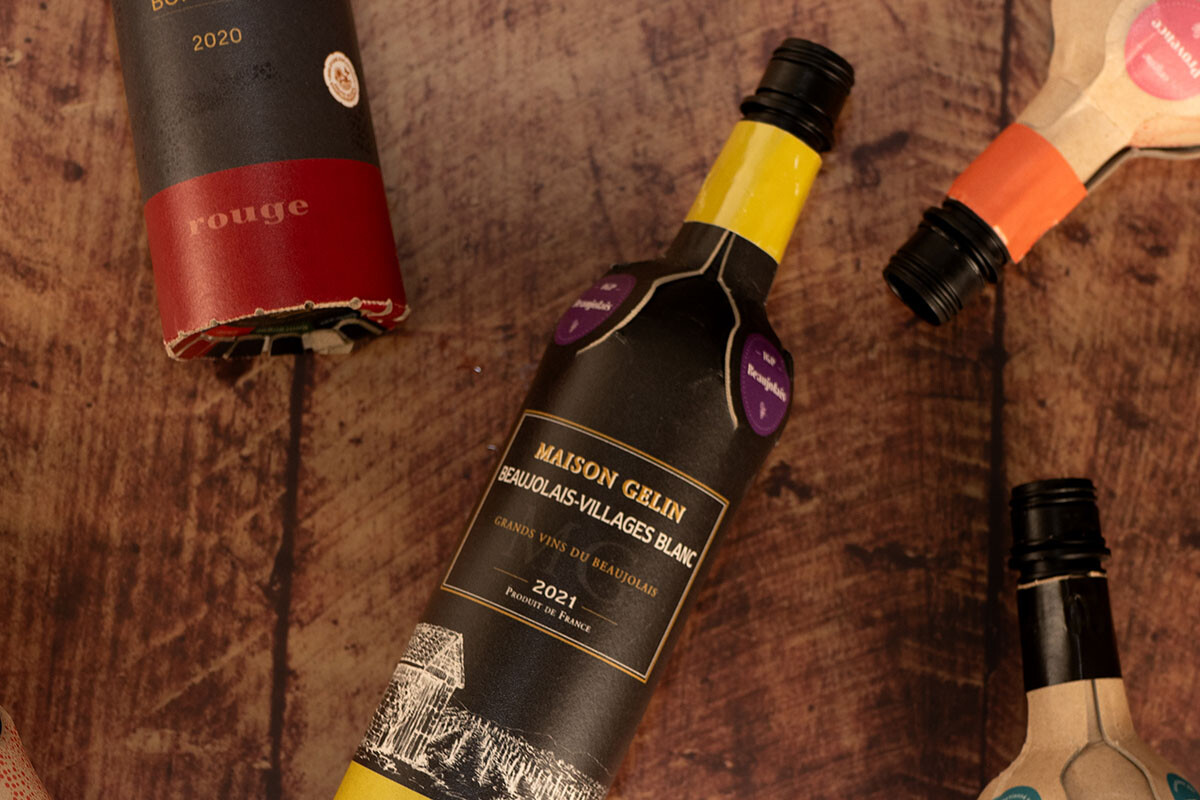
“I think the conversation has changed significantly, “ explains Malcolm Waugh, CEO of Frugalpac, creator of a paper-based bottle with a plastic liner that claims to be “the biggest innovation for wine and spirits since the invention of the glass bottle”. This is a company and a man prone to grand statements – Waugh claimed in 2024 that one in four wine and spirits bottles could be made mostly from paper within 10 years – but there is much to be excited about if you do provide an alternative to glass. “Packaging is one of the areas where wine producers can make a significant carbon reduction without changing the product inside the bottle,” Waugh adds.
Attention first landed on such alternatives as producers and their customers – including those in foodservice and hospitality – began calculating their carbon emissions: the glass packaging accounted for around a third or more of those emissions. As academics at the University of Arkansas, in the US, put it in their paper published in the journal Cleaner and Responsible Consumption in June: “Even though glass is an ideal material for storing wine due to its impermeability, chemical inertness, and suitability for ageing wine, glass bottles are energy-intensive to produce and transport, contributing up to 34% of the total carbon footprint associated with wine production.”

This has been hard to swallow for an industry intent on decarbonising. Harder still have been the rising costs associated with producing, packing and transporting wine all over the world. In the UK, extended producer responsibility for packaging (pEPR) has been a huge blow to glass makers and users. “We are working closely with Defra and PackUK on EPR to help deliver a scheme that is fit for purpose,” Miles Beale, chief executive of the Wine and Spirit Trade Association (WSTA) tells Footprint. “We remain concerned that adding complexity and unrealistic deadlines to a system that is not yet operationally sound will mean businesses will not be able to implement changes in time. Add to this the excessively high EPR glass fees which are driving some producers to less environmentally friendly packaging and the scheme’s flaws become more acute,” he adds.
Excessive producer responsibility?
Beale is among the drinks industry representatives who have been outspoken in their criticism of the pEPR scheme, which is designed to shift the financial and physical cost of managing household waste from taxpayers and local councils to the commercial producers and brand owners who place the packaging on the market. They argue that glass is being unfairly treated given the weight-based approach to EPR fees – WSTA wants a per unit calculation instead – as are foodservice and hospitality businesses through so-called ‘double-counting’, whereby venues pay for commercial waste collection and also absorb passed-on EPR fees for packaging that is incorrectly classified as household waste despite never leaving the premises.
A solution for this is yet to materialise following the departure of Mary Creagh, who was reviewing the available options, and arrival of Emma Hardy as circular economy minister at Defra. It should be said that packaging laws in the UK have been subject to delays, dithering and, at times, disarray as ministers move around, batons are dropped and deadlines pass. Clarity has been hard to find – and still is.
Some businesses have been caught by surprise as they stare down the barrel of eyewatering EPR fees, but others have been better prepared thanks to their focus on more sustainable options for packaging wine.
“When we started the Bottle Weight Accord back in 2023, I would say that the primary motivation for lightweighting was to reduce scope 3 [emissions],” explains Peter Stanbury, director for research and standards at the Sustainable Wine Roundtable (SWR). “Even though reporting requirements only apply to a relatively few companies, smaller wine businesses are in the supply chains of those companies, and so need to report on scope 3. However, since then the financial imperative has also become very significant,” he adds.
The accord sets a target for its members to reduce the average weight of their bottles from an industry average of 550g to 420g by the end of this year. At the last count, in 2025, they had reached 430g. With members now accounting for 9% of wine consumed globally (2.5 billion litres), that is not to be sniffed at: 294ktCO2e savings last year alone, and 440ktCO2e over the two years. Were all these emissions savings to have been levied at the UK EPR rates, participants would have saved £58m in avoided fees. “Obviously, this figure is indicative rather than absolute because the accord is global, not just in the UK,” Stanbury explains. However, since EPR schemes are coming in elsewhere – the EU, several US states and Australia, for instance – it is “useful to have a number that shows the financial impact of lightweighting bottles. […] working with the BWA provides a direct positive impact on the bottom line, and businesses elsewhere want to get ahead of the game before EPR reaches them,” he adds.
In 2026, a lighter bottle is a significant sales point. Earlier this month, Picpoul de Pinet, an AOC appellation in southern France’s Languedoc region, known for its light, crispy white wines, officially approved the use of a lightweight version of its ‘Neptune’ bottle, which was created in 1996 “as a symbol of identity and attachment to the Mediterranean”. Moving from 540g to 420g – “without compromising on strength or aesthetics” – saves 40gCO2e (22%) per bottle.

Provenance is in
The Neptune bottle is manufactured locally in Verallia Glassworks, in southern France. Provenance has always been important to the wine, but not packaging. This is changing too.
“You want the whole package, don’t you? British wine in British bottles,” says Helenor Rogers, chief marketing officer at Croxsons, a British family-owned glass packaging specialist. “I think foodservice and hospitality would really embrace that [provenance story],” she adds.
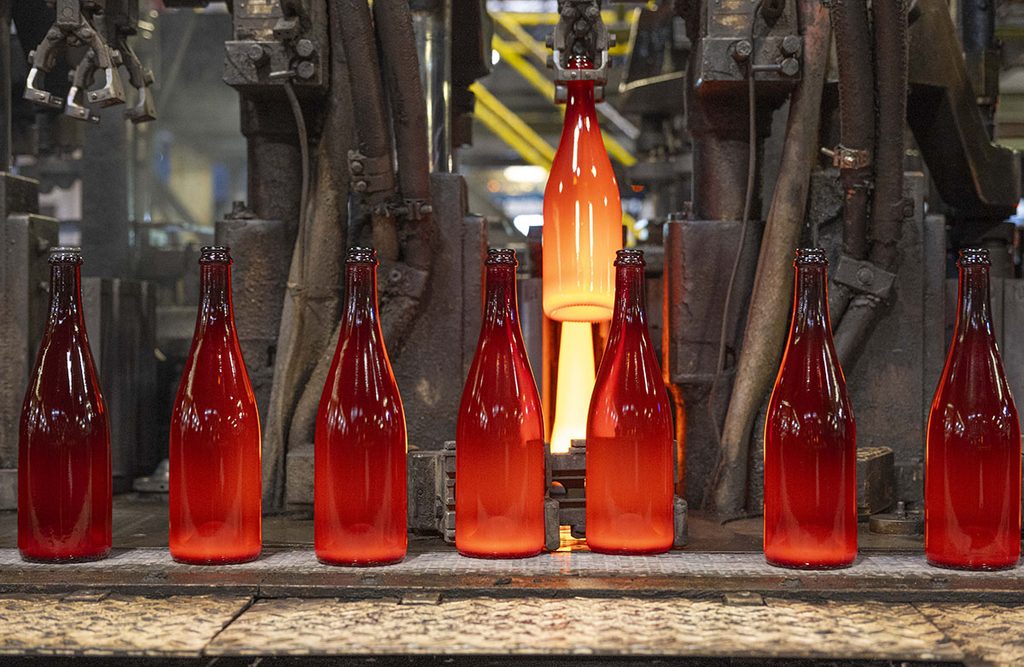
Sales of British sparkling wine have risen 187% since 2018, from 2.2m bottles to 6.2m in 2023 (WineGB), making this “the perfect time” to bring sparkling wine bottle production home, according to Croxsons which, in collaboration with glass manufacturer Encirc, has just launched the first British-made sparkling wine bottle. Amber in colour – to give English and Welsh sparkling wine its own identity – and made with 77% recycled glass, the ‘Sovereign’ bottle also helps bring down transport costs and emissions (for 100,000 bottles the savings are estimated to be between 4.6 and 7.7tCO2e, excluding channel crossings, pallets and packaging).
The bottle had to be priced at a level that would ensure buyer interest in UK production, while maintaining its premium look and feel – “this is not a beer we are talking about”, notes Veronica Chambers, quality and technical manager at Croxsons. Indeed, the premium feel of glass was for many years a handbrake on innovation for lightweighting, yet even premium wine producers are now cutting bottle weights successfully with some Rhône producers having reportedly reduced their bottle weights from around 600g to 380g. There is even some Châteauneuf-du-Pape now available in lighter glass. The significance of this “cannot be understated”, wrote Stanbury in his recent update on the accord, with those selecting lighter bottles “not seeing any effect on sales […]. This really does demonstrate the importance of collective action,” he added.
Paper chase and choice
How consumers feel about materials other than glass for their wine is less clear. The academics from Arkansas surveyed US consumers, finding that “in general, the perception is quality wine is in glass”, but “[t]hat perception can change slowly as new and innovative packaging for wine becomes available”, explains Renee Threlfall, associate professor of food science at the university.
Glass remained the bottle of choice for the 2,000 consumers polled, with aluminium “consistently favoured over PET and flexible bags” among alternative packaging materials. The more they knew about the carbon footprint of the materials being used, the higher was people’s willingness to pay a premium for it. “The way this type of information is communicated and marketed is crucial for increasing the adoption of alternative packaging,” the researchers wrote.
Frugalpac has created a 23-page report on the topic, with 73% of consumers reporting a willingness to switch brands for ‘sustainable packaging’. “Lightweighting glass is absolutely part of the answer and a 300g glass bottle is an impressive achievement,” Waugh explains. “But our latest Frugal bottle weighs just 71g and has a carbon footprint 84% lower than a standard glass bottle. Something being recyclable doesn’t automatically mean it has the lowest carbon footprint,” he adds, as a nod towards glass’s infinite recyclability claims and concerns about the recyclability of his paper-plastic mix.
Although Waugh does not encourage “a battle between glass and paper”, producers are asking questions of their packaging, he says, adding: “[They] are much more open to using different packaging for different products, markets and occasions. If you’re a hospitality group looking for scope 3 reductions before 2030, packaging is something tangible you can actually change rather than simply offset.”
Frugalpac bottles are now available in 27 countries, housing both wine and spirits. In Australia, the company has teamed up with packaging innovator Paper Bottles to supply vodka, gin and wines to more live events in the hope of demonstrating how venues can lower their environmental footprint in scalable ways in the lead-up to the Brisbane 2032 Olympic and Paralympic Games.
There are other alternatives vying for this lucrative and growing market for glass alternatives too. Packamama, a supplier of ‘flat’ wine bottles using a “unique material mix of recycled PET and performance-enhancing additives” recently secured future volumes of Avantium’s plant-based and recyclable polymer PEF (polyethylene furanoate), branded as ‘releaf’. With a AU$1m (£0.53m) grant from the Australian government, the aim is to accelerate the development of next-generation, low-carbon-footprint packaging solutions for the wine industry.
Can the innovation in glass keep up with these novel bottle upstarts? “This is a huge topic, and one we’ve just spent a solid six months researching,” says Stanbury. There is “a lot of noise and pizzazz around other formats, but the evidence suggests, strongly, that we’re not going to see a wholesale move away from glass any time soon”.
However, the fact that more alternative formats are now viable and improving (for example, Bag-in-box addressing the multi-materials challenge) means that glass companies have more incentive to respond by producing lighter bottles.
A modern retelling of the nursery rhyme may no longer have 10 green glass bottles sitting on the wall, but seeing them all fall off is, for now, a fairytale.
Further reading
EPR ire overshadows circular economy opportunity
The duel over the new EPR scheme for packaging shows no signs of ending as the final base fees are announced. But there is a silver lining for reusables

Hospitality calls for EPR exemption
Businesses continue to cry foul over scheme’s design ahead of the deadline for submitting the latest tranche of packaging data