
Perceived as fiddly and time consuming, utilising kitchen prep waste or surplus can often be seen as a marketable extra. But can practices be changed to make upcycling the everyday norm?
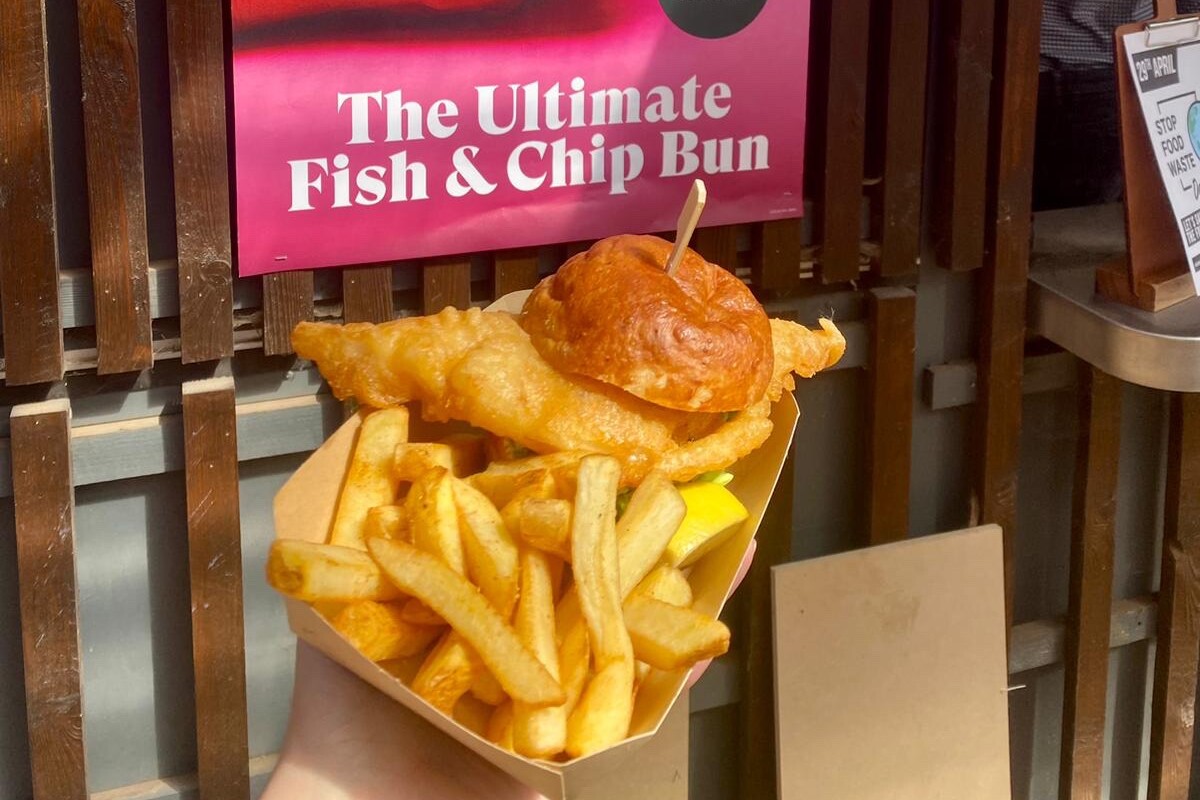
Seeking inspiration ahead of ‘Stop food waste day’, Eurest’s development chef Graham Hart looked for the most-wasted items across its sites’ kitchens. Leftover chips were a persistent offender, so he replaced the mashed potato in an existing potato bun with chips, filled it with battered fish and created an instant hit that became a menu staple. As did a porridge focaccia made from breakfast-buffet surplus, and a carrot cake in which half the carrot is routinely swapped for cauliflower leaves, potato and parsnip peelings, and other pre-approved trim.
What’s notable in the Eurest example isn’t the invention, but where the surplus ended up: not as a novelty, but something a site reaches for during an ordinary service. Yet utilising kitchen byproducts at scale is often still treated as something additional or special, reserved for a waste-focused menu or served with a flourish at a media showcase.
Wrap estimates the UK hospitality and food service sector wastes around 18% of the food it purchases – worth £3.2bn in 2021, roughly 75% of which could have been eaten. Cheap ingredients, a shortage of staff skills and time, rigid menus and a reliance on pre-prepared products have normalised high volumes of avoidable in-kitchen waste. Although food waste reduction has become a major focus for cost- and carbon-conscious operators, with massive savings to be made by streamlining SKUs, tackling portion sizes, production volumes and other interventions, wastage of trim remains embedded within the model of many operators.

Overcoming barriers
But why? Silo-founder Doug McMaster helped popularise zero-waste cooking with a kitchen that had no bin, but even his renown didn’t stop its Hackney Wick site closing in December after 11 years – sustaining it “in the heart of capitalism,” he said, was “like watching a fish trying to climb a tree”.
Part of the challenge is that using the whole product takes time, and time is not cheap. “It takes longer – both in the preparation, and in the thinking when designing menus,” says Chantelle Nicholson, chef-owner of the Michelin Green Star-holding Apricity in Mayfair. With the cost of employer national insurance and the minimum wage both rising sharply under the current government, “we have much lower food costs and much higher labour costs – whereas three years ago it was probably a different story”, Nicholson notes.
That’s particularly challenging when the end result is a low-value item, notes Juliane Caillouette Noble, CEO of the Sustainable Restaurant Association: making your own stock costs more time and energy than using a bought bouillon cube, whereas folding vegetable peelings into a burger carries a stronger carbon and cost case. Lower staff numbers can also impact overproduction for buffet environments – there is no time to run back and forth to monitor and top up buffet counters as needed any more.
At Apricity, the extra staff cost is justified because sustainability is core to the brand – but that’s harder to sustain for high-volume, multi-site operators. Storage is a real constraint too – a single box of cauliflowers can generate 3kg of trim – as is food safety law, when reusing buffet food for example.
Design out waste
The issue is that the industry has asked the wrong question for decades, argues Vojtech Vegh, a zero-waste chef who has spent 15 years working in kitchens – the last five training hotel and contract catering teams – and works with waste-tracking firm Winnow.
“How are we still, in 2026, asking if this is scalable?” he questions. “The conversation was always about how to reduce the food waste you have already created… be creative, make croutons, make a smoothie from your berries. Little of that is applicable in large operations with fixed menus and little flexibility.”
That framing taught chefs to see byproducts as an extra, fiddly task bolted onto an already stretched job, rather than an integral part of the menu. Vegh’s fix: stop inventing “zero waste recipes” and instead design menus around the whole ingredient, treating trim and surplus as integral, interchangeable ingredients written into standard operating procedures.
It starts in “the chef’s office”: if a menu includes mashed potato, the peel it generates needs an assigned use before the dish is finalised – not once a box of skins is sitting on the pass. A watermelon rind, peeled and shredded, behaves like a courgette, so it goes wherever a courgette would go; carrot peel gets folded into whatever recipe already calls for shredded carrot; veggie trims and peels can go anywhere that calls for shredded vegetables, such as veggie burgers. “You don’t need a brand new recipe,” Vegh stresses.
At the Mexican restaurant chain Wahaca, cauliflower hearts left over from its buttermilk cauliflower bites are puréed into its butter bean and confit garlic dip, while trim from whole pork bellies is slow-cooked into pork pibil. “We think about any potential wastage in the dish design phase,” says Carolyn Lum, Wahaca’s sustainability lead – echoing the “chef’s office” principle.
Partial solutions still add up, Vegh notes: reusing even a third of a breakfast buffet’s watermelon rind can save around 100kg of raw product from the bin in a busy hotel. At Apricity, spent coffee milk is stored until there’s enough to turn into a ricotta dish.
Rotating recipes
Deciding upfront what a dish’s byproducts become solves only part of the problem. Kitchens don’t generate byproduct and surplus to a predictable schedule, so no single fixed dish can absorb it reliably. At Wahaca, the aquafaba left over from cooking or canned pulses gets used in cocktails as a free, vegan egg-white alternative, notes Lum, but supply can only match surplus.
Eurest’s answer is a rotating recipe bank, “Plenty,” built to catch whatever trim a site happens to have that week.
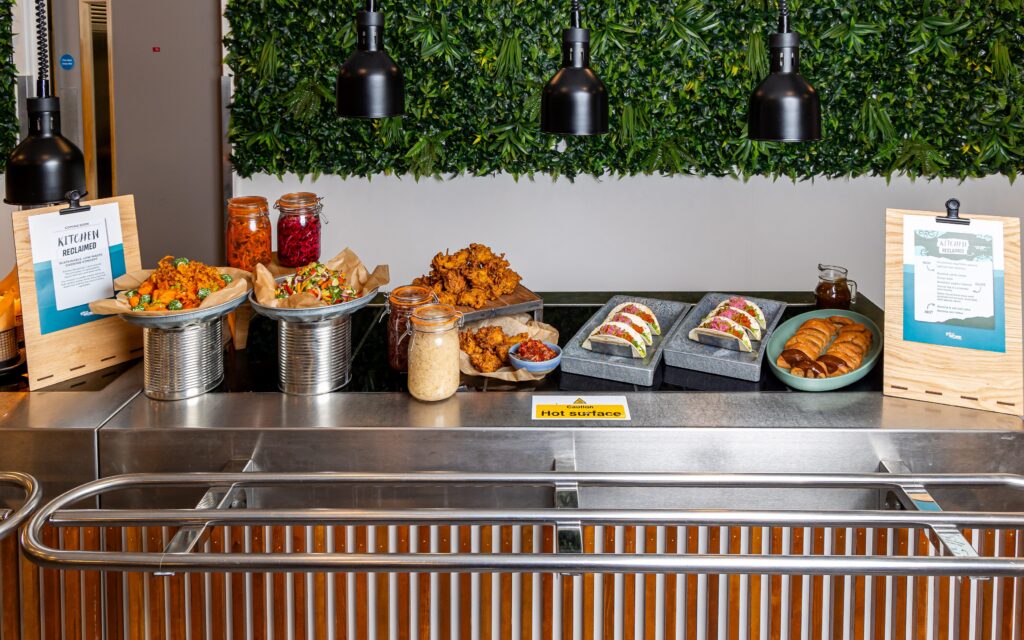
Elior runs a comparable dedicated concept, Kitchen Reclaimed, with recipes for turning surplus into dishes such as a roasted carrot salad with crispy peel and cauliflower stalk chermoula.
Sodexo’s Waste in Mind programme encourages kitchens to find a use for offcuts, from broths and bakes to peelings steeped for tea.
Carol Rhead, marketing and insight director for Eurest, is emphatic the logic runs one way only: “What you don’t want to do is originate things to create that recipe. If nobody’s got leftover porridge, you don’t want them making some porridge to make the focaccia.”
Caillouette Noble gives the example of the “wonky veg” movement, whose success drove demand for wonky produce beyond supply, pushing higher-grade produce down to ugly-veg price and status. Her point is that sometimes the answer to a byproduct isn’t to force it onto your own menu, but to find it a home elsewhere in the system. One example: a fish and chip chain discovered southern customers tend to leave fish skin, causing batter plate waste. Rather than find an in-house solution, the more efficient fix was buying skinless fillets, letting the skins be diverted upstream into pet food.
Value equation
Isolating upcycling’s specific value, in cost and carbon terms, is difficult. “The way Eurest’s carbon labelling works,” says Rhead, “it just recognises an ingredient, not whether it’s been diverted from waste – it’s categorised as carrot, not carrot peelings.”
Wahaca’s Lum notes the same problem: “We don’t really quantify the savings at the moment,” though cauliflower is costed with wastage factored in, “so it’s almost a bonus” when offcuts get used.
But essentially, says Vegh, there are always savings when utilising the whole product. Winnow data suggests improving yield from existing ingredients cuts procurement costs by 1–2.5%.
Andrea Zick of Brunel University, who analysed 52 weeks of waste data from a fine-dining kitchen, found preparation waste made up around 57% of measured waste. With a large proportion of unavoidable animal bones, she estimates roughly 40% of this waste is realistically controllable, with reductions of 25–50% achievable through better menu design. This translated to procurement cost savings of around 2–6%, and an estimated 9–20 tonnes of CO2 equivalent saved annually in her case-study kitchen. Her conclusion: despite the added labour and operational complexity, the combined economic and environmental benefits make food waste reduction a high-impact intervention.
Don’t call it waste
While some brands do market certain lines as waste-saving, the consensus overall is: don’t call it waste. Eurest, in Rhead’s words, “whispers about the waste” and “shouts about the taste” – leading externally on flavour, saving the full explanation for spaces like QR codes and staff briefings.
Vegh goes further, arguing against ever using the word “waste” near a menu: “I don’t want to call it watermelon rind chutney on the menu… it does not have to be a cauliflower leaf salad. It can be cauliflower salad.”
Wahaca’s Lum agrees: “I was told a long time ago that ‘food waste’ isn’t really sexy marketing chat.”
Zick’s insight backs this up – upcycling is more commercially successful when reframed through “seasonal,” “root-to-stem” or “chef-led” language than when linked explicitly to waste reduction.
Elior’s Kitchen Reclaimed naming follows the same logic.
Start small
Incremental fixes help: leaving skins on vegetables, substituting byproducts into existing dishes, standardising trim use in stocks, soups and sauces, linking ingredients across dishes, building in flexible menu items and improving prep planning. These are low-cost changes that fit existing kitchen workflows, and are practical entry points toward more systemic change.
The practical starting point echoed across those consulted for this article: start with your single most-wasted item, work out how to fold it into the menu, test it with your team, tweak it, and only then move on to the next item – a more impactful approach than trying to fix everything at once.
Deeper change means redesigning menus around whole-ingredient use, building reuse into kitchen workflows, developing chef skills, aligning procurement and management practices and building a bank of recipes to catch what isn’t anticipated – a system-level rethink of how kitchens and businesses operate.
As Vegh puts it, the goal isn’t cleverness, but that whole ingredient thinking ultimately becomes standard business practice.
Further reading
Can food waste reduction get back on track?
A 2030 target to cut food waste by 50% is in danger of being missed. Government and businesses need to seize the opportunity to turn things around
Minister hints at green light for food waste reporting
Hopes have been raised that long-promised requirements for large businesses to report on food waste will form part of the forthcoming circular economy strategy