

Warming seas have filled England’s south-west coast with octopuses that are damaging ecosystems and emptying fishers’ shellfish pots. But viewing the glut as a potential protein source raises difficult questions about sentience, slaughter and supply
When a British seafood restaurant in Hammersmith marked World Oceans Day in June by putting octopus, at the time a Good Fish Guide red rated species, on the menu, it highlighted a sustainability conundrum. Faber, known for its ethical sourcing, pivoted in response to the octopus blooms occurring off the south-west coast of England over the past two summers. These have damaged crustacean populations and left fishers’ pots full of empty shells, with the octopuses treating the pots as personal seafood buffets.
“Conditions change, and what’s available around our coast changes with them,” says Anthony Pender, founder of Faber. “And our menu is a reflection of this… the octopuses we’re buying are coming up as bycatch in other fisheries.” The logic goes that by creating a market for locally-caught octopus, hospitality operators can support local fishers and help keep numbers in check to protect ecosystems.
The scale of the recent bloom is extraordinary. The common octopus is native to UK waters but its presence is normally rare – until recently. Since 2021, total UK vessel octopus landings into UK ports have increased by nearly 1,500% from an annual average of around 220 tonnes from 2021-2024, to over 3,700 tonnes and counting for 2026. Bryce Stewart, senior research fellow at the Marine Biological Association (MBA), says the octopuses made their way to the UK from Brittany, and, once here, found that the unusually warm seas suited them. Evidence of breeding in UK waters and a spread beyond south Devon and Cornwall up the coast to Wales leads him to predict that the octopuses are set to stick around: “They’ve established themselves, they’re breeding, and the environmental conditions have changed to suit them.”
All of which begs the question: is it right that we start viewing octopus as a sustainable protein choice?
Empty pots
Official figures show shellfish catches – crab, lobster, crawfish, scallops and whelk combined – from the western Channel off Devon and Cornwall fell by almost half in 2025 compared with the 2021-24 average. Initial figures for 2026 suggest the decline is spreading – to the Bristol Channel, Celtic Sea and eastern Channel, and as far as the Irish Sea and central North Sea – with only the southern North Sea up. This is leading some fishers to shift their focus to octopus. However, the ability to profit from the glut is unevenly shared. Octopuses move through the fishing grounds in shifting patches; fishers bound by generations of informal agreements over where they work can’t follow them into waters claimed by others, so some are earning well while others catch almost nothing after the octopuses have eaten their way through stocks of crabs, lobsters, scallops and other seafood species.
Eleanor Adamson, head of fisheries at The Fishmongers’ Company, says the bloom has “destroyed the livelihoods of some in the fishing sector”, while others “have been able to adapt and have landed truly staggering amounts of octopus”. She also warns that octopuses are eating undersized and breeding shellfish, with “the potential to have a significant and long-lasting impact on wild populations”. Even if they vanished overnight, crab, lobster and scallop stocks would need at least four to five years to recover. In parts of Brittany, Stewart notes, octopus has already replaced crab and lobster as the main fishery.


Shipped abroad
For now, most UK-caught octopus is not eaten domestically. The value of UK octopus exports rose from £164,000 in 2024 to £12.8m in 2025, with France and Spain the main destinations, according to Seafish data. Adamson says almost all of it goes “straight to the European continent, where demand and prices are much higher”, leaving “limited benefit to the wider seafood supply chain here in the UK”. Poor octopus fisheries in Spain and Portugal have kept demand high, although prices roughly halved in mid-2026 as supply surged, says Stewart.
Rachel Walker-Boggis, head of brand at southern seafood restaurant chain Rockfish, and co-founder of the pot-caught Disco Scallops project, blames logistics and habit for the low levels of octopus staying in the UK. It is simpler for suppliers to ship mixed catches overseas than to build domestic routes to market, she explains, while British consumers tend to stick to a narrow range of seafood species. Yet appetite exists, with Faber’s octopus skewers steadily growing sales, while octopus retailed well on Rockfish’s online fish market despite costing £18 for a pre-cooked tentacle serving two, with around half of customers who tried it ordering again. However, Rockfish hasn’t yet added octopus to its restaurant menus because of the training required to enable chefs to cook it well.
A sentient catch
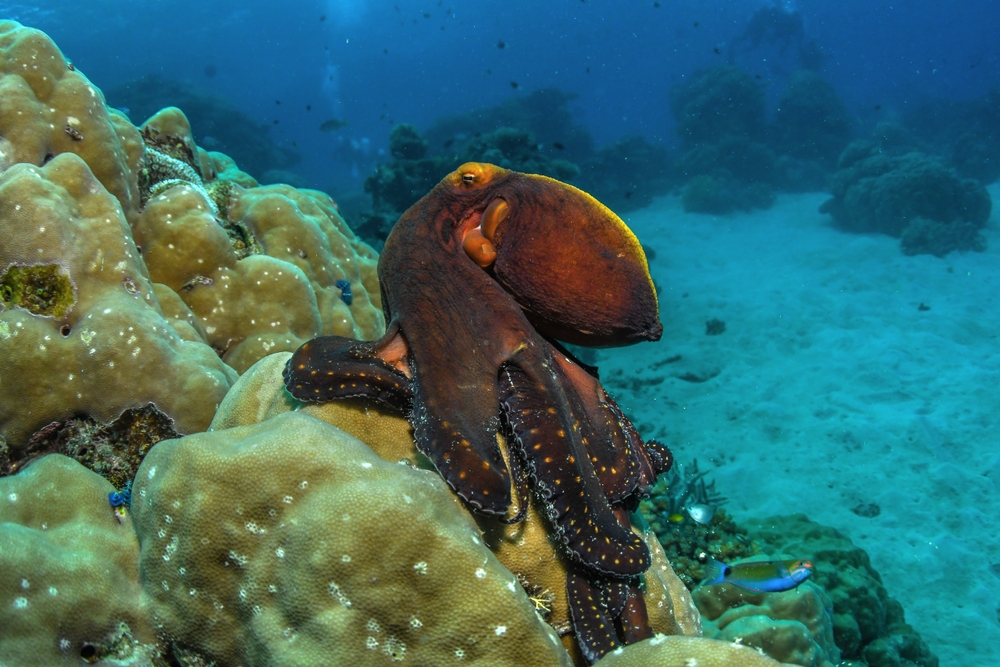
There is, however, a powerful counter argument to the one that says we should gorge on the octopus glut. In 2021, a review led by the London School of Economics for Defra examined more than 300 studies and concluded that octopuses and other cephalopods are sentient, leading to their inclusion in the Animal Welfare (Sentience) Act. A 2021 study by Robyn Crook found that octopuses avoid places linked to pain and seek out pain relief. Then there is My Octopus Teacher, the Oscar-winning 2020 documentary that came up repeatedly in interviews for this article as a major reason why people feel uncomfortable about eating octopus. This year also saw the release of Netflix’s film version of the best-selling book, Remarkably Bright Creatures, which is narrated partly by Marcellus, a giant Pacific octopus.
Sophika Kostyniuk, managing director of the Aquatic Life Institute (ALI), a non-profit that advocates for the welfare of aquatic animals worldwide, says My Octopus Teacher has been hugely important in shifting attitudes, which can be a “key that unlocks the door to conversations” with legislators, certifiers and corporate leaders to advance their priorities on aquatic animal procurement and management. “Octopuses are an absolute poster child,” she suggests, because they are fascinating, relatable and highly sentient problem solvers, which can use tools, feel pleasure and pain. Their physiology is also important: their neurons are distributed around their bodies, with around 60% located in their arms. “There is no scientifically approved, humane slaughter method for octopuses,” asserts Elena Lara, senior research and policy advisor at Compassion in World Farming (CIWF). For Kostyniuk, this makes eating them “an easy no”.
Experts across the industry spectrum agree this is a real sticking point. A 2025 update to the LSE review found no validated humane slaughter method for octopus. CIWF describes octopuses forced into ice slurry, suffering “a slow, agonising death” or stabbed through the mouth, and calls both cruel. SmartFish, a Mexican non-profit working with small-scale fishing co-operatives, teaches a precise knife stun through the mouth to disrupt the central nervous system, followed by immediate chilling, as the more humane option. But more research is urgently required to ensure genuinely humane methods can be identified, and then adopted.
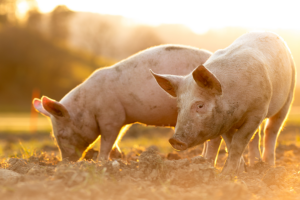
But should we consider octopuses to be a special case, distinct from the ethics of eating other sentient animals, such as pigs? “Is there a ‘humane’ way to kill any living being?” ponders Pender. “There is no perfect solution but we must do the best we can when it comes to welfare.”
Low impact, but not the lowest
And what about climate impact? Wild octopus needs no feed, and a life-cycle study of Portugal’s pot and trap octopus fishery puts its footprint at about 3.5kg CO2e per kilo landed. That compares with roughly 99kg for beef, 40kg for lamb, 12kg for pork and 10kg for chicken. Beyond carbon, however, the picture is more nuanced. Abigail Frankfort, aquatic food lead at the World Resources Institute (WRI), says weighing emissions, inputs, biodiversity and social factors, octopus fisheries “do not necessarily jump out as the best choice”, particularly against small, wild fish such as sardines and herring, or farmed mussels and oysters. CIWF goes further, arguing it is “clearly not a sustainable protein source”.
Farming does not provide the answer either. Nueva Pescanova dropped plans for the world’s first commercial octopus farm, in the Canary Islands, this summer; CIWF estimated it would have needed 28,000 tonnes of wild fish to produce 3,000 tonnes of octopus in its first year. Welfare was also a concern, with Frankfort warning that solitary predators in high-density tanks “will suffer hugely”.
Managing the bloom
For the foreseeable future, wild-caught octopus will remain the only option available to buyers. Currently, anyone can fish for common octopus without a permit; the only rule is a 750g minimum landing weight. This means fishers have moved into new areas to capitalise on the abundance, disrupting local fisher economies. In July, Cornwall’s inshore regulator banned vessels over 12 metres from potting for octopus in its waters, and in October, Defra convened fishers, scientists and managers to discuss the impact of the bloom around the south-west coast and how regulators and the industry can respond to the challenges and opportunities it presents. According to Stewart, options being discussed include limiting the number of pots, introducing permits, a higher minimum size and a breeding-season closure.
Frankfort supports catching more octopuses to control the population, provided frequent scientific assessment means catches fall when numbers do. But she warns that creating demand can create an incentive to keep the species around, while any fishery not handled carefully can cause harm.
Walker-Boggis agrees that setting a precedent creates an issue when abundance ends, especially for larger chains and retailers who are less able to pivot when populations change: “Once we as an industry and society have turned those taps on, we’re not very good at turning them back off again,” she notes.
Choosing with care
The latest sustainability rating from the MCS’s Good Fish Guide, updated in October, now rates UK common octopus an amber 4 of “OK, needs improvement”, instead of 5, “one to avoid”. This is for trawl and pot alike, noting that until management is in place “it is impossible for octopus to gain a favourable rating”. But despite the lack of specificity in the MCS guidance, many experts insist the fishing method still matters. CIWF describes trawled octopuses compressed for around 30 minutes as nets are hauled. SmartFish advocates that selective methods such as pots, traps or hand-operated fishing can reduce bycatch and habitat impacts, although gear alone does not make a fishery sustainable.
If choosing to supply or serve octopus, SmartFish suggests businesses ask four questions: is the population healthy; what are the ecosystem impacts; is the fishery managed and traceable; and how was the animal caught, handled and killed? It also urges restaurants to avoid waste and to use the whole animal, not just the tentacles.
“For us, knowing the boat, knowing who’s supplying us and understanding their practices is really important… Ask questions and keep asking them,” says Pender from Faber.
Walker-Boggis from Rockfish stresses the importance of telling customers your rationale for serving octopus. Nuance is hard to communicate, she says, but impacts on fishers and ecosystems are tangible touchpoints likely to cut through. She also points to the example set by Spain and Portugal, where seafood is celebrated in season and then left alone.
CIWF accepts that “businesses and consumers can make their own choice”.
Adamson at The Fishmongers’ Company agrees that eating animals “is always a personal choice”, but would “definitely encourage everyone to try octopus while it is present and being harvested in such vast quantities locally off our coast”.
So is it time to put octopus on the menu? For now, the answer seems to depend on the questions businesses are prepared to ask – and keep asking – about how it was caught, how it can be humanely handled and slaughtered, and how long the current bloom lasts.
Main image: Faber
Further reading
Can salmon farming ever be sustainable at scale?
Farmed salmon has become a foodservice staple, but evidence of environmental damage, welfare failures and food colonialism raises the question: is this fish as clean as it claims?
Does seafood hold the key to future food security?
With land under pressure from food production many believe our oceans can help meet the world’s nutritional needs, but only if demand can align with sustainable supply


Leave a Reply