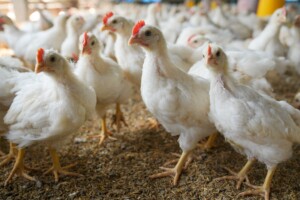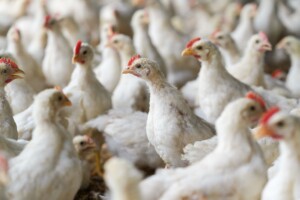
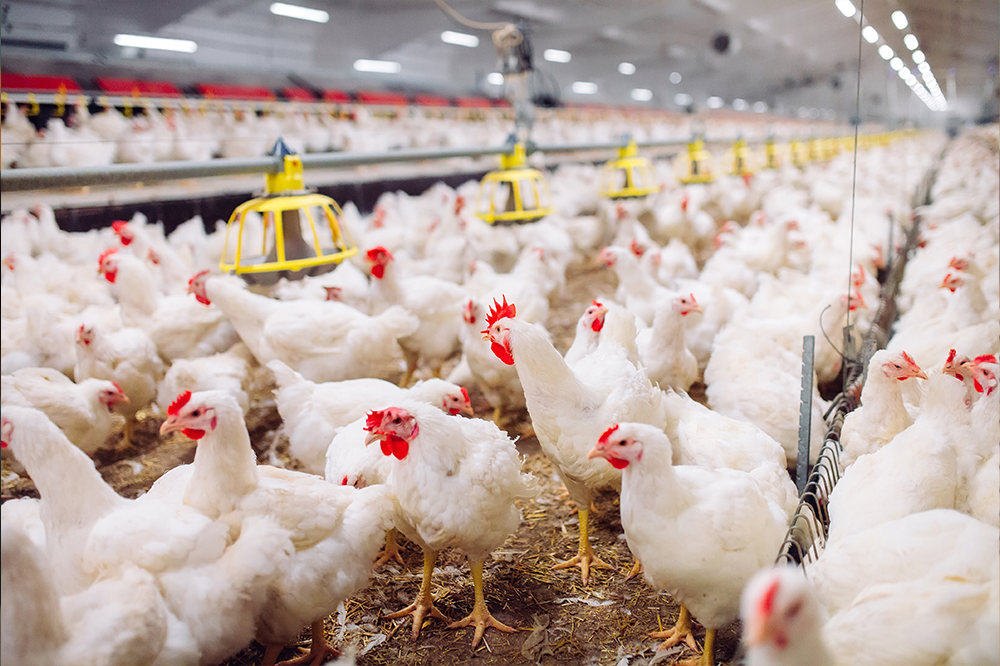
Animal welfare campaigners have warned chicken farmers they could be breaking the law by rearing fast-growing breeds.
The Humane League UK (THL UK) has sent letters to 1,600 chicken farmers across the UK along with the four largest poultry producers – Avara, Cranswick, Moy Park and 2 Sisters – claiming that a ruling by the Court of Appeal could be used as the basis for future legal action against the use of fast-growing breeds which it says account for around 95% of the UK flock.
THL UK has been battling the UK Government for a number of years seeking to get fast-growing chicken breeds banned, citing provisions under the Welfare of Farmed Animals Regulations 2007 which state that animals with genetics prone to detriment cannot be kept for farming purposes.
Although it failed in its latest appeal, the group claimed declarations made in the court’s ruling give grounds for future legal challenges. Specifically, it said the judge’s conclusion that it is reasonable to expect farmers to inform themselves about the welfare problems affecting the animals they keep “lays the groundwork for demonstrating criminal liability for any farmer that does not familiarise themselves with the commonly-held scientific opinion that fast-growing breeds of birds invariably suffer more than their slower-growing counterparts”.
It also cited the judge’s conclusion that should scientific evidence prove that common welfare issues, such as increased heart problems or leg development disorders, are intrinsically linked to a particular breed of fast-growing chickens and can’t be mitigated through an improvement in environmental conditions, then the law could prohibit those chickens from being farmed.
A 2020 report by Scotland’s Rural College, commissioned by the RSPCA, showed that fast-growing breeds, when given identical environmental conditions as slower-growing breeds, suffered from significantly poorer health.
The British Poultry Council, which represents the industry, has previously described THL UK’s claims as “spurious” and stated that conventional poultry production is crucial to UK food security.
Shifting the supply chain towards slower-growing breeds is a key plank of the Better Chicken Commitment, but despite progress in reducing stocking densities and improving access to natural light, businesses have struggled to reduce their reliance on fast-growing breeds like the Cobb 500, Hubbard Flex and Ross 308 which grow from chick to slaughter weight in around 35 days.
Further reading
Cage against the machine
Animal welfare remains high on the agenda as campaigners and corporates clash over labelling and transparency of industrial meat
Crying fowl
A schism has emerged over the best vehicle for improving chicken welfare after a group of leading hospitality operators responsible for 18 brands withdrew from the ‘Better chicken commitment’ (BCC)