Serving food and drink in reusable cups and containers is one of the most impactful ways businesses can reduce packaging waste, improve resource efficiency and embed the principles of a circular economy. Yet adoption of reuse systems at scale remains low, with logistical and cost barriers often seen as insurmountable. Compass Group is showing what’s possible in the UK & Ireland by rolling out Cauli’s technology-enabled reusable food and drink packaging system across a range of sectors including healthcare and business and industry, eliminating almost 400,000 single-use items to date. In this week’s episode, Cauli co-founder Ming Zhao and Compass Group UK & Ireland’s head of environment Ashleigh Taylor join Nick to discuss the journey they’ve been on in scaling a reusable packaging system and why foodservice, with its closed-loop settings, is well placed to lead a long-awaited, industry-wide charge on reuse.
Subscribe to the podcast



Further reading
Scaling reuse could slash EPR bill – study
Businesses could save millions of pounds in extended producer responsibility (pEPR) fees by adopting reusable packaging at scale, according to new modelling
More than 100 businesses are putting pressure on the European Commission to postpone some of its most ambitious packaging regulations
Transcript
Ashley Taylor: What’s particularly exciting about reusable systems and Colli is that they really make us think about how rethink how we use products and services in our operations and how we can embed those circular economy principles within our everyday operations. And you know, for Compass, a business of our scale, even relatively small changes can have a significant impact on reducing resource consumption, waste generation and of course, the associated carbon emissions.
Nick Hughes: Hello and welcome to the Small Print, a podcast by Footprint Media Group. I’m Nick Hughes, Footprint’s Editorial Director. Each week we delve beneath the headlines of an issue impacting the hospitality and food service sector through our unique lens of environmental and social affairs. Serving food and drink in reusable cups and containers is one of the most impactful ways in which businesses can reduce packaging waste, improve resource efficiency and embed the principles of a circular economy. Yet adoption of reuse systems at scale remains low, with logistical and cost barriers often seen as insurmountable. Compass Group is showing what’s possible in the UK and Ireland by rolling out Colley’s technology enabled reusable food and drink packaging system across a range of sectors including healthcare and business and industry, eliminating almost 400,000 single use items to date. In this week’s episode, colleague co founder Ming Zhao and Compass Group UK and Ireland’s Head of Environment Ashley Taylor joined me to discuss the journey they’ve been on in scaling a reusable packaging system and why foodservice, with its closed loop settings is well placed to lead a long awaited industry wide charge on reuse. Ming Ashley, welcome to the Small Print. It’s great to have you join us.
Ming Zhao: Great to be here.
Ashley Taylor: Nick hi, thank you for having us.
Nick Hughes: So Ming, let’s perhaps start with the Kolli origin story. If you like. Take me back to 2019 when you and Joe came up with the idea for the business. What was the light bulb moment for you when you realized that there was a problem that needed a solution?

Ming Zhao: Wow, what a memory lane that I’m going to walk down here. Light bulb moment I would say it was probably a call that I have received from an executive head chef working at a major financial institution. But before that, Joe and I were purely personally frustrated by the amount of waste that we were generating while working in our corporate jobs just by taking away food and drinks. Upon some research we knew that some 86% of compostable or recyclable packaging still ended up in landfill or incinerated due to lack of infrastructure or due to contamination. But my co founder Jill and I were not Strangers to sustainability. When we met, she was delivering food waste reduction campaigns for the likes of Sainsbury and Unilever. Even had a documentary on her living off Bing Dumpster in outside major supermarkets in order to highlight the scale of our waste problem. And for me, I began my first business at age 14 collecting and selling waste recyclables to waste management companies. So we basically sat together and trying to think of ways to solve this massive takeaway packaging issue. Started really small as a reusable food container pallet in a central London street food market while we were piloting, as I mentioned at the start, color call. A bit of a panic call really. He called me saying, ming, help. I was like, what’s going on here? And he was like, We’ve just lost 3,000 sets of crockery in our workplace restaurant. Is there anything you can do to help us? And I was so puzzled upon further conversation and discovery, we realized there’s a huge market in the food service sector where the operators want to do the right thing, which is to reuse as much packaging as possible. But there’s a challenge with the customers wanting to take away the packaging and the challenge of collecting the reusable packaging back. So that was the light bulb moments where we decided to really shift our focus from the open loop market to the food service market, which we knew in 2020 24, for example, spends some over $60 billion worldwide just buying single use and paying more to dispose of it. So we wanted a solution that is tech enabled and scalable, where customers can seamlessly borrow and return a reasonable packaging, but also provide transparent and accountability data points for the catering operators. So that’s a bit of a long story.
Nick Hughes: Yes, yes, Terrific. Well, I’m personally intrigued by how you lose 3000 sets of crockery from a restaurant, but perhaps that’s a story for another day. Ashley, turning to you from Compass’s perspective, you’re obviously coming at this from a waste reduction resource efficiency perspective. So tell me a little bit about the waste reduction ambitions you’ve set within the UK and Ireland business and the role you see for reusable packaging in achieving those.
Ashley Taylor: Yeah. So Compass, we’ve set a really ambitious waste reduction targets as part of our sustainability strategy. We’ve recognized that waste prevention sits right at the top of the waste hierarchy and we really need to prioritize that waste prevention and reuse before recycling. And as part of our Planet Promise, which was released in February this year, we introduced a new target to reduce single use food service packaging by 30% by 2035. And that really is shifting our focus to a reduction focused goal, prioritizing the elimination of unnecessary single use packaging and increasing those reuse systems and just removing the waste altogether before it’s even created. And but where we have also to support that, where waste is unavoidable, we have a target to increase recycling and around aerobic digestion rate. And obviously as part of that reusable packaging has a huge important part to play in us achieving that target. And I think what’s particularly exciting about reusable systems and colli is that they really make us think about how rethink how we use products and services in our operations and how we can embed those circular economy principles within our everyday operations. And you know, for Compass, a business of our scale, even relatively small changes can have a significant impact on reducing resource consumption, waste generation and of course the associated carbon emissions.
Nick Hughes: Yeah, that feels like a really significant point about reuse being it’s about rethinking systems, not necessarily replacing one material with another material. So Ming, on that theme, tell us a little bit about what the coli system and technology looks like, how does it work and where are you now in terms of its deployment within the food service sector?
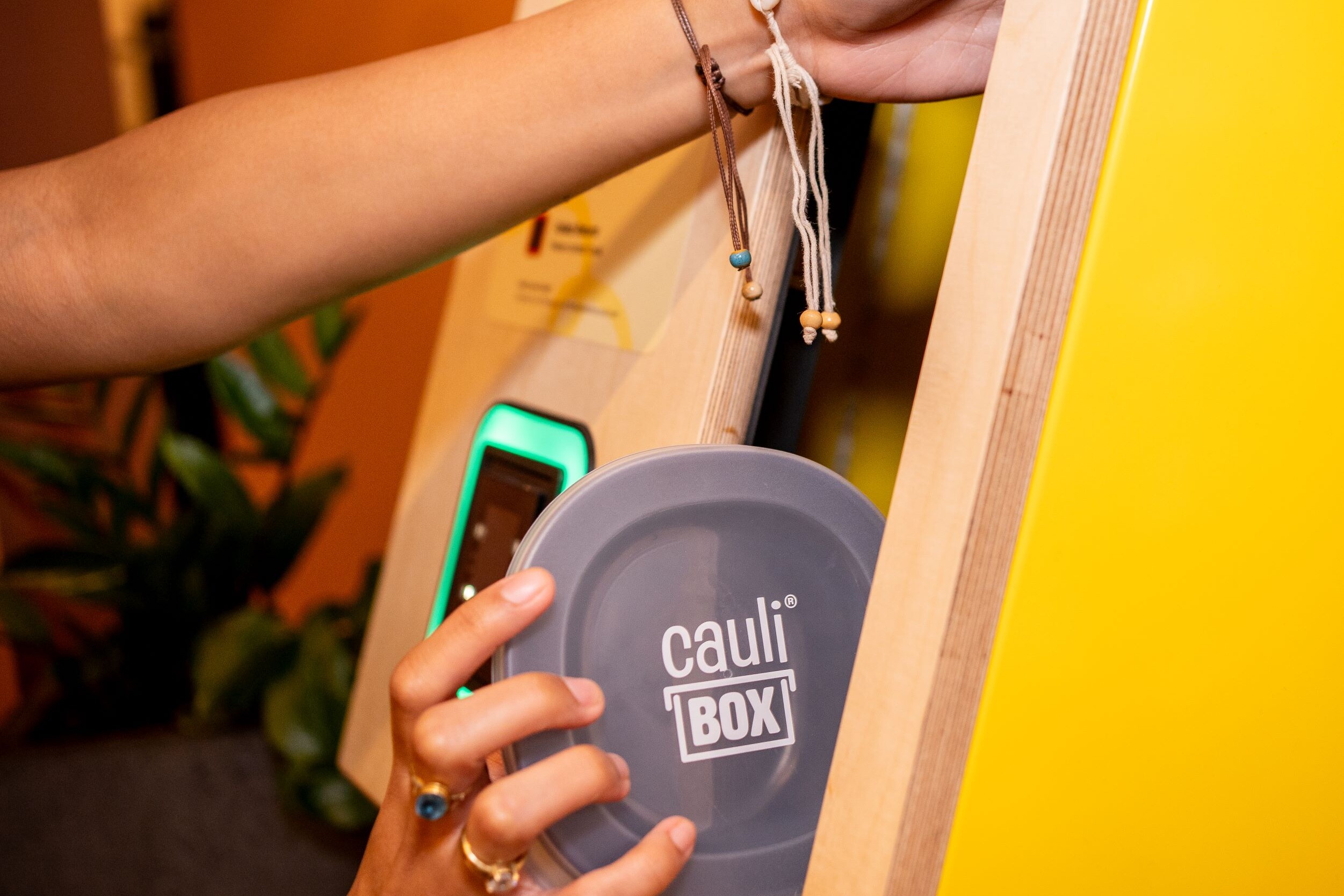
Ming Zhao: Absolutely. Now just imagine you are taking away your iced coffee in this heat wave at your workplace restaurant or from a university campus cafe you can borrow a beautiful and endurable reusable cup or, or if you want some salad, maybe a reusable box as well through just simply tapping either your payment method, either your digital wallet or payment card onto our tap and go terminal that scans a unique QR code that is placed on the outside of the packaging to create a pre authorization. So there is no deposit or upfront cost, it’s just a 0 pound 0 Euro pre authorization. When finished, anytime in seven days, you simply return it to a smart collection kiosk conveniently located everywhere around you and your pre authorization is released. The packaging then is washed and ready for reuse. Zero waste to landfill. Today we are the UK’s largest reuse system provider in the food service sector. Our solution has already helped food service, the sector and the clients, including workplaces, universities, hospitals, et cetera, reduced over 1.6 million pieces of single use packaging in the past four years.
Nick Hughes: So quite a significant scale. And just to be clear, if you don’t return the container within seven days, is it at that point that you incur a charge which presumably covers the cost of having to replace the container, the cup or the container?
Ming Zhao: That’s absolutely right. The whole idea is not to penalize the customers, but to incentivise them to always bring it back so we can actually close the loop for the circular economy.
Nick Hughes: And Ashley, how did the collaboration therefore between Compass and Colli come about?
Ashley Taylor: It goes back some years now. So it was actually in 2021, we had a client of our restaurant associates group was looking for a solution to reduce single use and to change their culture around waste. And that led us to Colli. But when Colli released their tap and go solution in 2024, it was really since the end of 24 that we’ve been working to build on the existing relationship and proving this new tap and go concept within different sectors and it’s been hugely successful. So we have had a couple of proof of concepts within our healthcare sector and our US sector, which is more like office environments. And as you can imagine, very different environments. You know, healthcare is very transient office environment being more closed loop. But what really stood out to us about Kali was that they had developed a really practical, technology enabled solution, but it was linked to deposit that works in a real world operational environment and it works for both our teams and our customers. And, you know, the collaboration. Okay, yes, we’re always looking for great innovation solutions about how we can reduce our waste, but it was about, yeah, how can we understand how to reuse can be implemented successfully, successfully at scale? What barriers do we need to overcome and drive the adoption? And yeah, as I said before, it’s ultimately our shared ambition of reducing single use.
Nick Hughes: Yeah, okay. And Ming, perhaps tell us a little bit about how you work with Compass during that initial proof of concept phase to design a solution that worked in those specific operational contexts. Because one of the things we’ve learned about reuse from all the various trials that have taken place over the years is that there isn’t a one size fits all solution, is there? So what did you learn from that proof of concept phase?
Ming Zhao: I would say first and foremost, it really has been a piece of collaborative work. We have by this point many iterations of our different types of packaging and technology hardware. We have a shelf in our office which we call it’s the Koli Museum because it’s got all the other iterations to remind us how far we’ve come in the past few years. And I think it’s all based on the candid and constructive feedback that our clients from Compass that have been given us on continuous basis and from us. We are startup. You know, the how fail fast, learn fast is in our DNA to give you Maybe an example to illustrate that when we first began, well, many of you would know our name initially as Collie Box, which is very cute. And the reason why we’ve transitioned slightly from being Colliebox to Collie is because in addition to the reusable food containers, we’ve introduced reusable cups in the past three, four years because customers are a lot more familiar with the concept of reusable cups, thanks to bring your own cups initiative. But at the start, our technology was really centered around our mobile app. That was customers will download the app themselves, self scan the qr, just show the verification at the point of checkout in order to borrow. And the feedback we received was when hungry customers, hundreds of them, descend to the restaurant, the last thing they wanted was to download the app there and then. And that was why how our customers and ourselves were brainstorming together, how do we remove this one hurdle, this point of adoption? And that was where Tap and go terminal came about. As Ashley mentioned in early 2024, no Power app download required. You just go and tap your card and if you do want the app later on for collecting our very popular Kohli coins, royalty points, etc. You can do so and just link the same payment card and you can still review your personal history, when to return reminders, etc. So I think that is one of the many, many examples I wanted to really kind of share in terms of how far this journey has come in order to, again, it’s all about making it easy and simple for the customers.
Nick Hughes: Yes. Removing those points of friction in the customer experience. Absolutely. Ashley, did you learn anything about people’s behavior and habits during the pilot phase? Was there anything that surprised you about how people engage with the system and, you know, anything that you, that you adapted before moving on to the full rollout?
Ashley Taylor: I think the biggest thing that we learned was that it’s behavior change is the biggest challenge rather than the technology itself. Convenience also supports driving that behavior change. You know, a lot of people are really supportive of sustainability initiatives and. But participation increases significantly when the process is simple. It’s intuitive, and it fits naturally within their nearly natural, you know, daily routine and as part of our operational workflows. So, yeah, it was really that clear communication was critical to the success of the rollouts. We had to have, you know, make sure our customers and operators understood how the system worked and why it mattered. And really simple messaging, visible return points, clear instructions, you know, how to help improve engagement and those return rates as well. So the example I gave earlier about Our Restaurant Associates group, I think we had like a 99.6% return rate, which is absolutely incredible. And you know, these things take time to develop. You know, reusable packaging isn’t just a packaging change, it’s behavior change. Successful reuse system needs to work for the people first. And if it’s easy, then the environmental benefits will flow from that. And Collie is definitely a very simple, easy to use system that’s being very successful. Within all those different environments that Compass operates within.
Nick Hughes: And where it has been deployed, is it the only takeaway option available to customers or are there still alternative single use containers that people can also choose to purchase from? I guess what I’m asking is, you know, do you sort of have a captive audience for this or is it, are you asking people to choose a reusable option versus a single use option?
Ashley Taylor: Yeah, so I think it depends on the environment. I think you hit the nail on the head earlier. It isn’t one size fits all approach. You know, we have let’s say a couple of different operational, different environments. So it might be our client wants no single use, so that would be the only option. There might be different environments where there’s a little bit of, you know, single use and colleague to support that and support that transition, you know, so this is a journey. It’s not as I said, one size fits all. But also we have lots of other tech like non tech enabled solutions within Compass as well. You know, just like keep me cups and that aren’t deposit based or have technology. So it really depends on the clients and the environment and what works operationally for, for that site.
Ming Zhao: Yeah. I just wanted to add to Ashley’s point. I think for us and our collaborators, collaborative work with Compass Group is all about essentially solving the problem for the clients. That is if the client has a single use problem. And how do we devise a solution that works best for their setup, for their operations and their goals and expectations?
Nick Hughes: Absolutely. And just give me Ming, a sense for the current scale of deployment within the Compass business. Sort of. How many units are you processing each week? And you talked about different types of packaging. Obviously the evolution of Collie Box to Kali to incorporate other packaging types. So have you deployed containers and cups throughout the business?
Ming Zhao: That’s right. We believe once the behavior change is in place then we can introduce more and more types of packaging to reduce bigger amount of single use. So currently we have cups of all sizes from 8 to 12 to 16 ounces. Also with the, you know, clear cold cups, perfect for the Summer for your ice drinks. We also have our beloved caulifloxes ranging from 500 milliliters, which are, which is great for soups, sides, salads, etc. To larger boxes, 101, sorry, 1,100 milliliters and pizza box as well. And we’ll continue to look into expanding our skills again based on customer feedback. We know many of them want a medium sized box, 750 milliliter. So anyone that’s listening if you have that demand, please get in touch with us. The more data points we get, the more we can do to actually bring this product to market. In terms of our work with the Compass, we are currently live in a wide range of business and industry outlets, education, healthcare and government. So for the past few years we’ve collectively reduced directly over 380,000 pieces of single use packaging. And what’s very exciting is that we’re also expanding with Compass beyond the UK into Ireland, which of course is now really pushing forward under for example EU regulations to remove single use. So very exciting times ahead for all of us.
Nick Hughes: This year sees the launch of the first ever Footprint Festival, a two day experiential and immersive sustainability festival set on a working floor farm in the heart of the Hampshire countryside. Created for senior leaders across food, service and hospitality, this one of a kind annual event takes place on September 17th and 18th. We’ll blend sensory experiences, transformative content, powerful networking and unforgettable food, drink and entertainment. Tickets are now on sale. Visit footprintfestival.com for more details. Ashley Compass obviously operates across thousands of sites within the UK and Ireland, each with their own unique features and client requirements. Do you feel there’s the opportunity to really scale reuse systems like Collie across the entire business? And will there be occasions when actually it doesn’t make sense to deploy a reuse system? And alternatives like single use, compostable packaging, for example, might make sense in that particular setting.
Ashley Taylor: There’s definitely potential to expand, you know, across our business, but as we said a couple of times, you know, not one size fits all. Compass stores operate within very different, you know, diverse unique environments. You know, from offices, universities, sports venues, hospitals and really remote locations as well. And you know, the success of a reusable system depends on, you know, factors such as consumer behavior, change, return logistics, available infrastructure and obviously again the operation complexity. So there will be environments where reuse isn’t going to be operationally viable, but where it is, then you know, the if we should definitely be working towards introducing a system, you know, and re stores we find tend to work best in those closed loop environments, you know, where customers regularly return. There’s a mechanism for the collecting, the washing redistribution. People are familiar with those environments. They go every single day and you know, it’s part of their daily routine, you know. But we have also, you know our levy, our events and sports and entertainment sector have partnered with a reusable event cup solution was one of their key initiatives to reduce the single use plastic and you know was saying earlier it’s all about messaging. You know they have dedicated one cup bins to ensure customers know how to return them. But that’s another partner that you know works in that environment and you know, since they’ve started working Together they’ve used 8.4 million reusable cup. So yeah, it’s, it’s really just important to assess each situation, each sector, each site by case by case basis. But yeah, REUS has a significant role to play in the future but it’s not always the same in every single setting and you know, it’s key to understanding that operational context and selecting the best solution that delivers the best overall operational, customer and environmental outcome.
Nick Hughes: Yes, I was at Wimbledon the other week actually and which I believe is a levy operated site, isn’t it? And there were reusable cups in operation across the site which is, it’s so nice to go to a major sporting event and not be handed a plastic cup to take, you know, a single use plastic cup to take your drink away. And so yeah, credit credit to them for that. Ming, just touching on Ashley’s point about how closed loop systems tend to be the easiest where reuse is concerned and that’s great and obviously you’ve made a real strides in institutional and a sort of event dining settings. How about the application of something like Collie on the high street perhaps where it’s not quite such a closed loop setting and people are taking packaging away with them and perhaps not immediately returning to that store. What kind of potential do you see for adapting the system and or the technology to work in those more open loop settings?
Ming Zhao: Quick question Nick. Our vision is to help as many food and drink outlets to switch to reusables as possible. As I mentioned, our journey actually started in the open loop environment before the pivot in 2021 for us I think we’ve learned a lot having done trials in both the open loop but also delivery sectors and also having our advisory board for example be made up of Julian McCarthy who is the founder of Pretend Itzu and Jamie Krumey who’s the co founder of 2good2go, both guys worked a lot in the open space environment. I think that really underlines our ambition for the future. And what we have seen is that there are two major barriers, to say the least for essentially deploying reuse widely in the open loop environment. The first one is the operational complexity, whether it’s the logistics or the cost that comes with it. And the second piece is customer acquisition. And I think on the operation side, with automation happening faster and faster these days and driving costs down, at some point we see that piece being able to be handled, whether it’s through what we envisioned, you know, delivery robots, et cetera, picking up used containers and getting washed and then deliver them back. But I think the other barrier, customer acquisition, can really only be done by us signing up hundreds if not thousands of individual customers in their workplaces, in their schools, universities, and educate them in that environment repeatedly. So one day when we are ready to take on the open loop environment, our closed loop customers can go on the high street while they’re on holiday or they’ll see colleague. I’ve seen colleagues, I use colleague. I know how exactly this works without individual outlet having to educate their customers as they walk through the doors. That’s personally speaking, a quite mission impossible piece. That’s why we’ve decided to really take back to, you know, the closed loop environment to start with. Not because it’s easy per se, because as Ashley mentioned, every setting and institution clients would have their expectations. But I think it’s just the most efficient way of scaling reuse. For us as a company, it’s crucial we make this piece work and to prove ourselves to be both environmentally and commercially profitable in order to take on the bigger piece. There is really no point in sustainability companies being pumped in cash by investors only to deploy a solution that won’t work at scale. And that’s exactly I think what we believe at Koali.
Nick Hughes: And just on that point about scale, I was reading Rapp’s final report on the plastics pact the other day and he was saying actually that reusing grocery has declined since 2018 as pilots have come and gone. But what it was talking about, which struck me as important, is the need for greater interoperability between businesses. And I imagine particularly on the high street, the convenience of being able to take a cup or contain a back to a range of different stores, not necessarily the same store from which you’ve purchased it, would reduce a lot of friction for consumers. Do you but do you see any appetite for collaboration between businesses over reuse systems or is that just a really hard sell?
Ming Zhao: Great question. So we have spoken pretty much with every retailer or franchise operator on essentially their vision for reuse and I think the elephant in the room is cost. I think this is a matter of if we can prove that reuse delivers economical benefits to the operators of the retail chains, et cetera, then it’s going to be an easy sale. And how do we drive down the costs? Again, it’s back to the two points I’ve raised on the operational side through automation and on the customer acquisition side through having already basically adapted those customers from the closed work environments so there is no actual spending needed on essentially customer acquisition cost in the open loop environment. I think for any business, especially in the current environment, if we can present a convincing case of cost reduction and environmental benefits, then I think it’s a no brainer. But if we can’t present this case, which I think might be the case for the grocery scenario, then I think that’s where the challenge will continue to remain.
Nick Hughes: Yes. And Ashley, final, final question to you. You know, Compass Group is the largest organization operating in the food service space and you have these closed loop environments generally. So do you feel that the food service sector as a whole has an opportunity to really get ahead of the curve on reuse and lead the charge and then hopefully other segments of the hospitality sector, restaurants and food to go outlets and even grocery can sort of start catching up. But is there an opportunity for food service to take the lead?
Ashley Taylor: Yes. No. Absolutely. And hopefully we’re already doing that, you know, so in collaboration with partners like Kali and with their introduction of our new target to reduce that single use food service packaging, that yeah, hopefully we’re going to be innovators within this space and you know, there’s growing pressure to reduce waste and use resources more efficiently. That’s going to continue to drive innovation and you know, the more so we have lots of nice closed loop environments that this is hopefully going to work within. And you know, we’ve had these proof of concept that have been really successful and also people get very motive about single use. You know, it’s very visible to our clients and our customers and if we’re introducing these new tech based reusable systems that you know, people get very passionate about it and want to be involved within that and feel like they’re doing something good as well. So. But yeah, so Kali’s been really successful partner for us so far and hopefully we’re going to scale that across the business and you know it’s going to have then really good evidence based solution that we can really deliver like really good measurable outcomes in terms of reducing single use and the environmental impacts that follow from that. So yeah, I’m looking forward to the next year.
Nick Hughes: Well, thank you both for sharing your experience working together. Between Colleen and Compass, it feels like we need as many examples as possible that demonstrate the business case for deploying reuse within the food system and it’s great to have that example at scale of what you’re doing. So thank you for sharing your insights and thanks for joining us on the Small Print.
Ming Zhao: Thanks, Nick.
Ashley Taylor: Yep, thanks for having us.
Nick Hughes: The Small Print will be taking a short break over the summer. We’ll be back in September with fresh stories of innovation, inspiration and perhaps even a dose of exasperation as we continue to drill into the topics shaping the sustainability agenda in the hospitality and food service sector. In the meantime, you’ll have a chance to catch up with previous episodes over the summer as we explore some of the themes that have shaped the Small Print over the first six months of broadcasts. Have a great summer and we’ll see you soon.