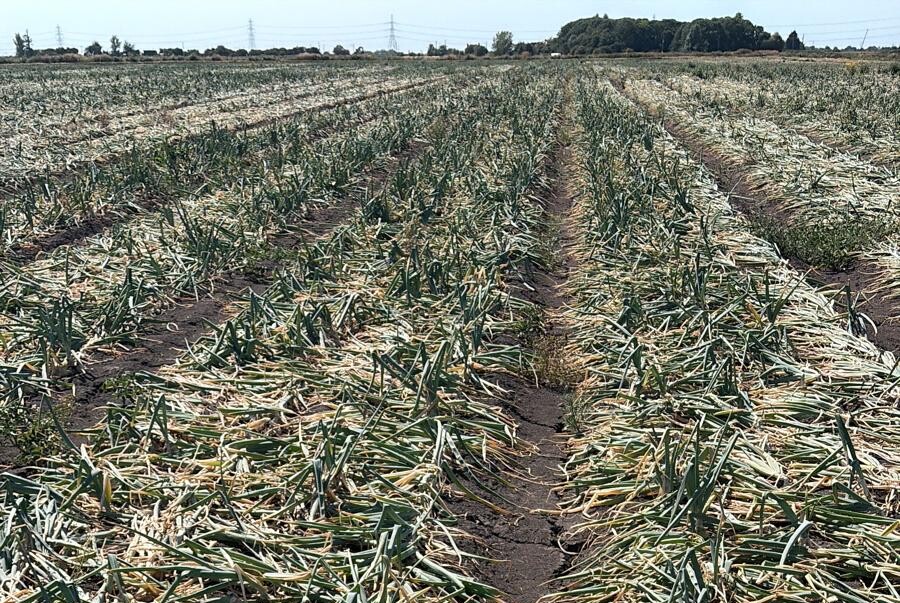
There can be few ingredients more essential to the hospitality and foodservice sector than the humble onion. From its role as the basis for soups and sauces, to its use as a standalone ingredient in burgers, stir fries and all manner of other dishes, the onion is one ingredient chefs cannot do without. Yet onion growers have just experienced their most challenging season ever following a summer of extreme heat and drought, with the British Onion Producers’ Association (BOPA) warning of major challenges with yields and quality. In this week’s episode, Nick is joined by BOPA’s chairman Ben Collins to highlight the difficulties extreme weather is causing onion growers, and set out the support British growers will need from buyers and policy makers to ensure a sustainable supply of onions long into the future.
Subscribe to the podcast



Further reading

How can foodservice handle the heatwaves?
As high temperatures and drought threaten key food and drink ingredients, the impact from lower yields and quality issues will trickle down the supply chain

Ministers meet to discuss extreme weather
Ministers joined Andy Burnham to discuss the immediate threat from wildfires and pressure on water supplies
Transcript
Nick Hughes: Hello and welcome to the Small Print, a podcast by Footprint Media Group. I’m Nick Hughes, Footprint’s Editorial Director. Each week we delve beneath the headlines of an issue impacting the hospitality and food service sector through our unique lens of environmental and social affairs. There can be few ingredients more essential to the hospitality and food service sector than the humble onion. From its role as the basis for soups and sauces to its use as a standalone ingredient in burgers, stir fries and all manner of other dishes, the onion is one ingredient chefs cannot do without. Yet onion growers have just experienced their most challenging season ever, following a summer of extreme heat and drought, with the British Onion Producers association warning of major challenges with yields and quality. In this week’s episode, I’m joined by BOPA’s chairman, Ben Collins, to highlight the difficulties extreme weather is causing onion growers and set out the support British growers will need from buyers and policymakers to ensure a sustainable supply of onions long into the future. Ben, thank you for joining me on the Small print. Great to have you talk with us. Before we get into the particular challenges facing onion growers following this summer’s extreme weather, perhaps you can give a quick introduction to BOPA and the work you carry out on behalf of your members.
Ben Collins: Hi Nick. Yes, thank you very much for having us on the show. My name is Ben Collins and I’m the chairman of British Onions. British Onions, or BOPA, was founded in 1986. We the aim of sort of encompassing the whole of the British onion industry and strengthening its position in the world market. It’s open to anyone involved in the industry. We’ve got representatives from all the major packers in the uk, processors, agronomists, and it probably covers around or the members probably incorporate around 80% of the UK onion crop grown. So we’ve got a really good base for collecting information and which is basically what British Onions does. We have two committees, we have the marketing committee which meets periodically through the year to talk about challenges within the growing season, challenges within the world market, and then the other branch is the the R and D committee, which are looking more at sort of agronomic challenges, perhaps other bits and such, research projects for different things, which I’m sure we’ll touch on later on, like Fusarium. But, yeah, that’s basically what BOPA is.
Nick Hughes: Yeah. Okay, super. So at Footprint, we’ve been covering the impact on UK food production of this summer’s extreme weather. Over recent weeks, we’ve highlighted the impact on arable crops, on livestock, and of course, on horticulture, everything from brassicas to salad crops. How has the combination of unprecedented heat and, of course, drought we’ve experienced impacted onion growers specifically?
Ben Collins: I’ve never been here. This is uncharted territory, really. It’s the. And it’s as. As you say, it’s the combination of drought and heat that’s. I think it’s important to. To note that the heat is probably the thing that has done the most damage this year. An onion crop, when it’s growing, has a sort of an optimum growing temperature, if you like. When we’re hitting over 28 degrees with the varieties that we’re growing here in the UK, which are these Rhinesburger varieties, the crops are basically just shutting down. Despite the fact that growers have been watering every five to five to seven days and trying to get around with as much water as they can, they’re actually just physically losing growing time and. And the water that they’ve been applying is basically being. To. To keep crops alive as opposed to gaining any yield that. I think that’s the. That’s the bit that we’ve really got to hit home is it. It’s the. It’s the temperatures that were. That, of course, that this year, as a result, I guess. Yeah, like. Like most other veg yield will be down. Yield is made up of two different factors. It’s. It’s plant numbers and it’s bulb size and bulb weight, I suppose so, although the plant numbers have been reasonable and not as good as last year, but they were very much workable. The bulb size and the bulb weight is what’s hit our yield, basically. So we think we’re going to be within the region of 25 to 40% down on yield, which obviously leaves quite a big hole in the UK industry. Couple that with the high soil temperatures and what we think will be quite a high risk of disease coming in this year in the form of Fusarium makes for the perfect storm, really. Which we’re all quite nervous about.

Nick Hughes: Yes. I mean, 25 to 40% down on yield that’s quite an extraordinary number, isn’t it? And as we were discussing before we started broadcasting, people might think, well, we’ve had a week or two of fairly decent rain, but that’s come far too late for this season’s crop. So what are you expecting to be the impact for the supply chain? Should buyers be prepared for a shortage in UK supply and higher prices? And if so, can that some of that shortfall be plugged by imports? Because of course we’ve seen Europe has suffered just as much from these conditions as the UK has.
Ben Collins: Yeah, 100%. I think the fact that Europe has been hit by the same sort of weather conditions, it is a worry. Like say we normally we would just top up through the season through our neighbors in Holland who are a huge producer and exporter. So that would be the go to. If we had a bad year, we just sort of make some phone calls over the water and fill the gap. Like you say, they’re in the same boat. So. So yes, it’s, it’s looking towards the back end of the season really, and, and Southern hemisphere. We’re quite lucky in the onion world in that we have one harvest. We harvest, get everything in store. We can then take stock of what we’ve got. And from that sort of information of sort of, once we’ve got an idea of how much we physically have and what the quality looks like, we can make informed decisions on what we’re going to need to get through to the back end of the season or into next season. So, yeah, I suppose in the, in the long term, it’s looking at imports from abroad. Um, in the short term, I think you can expect to see smaller onions on the shelves, whether that be in retail or in food service. The, the, the larger onions just aren’t there in the crop. So hopefully some temporary specifications to, to utilize more crop of what, what crop we have. We’d sort of need the support from our customers in terms of utilizing as much crop as we can in terms of price. Yeah, it’s, it’s one of those releases. It’s a simple supply and demand really. The supply is going to be short and the demand is pretty consistent with onions, to be honest. So, yeah, I would expect to see a rise in prices.
Nick Hughes: Yeah. Okay. And you’ve described this year as the most challenging ever and clearly the weather has been extreme, particularly this summertime. Equally, farmers have been facing more extreme patterns of weather over recent years, as we know whether that’s characterized by excess rainfall, persistent heat, drought conditions. So, you know, this has been affecting growers for some time already, hasn’t it? Albeit perhaps not to the extremes we’ve seen this year. So what steps have onion growers already been taking to try to adapt to these ever more volatile weather patterns?
Ben Collins: Yeah, like you say, it’s. It’s not, it’s not. It’s not the first time we’ve had. We had a bad year in 2018, a bad year in 2022, and now 2026. So that’s three years in. In the last eight. Is it eight or nine years? So. So it’s. Yeah, like you say, it’s certainly something that’s not going away. And growers have reacted, I think they’ve, you know, they’ve looked at their cropping, they’ve been more cautious about overcropping stuff. In terms of irrigation, they’ve looked at other different types of irrigation. So historically, everything was done with sort of big booms and water guns where there’s more people looking at drip irrigation, sprinkler systems. There’s been a huge amount of investment in terms of infrastructure on farm and being able to move water around farms, underground mains and all of that sort of stuff. There’s. So, yeah, there’s been a huge amount of investment into it and that’s something that just needs to continue, really. I think we need to look at. We need to look at availability of water and we need to look about. We need to look at the. The efficacy of using the water as well, I suppose.
Nick Hughes: Okay, so those measures that you talked about, drip irrigation sprinkler systems, is about using what water we have more efficiently, I guess. But clearly there’s a lot more that needs to be done in that regard if this is to become the new normal. So what further support do you think growers need to invest in those kind of more efficient irrigation and water storage systems? I know that the government in the past few weeks has announced some funding, I think about 15 million in funding for on farm reservoirs and has also brought forward some changes around planning consent to make them easier to build. Does that kind of stuff help you or do you need more?
Ben Collins: Every little helps, but the 15 million that’s been allocated by the government is a really nice gesture. Unfortunately, it just doesn’t touch the sides. Just talking very crude figures. If you were to build a reservoir to irrigate 50 hectares of veg crop, you’re looking at an investment of about 1 million, crudely speaking. So it’s just not enough money. And I think, I think within the UK grower base. There’s certainly an appetite to build more reservoirs and to build in that sort of insurance when you’re growing veg crops. The challenges are the sort of, the security and being able to fill that reservoir. That’s the main challenge really. Anyone can dig a hole and fill it with water, but anyone can dig a hole, but not everyone can get the water to fill that hole. And I think that’s where we need to have a bit of a joint up approach between the environmental agency, the government and the growers need to have some very open discussions about water abstraction and licenses and how we can all help each other to basically build a bit of security into growing Vegas.
Nick Hughes: Yes. Okay, Just, just expand a little bit Ben, if you will, on, on what growers are sort of permitted currently with regards abstraction and licenses. Obviously as a household we’ll get a hose pipe ban when drought conditions strike. What kind of restrictions are placed on, on growers where water is concerned?
Ben Collins: Yeah, so the, so the EA is basically in charge of what we call the environmental agency is in charge of what we can, what water we can pump at different times of the year. In August in East anglia, there was 1500 irrigation restrictions in place, which caused a massive issue to the UK onion crop. Because we were in a period of time where we really needed the water to irrigate crops for yield. The crops were in a bulbing stage rather than a sort of a leaf growing stage. So it was a key time for water and we had a lot of growers that were under restrictions. Basically what that means is we’re, we just haven’t got the water when we need it, which seems crazy really, when, you know, this year we came out of January and February was probably the wettest January in February in 20 years and there was an abundance of water and we couldn’t pump enough water at that time to sort of to store that water to be able to use in the summer. And I think that’s where we need to have some growers. The environmental agency and the government need to have some good conversations and some beneficial conversations on sort of water security going forward.
Nick Hughes: Absolutely. And that strategic element around water and you know, the ability to capture it when it’s plentiful and redeploy it when it’s not, actually seems to be a relevant conversation across all kinds of sectors, not just agriculture. In a little over two weeks time, hundreds of the UK’s leading food, service and hospitality professionals will descend on Barnes Grove Farm in Hampshire to tackle the biggest challenges and opportunities facing our industry. Footprint Festival takes place across the 17th and 18th of September and features more than 130 speakers across five stages. Those attending will hear from influential thinkers including Sir Charles Godfrey on future proofing hospitality, Minette Batters on Farming’s Future, Douglas McMaster on Waste Free cooking, and Hugh Fernley Whittingstall on fiber. But Footprint Festival is so much more than a hub for conversation with workshops, exhibitions, demonstrations, networking and entertainment. You’ll leave with fresh ideas, valuable new connections and the energy to help shape what’s next for our sector. Barnesgrove has a fixed capacity and there are just a few tickets remaining. Secure your space now by visiting footprintfestival.com so Footprint readers, caterers, restaurants, pub groups, etc. Are very interested in supporting more resilient and some are using the description regenerative farming via their procurement, both from a carbon reduction perspective because they have internal net zero targets to meet, but also with an eye on their long term resilience of supply and being able to access the raw ingredients that they need. So what are the opportunities for onion growers to adopt more climate resilient farming techniques? Are there things already happening at a farm level in terms of use of COVID cropping, reduced reliance on artificial fertilizer, encouraging more biodiversity by planting hedgerows and wildflowers, et cetera? These are examples I know from other commodities. But what is possible with onions? Are there any limitations to adopting these kind of more nature friendly practices where onions are concerned?
Ben Collins: Yeah, I think the grower base is probably doing a lot of that stuff anyway because it sort of all comes up in, you know, a lot of the, the other farm practice with other crops as well. I think one of the big opportunities for us as British onions is looking at at onion breeding and varieties going forward. I think where historically we were, when we were looking at our varieties and variety choices and breeding programs, it was all about better skin finish, Perhaps an earlier harvest, good yielder obviously would be up there, better storability, all of that sort of stuff. I think going back to the, to the, you know, the, the water issues, we’ve got to be looking at drought resistance, something that’s going to be able to sort of cope with these hotter, drier summers. Unfortunately that’s not something that happens overnight. That’s something that’s we’ve got to start now and we’ll hopefully see results in 3, 4 years with breeding programs, but I think that’s something we need to look at. The other thing we haven’t touched on a huge amount is Fusarium which is something that we’ve seen on the rise in Northern Europe for the last 15 years. And it’s costing the industry a huge amount of money every year. We know that drought conditions and heat make it worse, but despite that, it’s there anyway. And I think it’s something that we, again, from a breeding point of view, we need to be looking at breeding Fusarium resistant varieties or Fusarium tolerant varieties, perhaps. I should say.
Nick Hughes: Yes. Okay. And you mentioned that this isn’t a quick fix, clearly. And crop breeding programs take some years to come to fruition. Are you able to share anything that’s happening currently in terms of, you know, are there trials taking place on farms? And also, what’s the role in the supply chain to support those kind of crop breeding programs? Because one of the things that we talk about a lot is who. Who takes on the risk essentially for these kind of programs. And it shouldn’t be all on the farmers, should it, to be experimenting with new varieties and spending time and money on developing these programs. So what’s going on already that you can tell us about? And is the support for those programs coming from further down the supply chain from the, you know, from the packers and the processors, but also from retailers and food service operators?
Ben Collins: Yeah, there’s plenty of stuff in the pipeline within sort of the R and D committee at British Onions, they’re looking at. Yeah, there’s lots of grant funding going on for different projects, including sort of Fusarium soil testing. So we can use that as a. As a tool for land selection going forward. So as British Onions, we’re always looking at different grants and funding that we can sort of tap into. I agree that the growers shouldn’t be taking all of the risk of trying all these things out, but it’s in their interest in the day. But yeah, I guess none of these things are free and they take time and money to do. So it’s just a case of building that into prices so they’re sustainable.
Nick Hughes: I guess the point is it’s a shared endeavor. Right? It should be a shared supply chain endeavor because everyone benefits from the results, which are hopefully more resilient varieties that can withstand these, you know, extremes of weather and resilience of Fusarium as well. So it is a shared endeavor.
Ben Collins: Yeah, yeah, exactly that. It’s a shared endeavor that, yeah, everyone would benefit from. Benefit from, really.
Nick Hughes: And do you, do you have a message to those downstream food businesses who rely on a consistent supply of high quality, affordable onions? You know, what further support, whether that’s financial or non financial even do onion growers need and would like from supply chain partners in order to invest for the future with confidence?
Ben Collins: I guess it’s just security, long term security. Growing onions is, it’s a risky crop to grow. You’ve got drought, you’ve got fusarium, you’ve got all sorts of challenges growing the crop. And whilst there’s a very good dedicated group of onion growers out there at the moment, the stress of growing it and the sort of the it’s becoming more of a challenge to sort of get well a get new growers in to grow and to keep the ones that are growing enthused and to keep doing it. So I guess, yeah, security is a major thing.
Nick Hughes: And when you say long term security, are we talking about longer term contracting for example?
Ben Collins: Yeah, yeah, long term contracting, setting prices out, you know. So yeah, so they know what they’re facing into for a year and just sharing the risk?
Nick Hughes: I guess absolutely, yeah. And are you, I mean in terms of the future for British onion growers, are you confident that the UK industry know will be resilient to the challenges it is facing? Is there any sense that or worry that the sector might contract in the years ahead? As you said, if you can’t attract new growers and for whatever reason existing growers leave the sector? Or do you feel that despite the challenges being faced, there is still a positive outlook for UK onion growing?
Ben Collins: I think the group of growers that we have in the UK now are very dedicated to a sustainable supply going forward. I think we need to adapt to ever changing weather patterns but I think there’s a willingness to invest and there’s a willingness to, to sort of to give it a go.
Nick Hughes: So yeah, Ben, that’s been most insightful. Lots of challenges obviously facing onion growers but equally some hope. I think that with support from along the supply chain there is a sustainable future for British onion growing. So thank you so much for joining us on the Small Print.
Ben Collins: Thanks very much.
Nick Hughes: We’ll be back next week with another episode of the Small Print. If you like what you’ve heard, please take a moment to rate share and subscribe.