The annual Groundswell Festival of regenerative agriculture took place at Lannock Farm in Hertfordshire last week. In this week’s bite-sized episode, Nick shares his key takeaways from the 10th staging of the event which speak to the trajectory of the regenerative movement, the tensions that still exist within it, and what it all means for farmers and businesses. In particular, Nick highlights growing scrutiny over the relationship between more sustainable food production and healthy consumption amid passionate debate over whether it matters how ingredients produced in regenerative systems end up being deployed within the food chain. As one speaker asked provocatively: ‘Is a regeneratively farmed KitKat too good to be true?’
Subscribe to the podcast



Further reading

A government proposal to freeze the price of essential items sent a chill through a food industry battling structural challenges for which ministers appear to have no answers
Is nutrient density the next frontier in sustainable agriculture?
As science begins to explore how different farming practices affect the health properties of food, there are new opportunities to incentivise farmers to produce nutrient-rich ingredients
Transcript
Hello and welcome to the Small Print, a podcast by Footprint Media Group. I’m Nick Hughes, Footprint’s editorial director. Each week we delve beneath the headlines of an issue impacting the hospitality and food service sector through our unique lens of environmental and social affairs. So I’m back home after an enjoyable and insightful few days at the Groundswell Festival at Lanark Farm in Hertfordshire, and I’ve been reflecting on what I heard in the discussion tents and on the sidelines of the event. This year was the 10th year of groundswell, and there’s no doubt that the festival has grown hugely in both scale and scope during its first decade. Walking around the fields, looking at the stands and the lanyards, yes, you see farmers. But I’d wager they’re outnumbered now by people representing NGOs, academics, suppliers of agricultural inputs and technologies, food manufacturers, retailers, hospitality sector businesses, media, of course, and many others besides. And that variety is reflected in the topics being discussed. I’ve attended sessions on food security, on supply chains, on ultra processed foods, on beans and pulses, on regenerative brewing. A real diversity of subjects and a real diversity of opinions being shared. So rather than trying to summarize everything that was said, what I’m going to do is pick out a handful of my key takeaways from this year’s festival that speak, I think, to the trajectory of the regen movement and also the tensions that still exist within it and what it all means for hospitality and food service businesses. Number one on my list is that it feels like we’ve largely moved away from the question of why regenerative farming to questions concerned with what and how. Here’s Martin Lynes, an arable farmer and head of the Nature Friendly Farming Network, on how attitudes to regen among fellow farmers seem to have shifted.
It’s a growing movement. Last year was the first year I get to go to loads of Shows and events across the country. Nobody come up and give us a hard time. They all want solutions, actions, support, advice. And I found that as a movement of change.
Martin Lynes there, speaking during a session on Lessons from Around the World in Scaling Regenerative Agriculture. What’s driving this attitudinal shift that he alludes to to adapt? A well known aphorism? It’s the economics, stupid. The effects of geopolitical shocks like the war in Ukraine and more recently in Iran have reverberated along supply chains. Food producers farming conventionally, by which I mean those producing a narrow variety of commodity products with a heavy reliance on fossil fuel inputs, have felt the full force of significant price inflation, with fertiliser up more than 40% this year alone, diesel up around 50%, and other key inputs also increasing significantly in price. Those adopting more regenerative systems that seek to harness the symbiotic relationships that exist within the natural world have been relatively more insulated from the spike in input costs, albeit not protected entirely. Not only that, but those seeking to build soil health and improve the water holding capacity of their land have been better able to withstand a prolonged period of extreme weather, which has seen three of the five worst UK harvests since records began occur so far this decade. A recent study of French farms found that those adopting more regenerative practices consistently outperformed more conventionally farmed holdings during drought conditions, both in terms of yield and profit stability. As was the case last year and the year before, much of the discussion at Groundswell rightly centred on who pays for the cost of transitioning to regenerative farming in the short term and who derives the longer term value from it. Amid an ongoing sense that farmers continue to take on much of the risk but see proportionately less of the reward. But Martin Lynes made the point that what is often lost in the conversation around the economics of Regen Ag is what is the cost of not changing, of not farming in a way that builds resilience to climate change, the threat from which is only going to get worse. This leads on to the second point that I took away from Groundswell, that Regen Ag is no longer the preserve of a small handful of pioneering farmers who have rejected the dominant model of agriculture. It is starting to penetrate the mainstream. Let me qualify that statement by stating that Regen Ag exists across a broad spectrum. There is no suggestion that the kind of holistic landscape level farming systems, perhaps better captured by terms such as agroecological, are becoming mainstream. What we are seeing though, is major producers dabbling in regenerative techniques because they see the intrinsic value to their business model. Now, opinions will differ on the extent to which such farming is truly regenerative in the literal sense, but the trend itself is worthy of exploration. Geese Group is one of the UK’s largest suppliers of fresh produce. With farms and facilities across the uk, Spain, Eastern Europe, West Africa and the United States, it is unequivocally a part of a mainstream supply chain built for scale and efficiency. It also sees regenerative farming as a core part of its future strategy and is incorporating the principles of Regen Ag slowly but surely into the way it farms. As Geese director Julius Joel explained during the session on Scaling Regen Ag, we’re transitioning gradually.
I think one of our central tenets is no cold turkey. We’ve always wanted to make sure we could transition without yield loss and without any supply failures. So that’s unaffordable, I think, for any farming business. And I don’t understand why any of us would try and change our farming model if it meant losing out on income. We’ve been, yeah, we’ve gone down the same route as I suspect many of you here, in terms of learning about how to implement the principles of regenerative farming and then getting into the next levels of learning about how soil biology works, how the food soil ecosystem works, and how we can manipulate use the ecosystem to drive faster photosynthesis, et cetera, and how cycling carbon has become one of our principal focus areas.
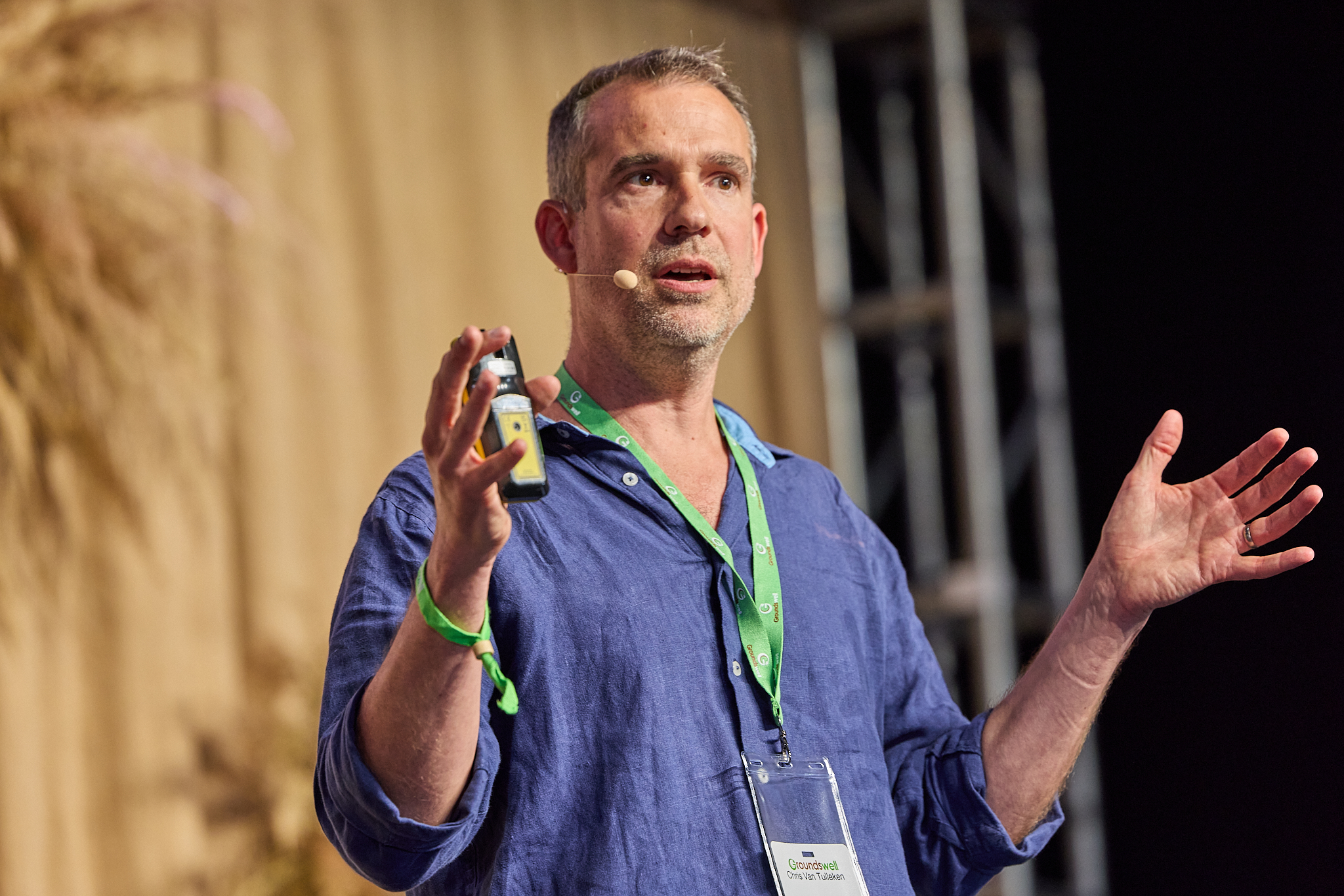
Julius Joel went on to reveal how adoption of regenerative practices such as cover cropping and reduced tillage has resulted in a 60 to 80% decrease in the use of fertiliser on farms most advanced in their transition, along with reductions in water usage. It’s a tangible example of where environmental and economic good sense have collided to create a compelling business case for Regen Ag. So more individual farmers are seeking to farm regeneratively. Businesses that oversee large farming enterprises like geese are also on this transitional journey. What about further downstream? How is demand for regeneratively farmed food and drink growing among food brands, retailers and food service operators? And just as importantly, how is this food and drink being sold and marketed to customers? You can’t miss the wild farm stand at Groundswell. Its fluorescent green canopy, scattered with farming iconography, stands out a mile amid a sea of white. It’s befitting of a brand that has become the poster child for the regenerative movement and whose co founder Andy Kato, formerly of Groove Armada, once again delivered the headline DJ set at the festival’s afterparty. It’s hard not to be in awe of WildFarm’s growth trajectory. Its branded products are stocked by retailers including Tesco, Waitrose and Ms. Its ingredients are used by food service businesses like Nando’s, Gales and zz, and it has brand partnerships with the likes of Jubel and most recently Nestle, which is using a proportion of wild farmed wheat to make the Wafer for its KitKats in the UK. More on this Shortly, as the KitKat tie up proved something of a totemic and divisive partnership for Groundswell visitors. Everyone, it seems, wants a piece of the wild farmed action, and the brand has understandably won praise for the marketing job it has done. For the first time at Groundswell, the question of how regeneratively farmed ingredients are actually used in products found itself firmly in the spotlight. Where this year’s Groundswell differed from previous years, in my view was in really interrogating the relationship between more sustainable food production and healthy consumption, not just in terms of the relative nutrient density of the same food, but a carrot, for example, produced in a regenerative versus conventional system, something that has formed a growing part of the conversation over recent years. But in asking whether it matters how ingredients produced in regenerative systems end up being deployed within the food chain. Enter Chris Van Tulleken, the doctor, TV presenter and author who has become the figurehead of a movement to shine a light on the harms being caused by overconsumption of ultra processed foods. It was standing room only inside Groundswell’s Big Top as Van Tulikan delivered his keynote address. Those familiar with his book Ultra Processed People will be familiar with the thesis that ultra processed foods have been deliberately engineered and marketed to encourage overconsumption and should not be considered real food since they do nothing to nourish us, and that purveyors of these products have employed tactics traditionally employed by the tobacco industry to conceal the harms and escape regulation. Perhaps unsurprisingly given the audience, Van Tulleken’s talk was well received inside the tent. In particular, his closing thought captured attention that is emerging within the regenerative movement. Van Tulleken gave the example of McDonald’s using organic milk for its tea and coffee, a fact it plays on in its marketing, to show how, in his view, small commitments to support better production can create an outsized halo effect for businesses that are not actually interested in supporting a shift to a healthy, more sustainable food system. What he said next is worth listening to in full.
By just buying into this idea of organic farming, something I think is just so powerful. And we’re going to see this with regenerative as well. They’re able to sort of brand themselves as an organic company, but their beef isn’t organic, their flour isn’t organic, their eggs aren’t organic. And so it’s very easy for some of the people who cause, some of the institutions that cause the problems in the system to use the practices that you are all developing and promoting as a smokescreen to increase their power. And so I’m not saying it is a bad thing that McDonald’s did this, but I think we have to be very, very aligned to unintentional consequences. If the only thing that changes in the system is a transnational food company uses regenerative wheat, uses your carrot milk, if that’s all that changes, it’s a win that isn’t all that changes. The companies then use that brand, that idea, that notion to create the idea that that is the system they are supporting. When in fact at another table, in another room, they are doing everything they can to undermine that, to hold on to the system that I think most people in this room are pushing against.
Van Tulleken didn’t explicitly reference KitKat, although his sister in law, the policy expert Dolly Van Tulleken, did the following day when she asked during a session exploring what regenerative farming really means for value and the food we buy, the question is a regeneratively farmed KitKat too good to be true? Does it matter that wheat produced in a system designed to build soil health ends up in an ultra processed confectionery product consisting mostly of sugar and fat? Should we celebrate it as a sign of regenerative agriculture going mainstream? Or worried that so called Big food is co opting the regenerative movement to consolidate its own market position? In a session exploring how supply chains are evolving to meet and maintain regenerative principles, Nestle’s UK and Ireland head of sustainability Emma Keller articulated the supplier’s point of view.
It’s been a number of years in the making because it’s not easy when you’ve got a big company like Nestle to work with, essentially a startup. But because we both believed in regen, we were both wanting to support British farmers and bring them into the value chain. And I guess one of the things we’re really excited about is that it’s shown that regen can go mainstream, we can get it into a household mainstream brand.
One point that feels pertinent to the debate is that Nestle has chosen not to communicate its WildFarm partnership on KitKat’s packaging or through its consumer marketing. Perhaps this helps negate somewhat the argument around the halo effect brands derive from such tie ups and suggests Nestle is indeed doing it for the right reasons. Indeed. Perhaps the biggest unanswered question around Region act is is the extent to which it should become a consumer facing term. Certainly if businesses start actively promoting their regenerative credentials, we will need tighter guardrails around the use of the term, which in turn risks compromising its unique selling point versus standards like organic that regenerative farming is flexible, inclusive, imperfect and context specific. It surely matters less if farmers are taking baby steps towards adopting regenerative principles if buyers of their produce are not seeking to build brand equity by association. In the months and years ahead, we’ll start to discover whether business support for Regen Ag is contingent on it boosting their standing with customers, or whether healthier soils and more resilient supply chains are enough of a reward. One thing’s for certain, where regenerative farming is concerned, there’ll be no shortage of opinion on the matter. We’ll be back next week with another episode of the Small Print. If you like what you’ve heard, please take a moment to rate share and subscribe.