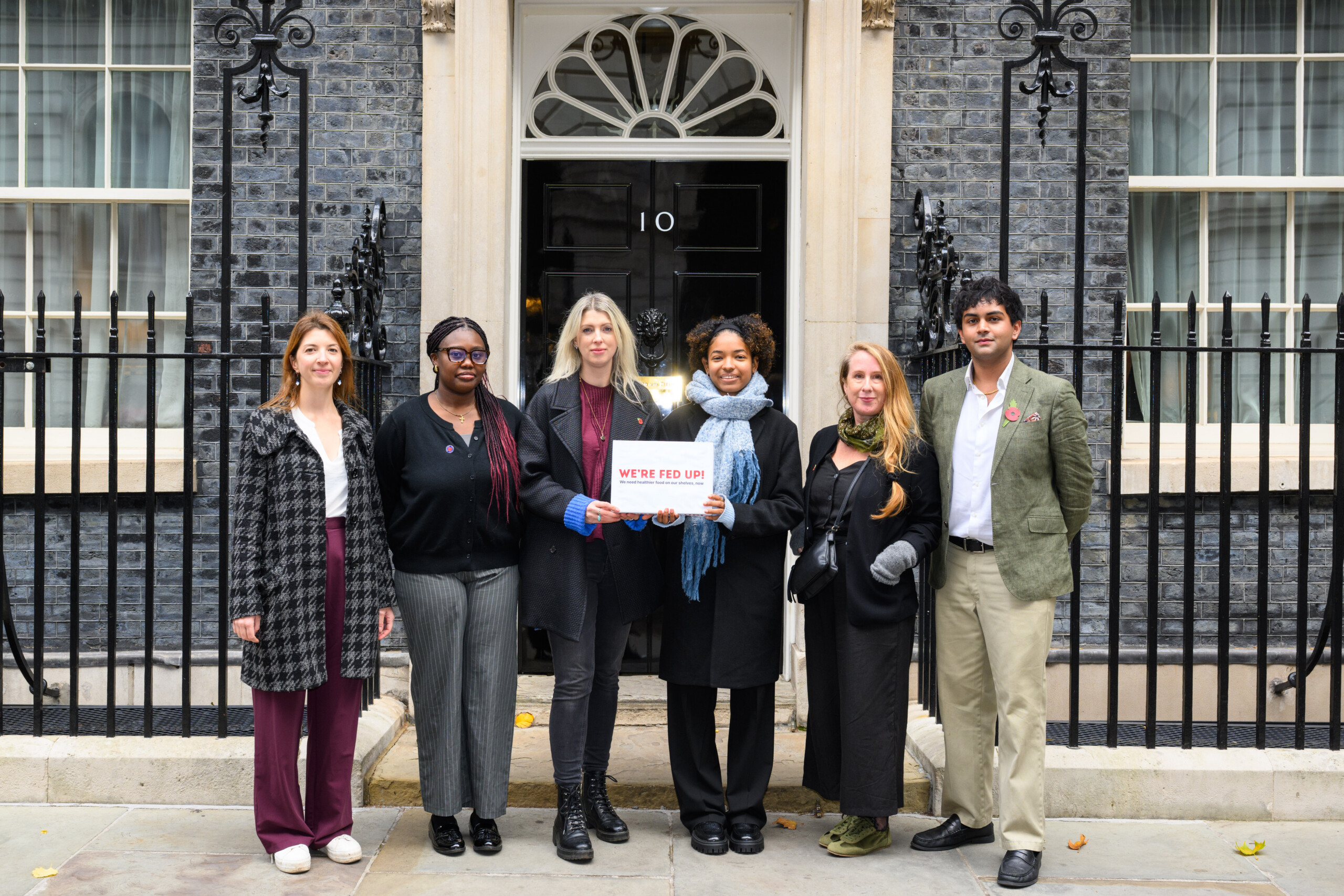
On Monday, campaigners delivered a Citizens’ Charter to the door of 10 Downing Street in which people from across the UK demanded urgent action to make healthier food more affordable and accessible. It came just days after the Health and Social Care Select Committee of MPs said they had “no faith” that the government will achieve its aim to “launch a moonshot to end the obesity epidemic”. Organised by the Recipe for Change alliance of NGOs, signatories to the charter want to see the government build on the success of the soft drinks industry levy by using fiscal and other regulatory measures to improve the food environment. With the Labour government well over two years into its term in office and recently under new leadership, Nick speaks with Kate Howard from Recipe for Change – who works as Children’s Food Campaign coordinator for Sustain – to discuss what actions citizens want to see from ministers and businesses where healthier food is concerned, and to assess where we stand with government policies designed to improve the UK’s dietary health.
Subscribe to the podcast



Further reading
Who’s really driving England’s food strategy?
Defra has confirmed it retains ownership of the Good Food Cycle, but questions persist over the industry’s willingness to wait for government leadership
Manufacturers pledge to publish healthy sales data
Five leading food and drink manufacturers sought to get ahead of the regulatory curve this week by pledging to publish data on the healthiness of their product portfolios
Transcript
Kate Howard: We do strongly believe that regulation is still needed to move the whole sector forward. So, yeah, absolutely, there are companies that are working to sort of reformulate, for example, change their product lines. But often, and we’ve spoken to many companies who do want to put better products on the shelves or in their shops and struggle with the fact that there isn’t wider regulation, which means that everyone else has to do so as well. It means they’re putting their heads above the parapet and there isn’t that level playing field around across the board. So that sort of isolated leadership is not the same as the system wide change that we need.
Nick Hughes: Hello and welcome to the Small Print, a podcast by Footprint Media Group. I’m Nick Hughes, Footprint’s Editorial Director. Each week we delve beneath the headlines of an issue impacting the hospitality and food service sector through our unique lens of environmental and social affairs. On Monday, campaigners delivered a Citizens Charter to the door of 10 Downing street in which people from across the UK demanded urgent action to make healthier food more affordable and accessible. It came just days after the Health and Social Care select committee of MPs said they had no faith that the government will achieve its aim to launch a moonshot to end the obesity epidemic organised by the Recipe for change alliance of NGOs. Signatories to the charter want to see the government build on the success of the soft drinks industry Levy by using fiscal and other regulatory measures to improve the food environment. With the Labour government well over two years into its term in office and recently under new leadership, I speak with Kate Howard from Recipe for Change, who works as Children’s Food Campaign Coordinator for Sustainability, to discuss what actions citizens want to see from ministers and businesses where healthier food is concerned and to assess where we stand with government policies designed to improve the UK’s dietary health. Kate, welcome to the Small Print. Thank you very much for joining us. It’s only Tuesday as we record this, but it’s been a busy week already for you. I know, and the Recipe for Change Alliance. Tell us about your visit to Parliament yesterday.
Kate Howard: Yes, we had a very exciting day yesterday at Downing street and then later in Parliament. So we took our Citizens charter with over 10,000 names, supporting names behind it, to Downing street to deliver our calls for change that we’ve developed with citizens over the last year. And then we had a parliamentary reception in the afternoon to bring those voices to the parliamentarians and really hear the change that they wanted to see as well.
Nick Hughes: Super. Well, we’ll get into the detail of the Citizens Charter and what it is and what it’s calling for in a bit. Just remind us what and who the Recipe for Change alliance is that has brought this all together.
Kate Howard: Yeah. So Recipe for Change is a coalition of NGO organizations calling for stronger regulation of the food industry. We have a vision of healthier food on our shelves and for everyone to be able to access healthy and affordable food. The core ask that we’ve been campaigning on is to build on the success of the soft drinks industry, levy and expand fiscal measures to unhealthy foods. So particularly looking at products which are high in salt and sugar. And then this work is led by us at Sustain, alongside partners of the Food foundation, the Obesity Health alliance, and we’ve got 45 organizations in the broader coalition as well.
Nick Hughes: Okay, super. And the work is funded by Impact on Urban Health? I think.
Kate Howard: Yes, yes. Impact on Urban Health is the funder. Yeah, they work closely with us.
Nick Hughes: Okay, super. So this is a citizens charter. So clearly there’s been, you know, it’s citizen led, huge amount of engagement with the public. Tell us a little bit about how the charter itself has been developed. What process did you go through and how did you engage citizens with it?
Kate Howard: Yeah, so we, we started from a position of being frustrated, knowing that there was a real public appetite for change, but feeling like the government wasn’t really seeing that or hearing that. And so, as I said, our broader vision, although we have customer specific policy calls that we work on, our broader vision is for those healthier, healthier food on the shelves. And so we developed what became known more publicly as we’re fed up, a citizens charter. So it’s really a people powered call for healthy, affordable food. We the entire process, we began by running focus groups with a range of people across the country, including parents, young people and families with experience of food insecurity as well. And we brought them together to really hear about their experiences of buying food for their families. What gets in the way of eating well, what they’d like to see change, and what they want the government and food businesses to do. And then we sort of pulled together everything that they had shared with us and that formed the citizens charter. So with six calls for change that came directly from the citizens. So wanting to make food healthier, more affordable and accessible wherever people live. Holding food companies accountable for improving health, not undermining it, for protecting children from harmful food marketing. From providing clear, honest information that people can trust. Putting people in communities at the heart of local food decisions. Last but not least, creating welcoming community spaces where people can access and share Healthy food. So we pulled all those together and then we really wanted to see if what we were hearing reflected what the wider public across the country felt as well. So we also did some polling with YouGov, which really backed up that there is that really strong appetite for change across the country as well, with really significant numbers wanting action from the government and from food businesses, businesses to make food affordable, healthier food affordable and also more readily available. And only 11% of people polled felt that the food businesses would make their food healthier without government intervention as well.
Nick Hughes: The message, I guess, from reading the charter and the report alongside it, is essentially that the people are unhappy, fed up, as you put it, with unhealthy food being the norm in our society. And there may well be listeners who dispute that characterization of food environments being inherently unhealthy, in which case, remind us, if you will, what does the evidence say about the relative affordability and accessibility of nutritious food versus less healthy options?
Kate Howard: Of course, the picture varies wildly across the country, so people will have different experiences. But the people we spoke to, and as well as a lot of the statistics and the evidence shows that there’s, there’s a real imbalance in the way that people can access affordable healthy food. So of the polling that we’ve done, 60% of the public say eating a balanced diet is hard for them. And as I mentioned, we, almost 80% of people think that the government should be doing more to make a balanced diet affordable as well. Stats from the Food Foundation’s recent Broken Plate report show that healthy foods are more than twice as expensive as less healthy foods on a calorie by calorie basis. And again, that is, some people will dispute that from their own experiences, but that’s looking at the entire picture across the country and how that averages out. And then you have things like one in four food outlets across the country or across England are fast food businesses. And that is even more. That’s one in three in more deprived areas as well. And then you tie onto that there’s things like advertising and promotion. So for every £1 spent on advertising fruit and veg, £18 is spent on advertising confectionery snacks and desserts. And there’s plenty of evidence that is also more targeted in more deprived areas too. So it’s particularly people who are low on lower incomes. We’re really targeted and suffering in these more in these food environments that are much harder to access healthier food. I think really what came out of the conversations in our focus groups as well, really Sort of put that human experience onto it too. So, for example, Kirsty in Bristol, who we spoke to, described that it’s often cheaper, she finds, to buy a five pack of chocolate bars than to buy raspberries or blueberries.
Nick Hughes: It feels like an important point to make that this is about equality of access as much as anything, isn’t it? And this notion of food environments, food deserts almost, where there are pockets of the country where you can live, you know, and not have access to healthy, fresh food, fruits and vegetables, and not have the ability to meet the government’s eat well diet, because you’re not practically able to do that. And I think that will lead us on later to the talking a little bit about the eating out of home environment as well. And like you say, the prevalence of unhealthy fast food outlets in more deprived areas versus more affluent areas. But let’s start with government, because Recipe for Change is, as I understand it, in essence, a campaign for stronger regulation of the food industry and the sort of the nutritional aspects of the food we buy. So we should do a bit of a stop check, shouldn’t we, of where the current government stands, what it has achieved since coming into office in 2024, notwithstanding of course, the recent change in Prime Minister, which may have some kind of impact, of course, on some of those policies going forward. So you have compiled a bit of a list here. We’ve seen funding for breakfast clubs. We’ve got new school food standards that have now been agreed, don’t come into force until next September. We’ve seen the bans on junk food advertising and promotions finally enacted, albeit with plenty of loopholes, as I’m sure you’d point out. We’ve got a forthcoming ban on selling energy drinks to under 16s. Then we have the policy proposals like the healthy food standard change in the nutrient profiling model that have been announced but have yet to be fully fleshed out. So how do you assess where we are from a policy perspective? What’s been good, what’s been bad, what needs to be developed further? Where do the gaps still exist?
Kate Howard: Mm. Yeah. So as you say, there’s been, there’s been some great steps, definitely some areas that we welcome since the government’s come in. What I’d add to your list as well is the expansion of the soft drinks industry, Levy, the announcement of that last year, which is on its way in to milk based drinks as well. So that’s, that’s been, that was a loophole that we’re really glad has been closed as well, and the lowering of the threshold, which that’s paid, which means more drinks will be captured too. So there’s absolutely. Yeah, there’s been the expansion of the soft drinks industry, Levy. There’s been energy drinks, as you said, school food standards. There’s been lots of good stuff. I think, however, where we feel some real frustration that there continues to feel like there is announcements, consultations, and then they’re followed by delays, fragmentation or things being weakened by loopholes. So as you said, the advertising restrictions, great that they came in finally, but there were some real loopholes there and they were absolutely weakened by delays and sort of pushback from the food industry. So this is definitely a pattern that we’re seeing. And I think the latest example is with the Healthy Food Standard, which you mentioned. We absolutely supported the announcement of that, but we would do a consultation in spring this year and it’s now almost the end of the year, really, and still no sign of it. So it just is sort of adding up to the fact that we’re not quite sure what’s going on with the government and there really does seem to be lacking a bit of an ambition to act at the moment, which is feeling really frustrating.
Nick Hughes: Well, I’m just going to pick up on the Healthy Food Standard because like you say, we’ve been trying to find out exactly when the policy document in consultation is going to be published and haven’t got a clear sense of that. And obviously, in the meantime, we’ve seen some businesses fill the void, if you like, by pledging to publish voluntarily their own healthy sales data, obviously on their own terms and based on the old nutrient profiling model, which is somewhat more generous to certain types of foods based on their. The levels of salt, fat and sugar in them. So should we be concerned that we just, you know, a little bit like with the food strategy as well that we’ve kind of got. The government is very good at signposting what it wants to do, but perhaps less good at actually delivering the detail behind it and putting in place an action plan.
Kate Howard: That’s definitely a concern. And I think you and many of your listeners might be aware as well of the Health and Social Care Select Committee last week coming out with their latest report, where again, they issued a pretty stark warning that they had no faith in the government’s ability to follow through on this commitment without more concerted and coherent action across government. So it’s absolutely a frustration that we’re feeling that it feels like there have been promises and then not a lot of follow through. Or not. A lot of clarity about how that process is happening and where stakeholders are being engaged or not is becoming very unclear for us sometimes.
Nick Hughes: Yeah, you’re right. And just on that Health and Social Care Select Committee report, they essentially said there are no targets, no milestones,
Kate Howard: no
Nick Hughes: real action plan. So it’s not, you know, you know, it’s not just campaign groups saying this, it is parliamentarians saying it as well. So if we look at the eating out of home sector specifically and some of the levers, policy levers that you feel the government could pull to make those environments healthier, you touched on planning their fast food takeaways and their proliferation in more deprived areas. What are the kind of, you know, what would you like to see strengthened in that area to. Well, A, to sort of stop unhealthy chains expanding in those areas and B, I guess to encourage more investment from those businesses selling healthier food to go.
Kate Howard: Yeah, I think it’s worth adding that recipe for change. We, we really focus on the sort of retail environment, less so on the outer home sector. But of course it is all tied together. So we’d absolutely like to see stronger restrictions around the proximity of new takeaways, close to schools, for example, and I think much more investment in local high streets. This is what really came through in the focus groups we ran with the citizens as well, that they want independent small shops where they can buy fresh, affordable food, fresh, healthy food. So we would like to see much stronger investment in local high streets to enable this.
Nick Hughes: Yeah, and actually, I mean investment in high streets is something that this new government under the new Prime Minister Andy Burden has specifically said. It wants to revitalize the high street. I haven’t heard that much, said so much, so much about healthy food being part of that mix, but does feel as though there’s an opportunity there?
Kate Howard: Absolutely, yeah.
Nick Hughes: One thing I wanted to pick up on with UK is this idea that businesses won’t act unless they’re required to do so. And I think, you know, I think it’s fair to say the ever, you know, there’s quite a lot of evidence that perhaps supports that historically in terms of, you look at voluntary reformulation programs for sugar and salt and calories, which perhaps have fallen quite a long way short of where they were meant to end up. But equally, some companies, including those within our sector, the eating out of home sector, might argue that they are already acting on health and sustainability by, for example, you know, the contract caterers developing more plant forward recipes, reducing animal protein, to give one example. So is Your assertion that voluntary action across the board has been insufficient or do you sort of accept that there have been pockets of good practice and we need to be a little bit careful not to tarnish the whole industry with, with the same brush?
Kate Howard: Well, I think both things can be true. You can absolutely say there are pockets of great work happening and meaningful action taking place. But that also doesn’t mean the voluntary action has worked sufficiently across the board. And we do strongly believe that regulation is still needed to move the whole sector forward. So yeah, absolutely. There are companies that are working to sort of reformulate, for example, change their product lines. But often, and we’ve spoken to many companies who do want to put better products on the shelves or in their shops and struggle with the fact that there isn’t wider regulation, which means that everyone else has to do so as well. It means they’re putting their heads above the parapet and there isn’t that level playing field across the board. So that sort of isolated leadership is not the same as the system wide change that we need. And you mentioned voluntary reformulation, a great example. Those, the voluntary reformulation programs really have not delivered the change that we needed. So some food categories saw more movement than others. But across the board the reformulation levels were not sufficient enough. And the only reformulation program that we’ve seen that’s really been successful is the soft drinks industry levy, which of course was mandatory. So that the levels of reformulation were significantly higher with that. And I think through our citizens charter as well, and the polling that we did as part of that, as I said, there was a real skepticism from the public that food businesses would voluntarily improve their food without government intervention. So this is, this is us seeing this as people in the sector, but the public believes that strongly as well. And I think on the voluntary angle, it’s fantastic. We love when food businesses do put their heads above the parapet and take that leadership role, whether that’s to sort of change what they’re promoting or to reformulate their products. But that as a, as an approach, as something to rely on is not sufficient. And we, we do need, yeah, we need
Nick Hughes: more regulation.
Kate Howard: All businesses. Yeah,
Nick Hughes: yeah, yeah, of course, yeah. And, and yeah, so you touched on the, so soft drinks industry levy as, as the kind of model of what has worked. And of course I mean it, on the surface it’s, it’s a tax. But actually as you alluded to, what that did was drive reformulation to bring as a lot of drinks below the thresholds at which the levy applies. Not all of Them, but, but, but, but plenty of them. So taking that model, how do you see that model could be applied to in other areas? Is it a case of taking HFSS products and you know, applying a levy to them? Is it as kind of straightforward as that in your view?
Kate Howard: Yeah, so we’re, we’re looking at a couple of models. So one is the proposal in Henry Dimbleby’s original National Food Strategy, which was an industry wide levy on all salt and sugar. So as many of your listeners will be aware, he had proposed tiers for different products with carve outs for a few specific products that wouldn’t be affected. This model would probably have the biggest impact as it’s industry wide. It would probably affect a few more staple products as well. So it would have the biggest health impacts. There would be a chance that it would be a struggle to, or it might be harder to reformulate some products. So that’s where you might see some cost pass through that which we would like to avoid. Of course we don’t want to see people’s shopping baskets going up. So we’ve also explored another option as well and we’ve published some research earlier this year looking at a more targeted model which is an NPM based model which takes the products in the 13 HFSS categories and again looks at salt and sugar reformulation just in those categories. And again, even in that model which is more targeted, you’re seeing huge health benefits. And still potentially, although we primarily want it to be a reformulation model so that we want to see the products themselves improved, there could still be £1.6 billion raised from that as well, which we would recommend goes to supporting access to good food and, and healthier products as well. And in that model you would see next to no, if any sort of product cost increase on products as well.
Nick Hughes: Okay, interesting. And I guess that cost point is important in the context of we have a cost of living government essentially and already, you know, inflation within food is, is, is high and expected to get higher still after the, the summer that we’ve just had of extreme weather of course, and the, the El Nino effect that is
Kate Howard: due
Nick Hughes: to kick in this winter and that’s going to push food prices even higher. So, so do have you had any sense, Kate, obviously you had some parliamentarians attend your meeting yesterday. Any kind of signal from within government departments at junior ministerial level or higher that this kind of stuff is being considered and has legs within government? Or is it a bit of a flat no at the moment because of those concerns over Cost of living.
Kate Howard: I’d say everything’s on the table, everything’s being considered. We do have productive conversations and our modeling that I mentioned that came out earlier this year looking at a more targeted levy, was, was well, well received. So I would say everything’s on the table. I. We are very consciously aware, obviously, the. The conversations around the cost of living and that is not something that we would like to worsen. So absolutely anything that we’re proposing would be sort of next, next to no, if any, cost increases.
Nick Hughes: Yeah.
Kate Howard: I think where we’re at at the moment is there is this really big, potentially game changing policy on the table right now with the healthy food standard and the reporting and the targets as part of that. And what we really need is for that consultation to come out so that we can see what the government is proposing in detail, so that we can engage with it and then also see where there are any other gaps and where fiscal measures can really plug that gap, particularly if it might be sort of upstream, looking at manufacturing, for example. But at the moment we’re. We’re sort of waiting for that information before we can push further.
Nick Hughes: Yeah. Okay. And the report says that safeguards are needed to limit industry influence on policy design. Now we’ve just seen the IGD take the lead on developing a Food Nation 2040 plan to target food system interventions where they can be most impactful for health as well as for sustainability. And this has caused some debates, I think it’s fair to say. Some see it as further evidence of industry capturing the policy making process and molding it to suit their own requirements, whereas others see it as a welcome sign of businesses grasping the nettle and not hanging around for regulation. Where do you stand on this and the IGD’s kind of leadership on this?
Kate Howard: Yeah. So there’s absolutely a place for businesses to be involved in conversations and particularly in implementation. But we do believe strongly that they shouldn’t be involved in sort of setting the ambition and sort of developing policy proposals. What we saw was a great example with advertising. That policy has been delayed, weakened and very much diluted to the point where some of what’s out there now is not very effective. The fact that very brands which have primarily unhealthy products can still advertise if it’s brand advertising, feels like a real loophole. And so that, I think, is a great example of where we need to sort of have a bit more safeguarding from the industry being involved in policy development. I think essentially the industry should absolutely be involved in helping to work out how everything is delivered, how change is delivered, but should not be involved in sort of the detail of the policy or the pace of change.
Nick Hughes: Okay. I mean, we’ve talked about the sort of the implementation gap within policy. I think we’re seeing it with the food strategy, the overarching food strategy. We’re obviously seeing it with regards the healthy food standard. So, yes, you don’t want to see businesses involved in the policy design process. But while we wait for that regulation, if indeed it comes, what are the kind of things you’d like to see businesses doing and what actions you’d like to see them taking voluntarily to ensure that that healthy choice is also the most affordable and accessible?
Kate Howard: Well, I think, as I mentioned, the. It is great for businesses to act voluntarily and we support where they’re making meaningful action and whether that is reformulating products, changing how they’re promoted in store, adjusting their advertising and promoting more healthier products in their advertising, beginning meaningful reporting as well. So we do support that, but ultimately that just. That isn’t enough. I don’t think we can focus on voluntary actions. We do need the government to step in and make these actions mandatory because the voluntary actions just have not delivered sufficient change in the past.
Nick Hughes: Yeah. And it’s that level playing field piece exactly,
Kate Howard: isn’t
Nick Hughes: it, that you mentioned, which I think is a particularly relevant for the hospitality and food service sector, where you’ve got, you know, it’s quite a fragmented industry. It’s not like the retail sector where you have, you know, you Capture, you get 10 large retailers committing to something and you’ve captured the entire, pretty much the entire market. We do sort of see those more kind of progressive companies at the forefront. But then there’s a long tail of companies behind, perhaps not taking very much action or if indeed any action at all on
Kate Howard: health. And it’s not fair for those companies that are trying to take action and improve what they’re, what they’re selling. And it’s not fair for companies that are waiting on regulations to potentially come out but don’t know when they’re happening, if they’re being delayed, that it makes it really difficult for them to run their businesses as well. So we do need much clearer, not only do we call for regulation, but clearer timelines and for commitments to be stuck to as well.
Nick Hughes: Yeah. Okay, look, okay, I want to end, we started on, you know, this citizens charter and I want to end with this through the citizens lens as well, because obviously you’re keen for citizens to have a stronger voice in shaping the food environments around them. There has, I guess, been some recent evidence of more citizen engagement with the strategy making process within government. I know the Food Farming and Countryside Commission led conversations that have been helping to inform the government’s food strategy for England. I guess there’s a difference between citizen views, feeding into these kind of strategies and the extent to which they’re actually shaping the policies that come out. But what does it look like in practice to you for people to have the ability to shape healthier food environments in their communities?
Kate Howard: Yeah, so it is fantastic, as you mentioned, that citizens have been involved in feeding into the food strategy. That’s a really valuable piece that’s really important for us to see. I think that there is so, as we say at that national level, a lot of mechanisms for citizens to feed in. I think locally is where you really see opportunities as well. So there are obviously, of course, local food strategies. We’ve got sustainable food partnerships of which there are many organisations which are citizen focused and give the opportunity for citizens to be involved in feeding in directly to council decision making. For example. What came through as well is in our focus groups, a lot of people feeling like they just didn’t really have a say over their local high street and kind of the food that was available to them. So there are a lot of spaces like community kitchens, markets, food hubs, where people can come together, make decisions, cook and share and even those really on the ground initiatives can make a real difference to people feeling like they have ownership over the food that’s that’s being provided in their local area as well. So I’d say there’s a real range from national feeding into the free strategy down to those sort of local very on the ground initiatives too.
Nick Hughes: Okay, great. And in terms of the Citizens Charter itself, I understand that people can still show their support for that, can they?
Kate Howard: So we’ve handed in the signatures and officially closed the petition, but we will be continuing to keep the six calls that are part of the charter very visible. We’re going to continue to platform citizen stories and sort of connect those everyday experiences to policy decisions. So we will be keeping in contact with everyone who did sign it and continuing to put out more information on recipe for change on our website. And we where the Citizens Charter was really a visionary piece, sort of looking at the vision for a healthy food system that citizens want to see. We will pivot a little bit more into going a bit more into the policy solutions now and the mechanisms to make this happen and bringing the citizens along with us. On that journey as well.
Nick Hughes: Okay, super. Well, we look forward to seeing future outputs with regards to the charter and from Recipe for Change alliance as well. And Kate, thank you very much for joining us on the Small Print.
Kate Howard: Thank you very much.
Nick Hughes: We’ll be back next week with another episode of the Small Print. If you like what you’ve heard, please take a moment to rate, share and subscribe.


Leave a Reply