
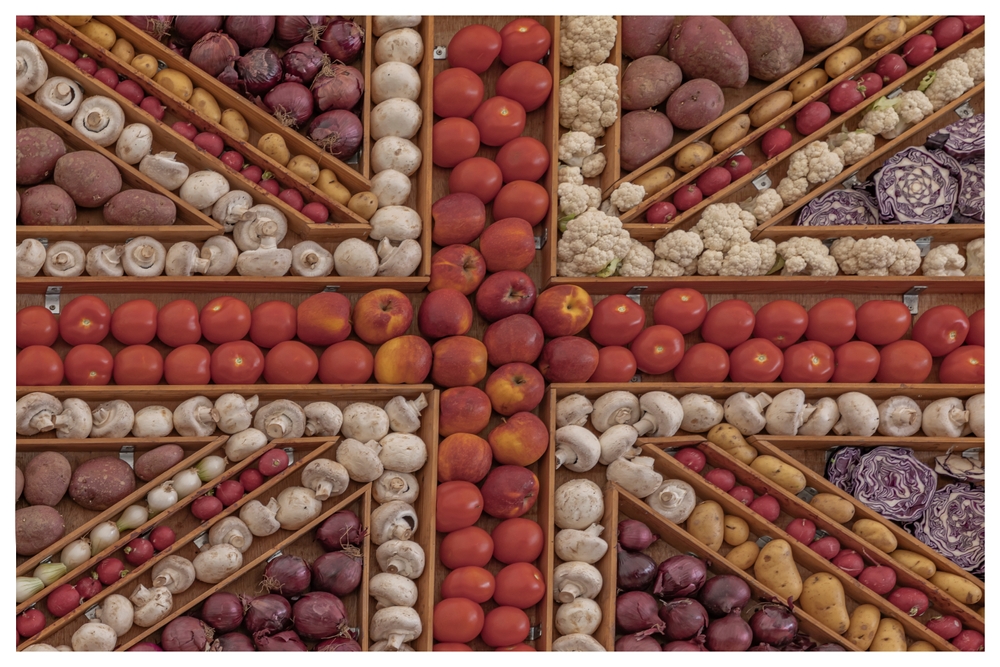
As climate risks threaten key producer countries, the government’s plan to grow domestic horticulture is a rare opportunity to align sustainable production with healthy diets
It’s taken some time but the combined threats from the climate crisis and geopolitical instability, and their impact on the UK’s food security, are finally being recognised in a raft of new UK Government plans, roadmaps and frameworks.
Along with the recently published ‘Farming roadmap’ and ‘Land use framework’, a new ‘Horticulture sector growth plan’ is top of the list of priorities (along with a plan for poultry) for the Defra-facilitated Food and Farming Partnership Board.
The focus on boosting supply of home grown fruit and veg is long overdue with UK production having declined by 16% since 2015. This continues a long-term downward trajectory, which started in the 1980s when the rise of supermarket monopolies led to downward pressure on prices as retailers looked to grow their sourcing from overseas where horticulture benefits from longer growing seasons and cheaper labour.
The risks of this decline were highlighted by the government’s Climate Change Committee (CCC) in its latest assessment of climate risk, which noted that around 18% of the UK’s fruit and vegetables come from countries “particularly vulnerable” to climate change.
In this context, efforts to boost domestic production make strategic sense. But are UK growers in a position to produce more? What’s holding them back? And how can foodservice businesses contribute to a plan to help secure the viability and resilience of fruit and veg supply chains?
Public sector potential
First and foremost, foodservice sector stakeholders want recognition for their role within the supply chain, their scale, and their ability to offer UK growers a stable market for their produce with consistent volumes.
“The sector supplies schools, hospitals, care homes, hospitality venues and workplaces across the country, providing an important and diversified source of demand for UK produce,” explains Andy Pembroke, MD at leading fresh produce foodservice supplier, Fresh Direct.
“Government can support this by ensuring public procurement frameworks reward British sourcing, seasonal produce and long-term supply partnerships, rather than focusing solely on lowest-cost purchasing,” Pembroke adds.
Scotland’s newly established Public Sector Food Procurement Taskforce is a step towards the vision Pembroke sketches out, having been set up to work “at pace” to address barriers to public procurement of local produce.
Yet progress in England is slow. In its manifesto, Labour promised that 50% of public sector food would have to be sourced locally or to higher environmental standards, however the policy remains stuck in the data collection phase.
The role of foodservice
While there is some foodservice representation on the Food and Farming Partnership Board via chief executive of UKHospitality, Kate Nicholls, Pembroke believes wholesalers and distributors should also be consulted as plans progress. “We have a unique perspective on how policy can support both domestic production and long-term food security,” he says.
This perspective, and the sector’s purchasing power, is somewhat underestimated even within the fresh produce supply chain itself. Foodservice suppliers talk of how growers consider the market to be somewhat “lesser” than retail, either in terms of quality or contract terms, when in fact the opposite is often true. The sector is often able to offer wider specifications, with larger cauliflowers or onions, for example, proving suitable as an ingredient that is typically prepped before service. For growers, this can create less waste, and a wider crop purchasing plan.
Some chefs and caterers are making support for UK fresh produce a core part of their customer proposition. Chantelle Nicholson, chef-owner of London restaurant Apricity, is a renowned champion of seasonal veg-forward menus. She told Footprint’s The Small Print podcast earlier this year how she relishes the challenge of managing ‘the hungry gap’ – the period when UK winter vegetables have come to an end and spring crops have yet to mature. “The challenge of being able to work with what you’ve got versus what you hope to have is where the innovation really can kick in,” Nicholson said.

At a larger scale, catering company Baxter Storey’s sustainable nutrition strategy has local sourcing as a key pillar, alongside a focus on plant-rich menus. “Wherever possible, we work with UK farmers and build menus around seasonal ingredients, reducing reliance on imported produce and increasing the prominence of vegetables, pulses and wholefoods across our offer,” explains head of food procurement & UK agriculture, Kevin Dunford.
The government could boost these efforts within the horticulture plan by incentivising organic or local procurement, setting targets, or subsidising the supply of produce from sustainable sources into schools, prisons or hospitals to help close the price gap with imports. “People are willing to pay more, but there’s a limit,” Dunsford says.
Help for growers

Back on the farm, many growers would like to see the horticulture plan ease planning regulations for vital infrastructure, such as reservoirs, or carve out an exemption from biodiversity net gain rules that place added, and often insurmountable, costs onto the already high build costs of new polytunnels.
Access to labour is another perpetual challenge for growers who want a plan to provide guaranteed access to an adequate number of seasonal workers.
At the same time, there has been what is perceived as a “wholesale abandonment” of government financial support for the horticulture sector. This includes the stop-start approach to the ‘Sustainable farming incentive’, and the ending of the ‘EU legacy fruit & veg aid scheme’, which provided £40m a year of match funding into UK Producer Organisations, cooperatively-run bodies made up of smaller fruit and veg growers.
Growers say the various capital grant schemes intended to provide future support are too time consuming, competitive and bureaucratic. Meanwhile, the lack of capex hampers investment in infrastructure, R&D or sustainable production, which would alleviate many pressures.
UK growers are also having to manage the ever-growing challenge from climate volatility.
“Our fruit grower lost 50 tonnes of stone fruit crops from one day of hail this spring,” says Harry Dyer, co-founder of wholesaler and restaurant supplier Shrub. “Another had to start painting their polytunnels because of scorching heat on raspberries. We’re seeing fake springs and early flowerings. That’s not anecdotal stuff, that’s data. It has a real impact on our business,” he says.
Buying UK produce, as is Shrub’s ethos, brings significant risk if growers are unable to invest in more sustainable practices to help mitigate climate volatility, including polytunnels, water storage or soil health improvement.
Supply chain costs
Indeed, what’s clear from speaking to those working at all stages of the supply chain is that a horticulture plan must not stop at the farmgate. Just as farmers are struggling to manage price hikes for key inputs like fertiliser and diesel, cost pressures are impacting the entire supply chain.
Shrub buys from small organic farms or smallholders who use little in the way of inputs, but have an outsized benefit on biodiversity and soil health. The company’s fuel bill has gone up by hundreds of pounds a week, Dyer estimates, taking a significant bite out of Shrub’s profit margin.
It’s a problem faced right across the sector. Many wholesalers have pivoted to prioritise direct delivery in order to counter the decline of traditional in-person wholesale markets. One New Covent Garden Market trader says surcharges are now being put through on deliveries because of rising diesel costs.
Pembroke summarises the challenges that face larger businesses like Fresh Direct who want to show their support for UK produce: “Price pressures, public sector budget constraints and customer expectations for consistency can also make it difficult to maximise British sourcing at all times,” he says.
Educating consumers
Even if a plan succeeds in creating the conditions to grow UK production of fruit and veg, this will count for little without more demand for seasonal, sustainable produce.
”We’ve all learnt what the European food season is and we’ve completely forgotten what a UK food season is,” notes Dyer of Shrub.
Speaking to BBC Radio 4’s The Food Programme recently, senior analyst at the Energy and Climate Intelligence Unit, Jez Fredenburgh, pointed to consumer preferences for year-round salad, veg or tropical fruit as one of the reasons behind the UK’s reliance on imports.
The UK could feasibly scale up production of crops suited to UK climatic conditions – field vegetables like carrots and brassicas for example – but it would require us to “also eat more of those things”, Fredenburgh pointed out.
Foodservice operators can play a key role in helping better align demand with supply. Baxter Storey, for example, has persuaded one Oxford College customer to adapt menus, reducing meat by 20%, and allowing vegetables and legumes to take centre stage in dishes such as pearl barley and parsnip bourguignon.
While pioneering businesses are taking the lead, an educational or public awareness campaign is something many believe the government should consider deploying within any plan for growing UK horticulture.
Foodservice provides a key link between grower and eater, whether that’s within public sector institutions like schools and hospitals, or out-of-home venues like pubs and restaurants. That’s why it’s vital the sector’s perspective is properly represented within the government’s plan for horticulture.
As Dyer puts it: “So many of our restaurants are filled with people who know more about farming than I do. That’s the real conduit and incubator for more passion around food.”
Further reading

England’s first ever land use framework aims to maintain domestic food production while freeing land for nature, development and energy. Can it carry off such a delicate balancing act?

Will health policies survive Labour reset?
The government is coming under growing pressure to pause the development of measures designed to encourage a shift to healthier, more sustainable diets