
DAVID BURROWS AND NICK HUGHES
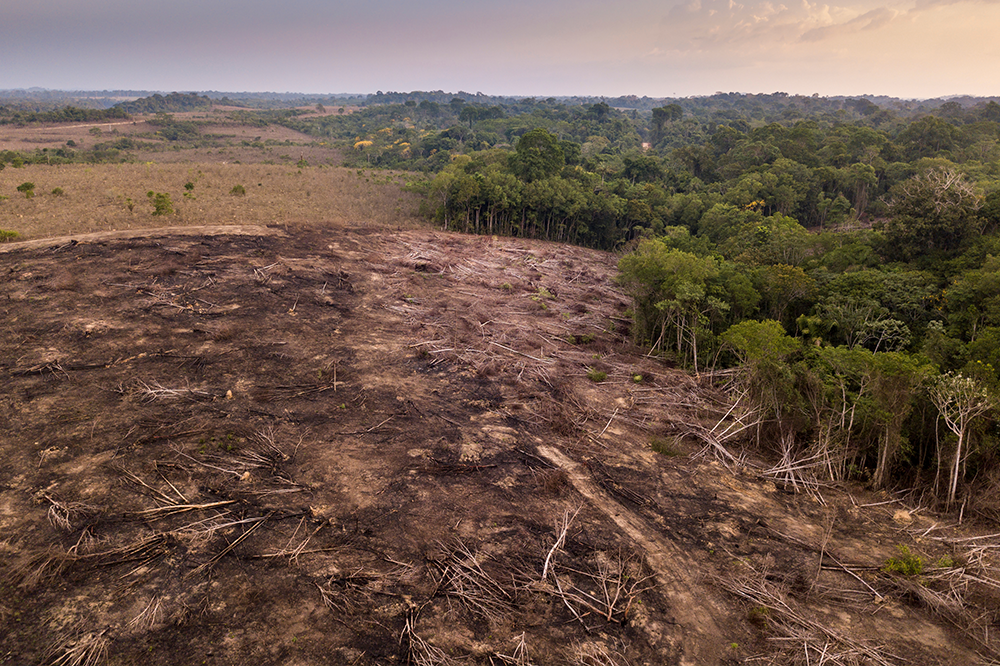
As visitors to London Climate Action Week events struggle to keep cool amid record-breaking June temperatures, the UK Government has finally moved to tackle a key driver of global warming – deforestation.
After years of delay, ministers confirmed this week that new rules will be introduced to ensure everyday products sold in the UK including soy, beef, palm oil, coffee and cocoa do not contribute to illegal deforestation around the world. The government has also signalled its longer-term intention to require products to be produced free from any deforestation, not just that which is illegal.
Powers to curb illegal deforestation were originally granted under the Environment Act 2021, however the process of legislating to make it mandatory for large companies to carry out due diligence checks to ensure there is no illegal deforestation in their supply chains has been subject to numerous delays.
The impasse was broken on Tuesday when a policy paper was published setting out the UK’s approach to deforestation regulations, with the government planning to launch a consultation soon.
“Tackling global deforestation is one of the most effective ways we can address climate change and protect some of the world’s most unique and precious wildlife,” said nature minister Mary Creagh.
Campaigners welcomed the move, which many feel is long overdue. “This is a strong signal to business that supply chains need to be deforestation-free,” said Cassie Dummett, coordinator of the NGO Forest Coalition. “For too long, consumers in the UK have been buying goods that are tainted with deforestation.”
Retailers also backed the decision to legislate. “We have long called for UK deforestation regulation as an important step in driving forest conservation across retail supply chains in line with business commitments, while supporting alignment with the EU where possible to avoid unnecessary costs and complexity for retailers and their customers,” said Andrew Opie, director of food & sustainability at the BRC.
The EU is pursuing its own deforestation regulation which, although further advanced than the UK’s, has also been subject to numerous delays and revisions.
Small Bites
Farm roadmap backs nature-friendly farming
Defra has published its long-awaited 25-year farming roadmap, which aims to give farmers across England “certainty beyond the next harvest for the first time”, providing “long-term stability”. The government said the strategy will mean farmers have better access to the tools, technology, skills and supply chains they need to invest, innovate and grow. It also plans to review how the economic value of agriculture is measured by developing new supplementary statistics to include the wider food supply chain, from processing and manufacturing to distribution and retail. As rising costs and extreme weather continue to heap pressure on producers, The Farming Roadmap 2050 sets out how farmers can reduce reliance on inputs like fertiliser through new technology and smarter nutrient management, and adapt to the growing impacts of extreme weather and climate change through nature-based solutions such as improved soil health and water management. The roadmap has received a mixed response. Sustain, the alliance of food and farming organisations, welcomed the government’s recognition that nature-friendly, lower-input farming underpins long-term food security, but expressed disappointment at the “minimal rhetoric on dietary change and livestock numbers” and a plan to expand the poultry sector, which it said risks compromising targets on pollution and biodiversity.
Brands still wedded to ‘fuzzy’ green claims
In the three months to November 2025, the Advertising Standards Authority (ASA) captured 7 million online adverts served up to UK consumers. Of these, 1% included environmental claims. Hardly a big share. However, where they do appear these ads are often framed in broad or absolute terms such as ‘eco-friendly’, ‘sustainable’ or ‘carbon neutral’, said the ASA in its new pulse report. Such absolute claims require a particularly high level of substantiation, which means the “regulatory risk” is shaped less by ‘how often’ green claims appear, and more by ‘how’ they are framed. Of the 145,000 agriculture and food ads, 3,000 (2%) made an environmental claim and 95% of these were absolute claims. ‘Eco-friendly coffee’ was a particular favourite of brands; many also remain wedded to what the ASA terms “warm and fuzzy” language like ‘grass-fed’, ‘regenerative’ and ‘less plastic’. Dominic Watkins from DWF, a law firm, told Footprint that although the ASA didn’t assess whether any advertising rules had been breached, food and drink brands should understand that penalties are coming. “This research comes at a time when the Competition and Markets Authority is increasingly investigating and using its new powers under the Digital Markets Competitions and Consumers Act to issue civil sanctions. To date most have focused on pricing issues [but] it is only a matter of time before they return to sustainability issues,” Watkins added.
Compass’s Cauli reuse scheme flowers
Compass UK & Ireland is expanding the deployment of Cauli’s technology-enabled reusable food and drink packaging system to help achieve its waste reduction targets. The rollout follows “an extensive proof-of-concept phase designed to refine reuse solutions across diverse, high-volume operating environments within our business”, the caterer explained. The coffee cups, takeaway boxes and pizza boxes are reusable up to 400 times, with a unique digital ID to “maximise lifespan and data transparency”. Smart tracking technologies keep everything simple and convenient. “A truly circular economy relies on accountability, not just alternatives,” said Cauli co-founder Mingqiao Zhao. “Many reuse schemes fail because without tracking, packaging simply disappears. By integrating smart traceability into the Cauli reuse system, we keep containers in circulation and deliver data-backed waste reduction at scale.” Foodservice and drinks companies involved in a last-minute push-back against new EU packaging rules claimed poor return rates for reusable packaging schemes often made single-use the more environmentally sustainable option. Compass’s data so far contradicts this: the caterer estimates over 383,000 single-use packaging items have been eliminated as it works towards a target to reduce single-use foodservice packaging by 30% by 2035.
Chef’s Special
The Food Safety and Standards Authority of India (FSSAI), Western Region has issued a directive to food business operators to stop using newspapers for wrapping, packing, storing, covering, or serving food immediately. The FSSAI warned the practice could pose serious health risks to consumers. The directive, as reported by the Food Packaging Forum, was triggered by a recent incident in Mumbai, in which a popular street food vendor was found to be using newspapers to serve food. According to the FSSAI, the printing inks on newspapers contain binders, pigments, chemicals, and heavy metals that make them unsafe for food contact use, such as mineral oil hydrocarbons. As FPF noted, these compounds can leach into food and be consumed, which could lead to long-term health effects. There are also hygiene concerns as newspapers pass through many hands and environments. The agency advised everyone from street vendors and cloud kitchens to restaurants and catering firms to shift towards food-grade packaging. Whether such packaging is any less tainted by toxins is the subject of heated debate (including across the mainstream newspapers we in the UK also used to wrap our chips in).
Last Orders

Coffee drinkers are being exposed to highly toxic pesticides that are banned in many countries, including across the EU. “Every fifth cup we drink is likely tainted by poison residues,” reads the report by a group of international non-profits including Pesticides Action Network (PAN) UK. Pesticides are made in Europe, shipped to coffee-producing countries, sprayed on crops, and the beans end up back here, before being roasted and served up, complete with those residues in what is referred to as a ‘chemical boomerang’. But it is coffee farmers, not drinkers, who are hit hardest by the hazardous chemicals. “We have here a textbook example of environmental injustice,” said Silke Bollmohr, senior policy advisor for global agriculture at Inkota-network, and lead author of the report. “Behind almost every cup of coffee is a farmworker who had no choice but to handle chemicals that wealthy countries decided are too dangerous for their own fields. Workers are dying and getting sick.” The adoption of agroecological farming methods is the suggested fix for a cleaner caffeine hit.